Showing posts with label water. Show all posts

Thursday, July 22, 2010


INTERNATIONAL POLITICS HUMAN RIGHTS:
WATER AS A HUMAN RIGHT:


Most of take our access to clean safe abundant water for granted. This is not, however, the case in poorer countries nor even on many reservation here in Canada. In a time when there are increasing disputes between countries for access to water and when there is a global push to sell off public utilities to the private sector the movement to declare access to water as a human right is particularly timely. Here's a notice from the Canadian Union of Public Employees (CUPE) asking you to add your voice to this movement.
WWWWWWWW
Water is a human right: Push for Canadian action


On July 28, the United Nations General Assembly will take a landmark vote on recognizing the human right to water and sanitation. CUPE members can help push Canadian representatives to support this vital resolution.

The resolution would recognize “the right to safe and clean drinking water and sanitation as a universal human right”. The resolution calls for increased financial, technological and capacity-building support to countries in the global South, to build the public services that will make this human right a reality.

The Council of Canadians’ Blue Planet Project has launched an online week of action to build support for the resolution.

Today, 1.2 billion people don’t have access to clean drinking water, and 2.6 billion don’t have access to basic sanitation services. For years, the Canadian government has blocked efforts at the UN to recognize these services as basic human rights.

CUPE has written a letter to Foreign Affairs Minister Lawrence Cannon as part of an action organized by Public Services International, the public sector trade union federation we belong to.

CUPE has also signed an open letter supporting the UN resolution.

What you can do

Now it’s time to add your voice, by sending a message to Canada’s UN representatives and Prime Minister Stephen Harper.

**Send an email to Canada’s representatives at the United Nations, Ambassadors John McNee and Henri-Paul Normandin.
**Send an email to Prime Minister Stephen Harper calling on the Canadian government to support water as a human right.

WWWWWWWW
THE LETTERS:
Here are the letters that the post above asks you to send. First of all go to this link to send the following letter to the Canadian ambassador to the UN.
WWWWWWWW
Dear Ambassador,

I am writing to express my support for the United Nations General Assembly resolution clearly recognizing the human right to water and sanitation.

I believe it is critical that the United Nations General Assembly demonstrate leadership in focusing priorities on securing water and sanitation for the 1.2 billion people without access to clean water and the 2.6 billion without access to basic sanitation. Everyone must be able to enjoy these fundamental rights.

Access to safe clean drinking water and sanitation is essential for the health and dignity of people around the world. This resolution comes at a time when communities around the world face the impacts of climate change and a global water crisis.

As you know, under Target 3 of Goal 7 of the Millennium Development Goals (MDGs), Environmental Sustainability, states pledged to “Halve, by 2015, the proportion of the population without sustainable access to safe drinking water and basic sanitation.”

I am hopeful that passing the resolution will make water and sanitation high priorities at the UN Summit on the MDGs being held September 20-22, 2010 in New York, U.S. It will also focus attention on water before the Rio +20 summit in 2012, another critical moment for the global community to come together for our common future.

When the General Assembly considers this resolution, I respectfully ask that your country provide its support for a clearly stated resolution declaring the human right to water and sanitation.

I would also encourage your state to co-sponsor this historic resolution and send a further signal of your commitment to these fundamental human rights.

Sincerely,
WWWWWWWW
And if you go to this link you can send the following letter to our beloved comrade leader Sneaky Stevie Harper.
WWWWWWWW
Prime Minister Harper,

I am writing to demand that Canada support the resolution put forward by the Bolivian Mission at the United Nations, which calls for water to be recognized as a human right.

This resolution would recognize the right to water and sanitation for the 1.2 billion people without access to clean water and the 2.6 billion without access to basic sanitation.

We are concerned that Canada along with a handful of states including the United Kingdom, Sweden, the United States and Australia, are attempting to block the process by watering down what is currently a strong proposal by Bolivia to address global injustice when it comes to access to water and sanitation.

It is essential that the resolution specifically declares “the right to safe and clean drinking water and sanitation a universal human right.”

Your government claims it is committed to maternal and infant health, yet you have obstructed the official recognition of water as a human right at several key UN meetings. Every eight seconds a child dies from drinking dirty water. Access to safe clean drinking water and sanitation is essential for the health and dignity of communities around the world.

People living in Canada want their government to show leadership on water issues by recognizing this human right and by taking an active role in dealing with the global water crisis. It is time for Canada to stand on the right side of history and support this very important call to have water and sanitation declared human rights.

Sincerely,

Monday, March 22, 2010


INTERNATIONAL POLITICS/CANADIAN LABOUR:
THE STATE OF OUR WATER:
Today is World Water Day, and the Canadian Union of Public Employees (CUPE) is involved in many events around the issue of water availability. Here's a story from CUPE about the significance of this day to Canada.
WWWWWWWWWWWW
Learn, organize and act for public water
Today, water activists are mobilizing to mark World Water Day. It’s an opportunity to re-energize CUPE’s work protecting public water systems and community water resources.

Our union has a long history of stopping water privatization by building grassroots coalitions. When we come together – workers, environmentalists, citizens’ groups, indigenous organizations, faith groups, young and old – we are unbeatable. Just look at the recently-opened water treatment plant in Vancouver, or Whistler’s new state-of-the-art sewage treatment system. Both remain public thanks to community activism against privatization.
Last fall’s Blue Summit celebrated a decade of our Water Watch coalition with the Council of Canadians. The summit declaration outlines our collective vision for public water resources and services.

At home and around the globe, privatization, underfunding, pollution, and international trade agreements are roadblocks to building and strengthening public water services.
Federal funding for community infrastructure, including water, hasn’t kept pace with growing needs in Canadian cities and towns. The federal government and several provinces are pushing P3s by attaching strings to public funding and through a federal privatization agency – PPP Canada Inc.
But in the wake of the economic and financial crisis it’s crystal clear that P3s for water infrastructure and services don’t work.

CUPE is also concerned about the state of water and sanitation services in some First Nations communities. More than 110 First Nations communities are living with undrinkable water. In some cases, they endure tainted, polluted and unsafe water for years. This violates a basic human right, and is a national disgrace.

Another threat is the proposed trade agreement between Canada and the European Union, which is backed by the European water multinationals. This deal could open public procurement of services – including water and wastewater – to foreign corporations. It would give corporations new rights and erodes the ability of governments to regulate in the public interest.
Finally, Canada must do its part to end the global water crisis. This begins with Prime Minister Stephen Harper reversing Canada’s opposition to the right to water at the United Nations.
Upholding this right and giving developing-world governments the resources to fulfill it will help lift millions in the global South out of poverty, especially women and children.

We encourage CUPE members to get active on these and other water issues in their communities this World Water Day.

Promoting public sector alternatives is as important as fighting privatization. We know that public works best for our water and wastewater systems. Through innovative new initiatives such as public-public partnerships, we will continue to show that privatization is no solution.
Together, in CUPE and with our allies, we will continue to protect water resources and services – for future generations, and for the planet. Public water is a human right!

Sunday, November 29, 2009


WATER/CANADIAN LABOUR:
AND NOT A DROP TO DRINK:
Molly has blogged on the subject of water in the past. Here's a report from the Canadian Union of Public Employees (CUPE) on an ongoing (at this time) conference in Ottawa, talking about this matter.
▼▼▼▼▼▼▼▼▼▼
Blue Summit tackles key water issues:
The opening day of the Blue Summit highlighted major challenges to public water systems and resources, and drew lessons from winning campaigns.

The two-day conference has drawn more than 300 participants from across the country and internationally, including a group of more than 80 CUPE delegates from every province.
CUPE and the Council of Canadians organized the summit, being held in Ottawa, to mark the 10th anniversary of the founding of Water Watch.

CUPE national president Paul Moist’s opening speech celebrated how the water movement has grown over the last decade.

He stressed the importance of working in coalition at the community level, as well as nationally and internationally. Key to that work is strengthening solidarity with First Nations communities, to support their struggles for safe drinking water and proper sanitation services.
The economic crisis creates a moment for change, says Moist.

“We don’t accept a society built on greed and private profit, we want a country and a world built on public services and community values, and we won’t rest until that happens,” he told the plenary.

An opening panel moderated by Morna Ballantyne set the stage for the conference by examining the state of Canada’s water.

Council of Canadians national chairperson Maude Barlow dismissed the Canadian government’s “bogus arguments” for continuing to oppose the right to water at the United Nations. The real reason, she says, is it would conflict with the government’s position that water is a tradable good under NAFTA.

Canada is actively promoting new trade deals – such as a Canada –European Union agreement under negotiation - that put our water services in jeopardy, says Barlow. The Canada EU deal is “more dangerous than NAFTA in terms of everything we hold dear in this country,” she said. This deal, along with changes to the Agreement on Internal Trade, are part of a ‘perfect storm’ of trade deals which seek to open up the $100 to $200 billion in provincial and local spending on public services, including water.

Water policy expert Ralph Pentland outlined how Canada is “in a state of general confusion and gridlock just when a sense of national direction is urgently needed.” He emphasized the need for strong legislation and a national water policy to protect Canada’s water resources.

Assembly of First Nations water expert Irving Leblanc painted a stark picture of the challenges facing many First Nations communities. Poverty, underfunding, a massive infrastructure deficit and the absence of legislation dealing with on-reserve water and wastewater issues have combined to create a First Nations water crisis.

Over 120 First Nations communities live with undrinkable water today. Some of those reserves haven’t had safe water for nearly 15 years, Leblanc told the plenary. He called for full consultation and participation in a planned federal First Nations safe water act – something which has not yet happened.

CUPE researcher Blair Redlin reminded delegates that Canada’s public water and sewage systems were established in the wake of widespread public health problems in the late 1800s and early 1900s. These fledgling services were initially privatized, but were taken over by governments when they failed to deliver.

Redlin criticized how the federal government forces communities to privatize by making funding contingent on P3s. Corporatization of some public utilities is a growing concern he said, pointing to the activities of Edmonton-based EPCOR as well as recent moves to corporatize Winnipeg’s water services.

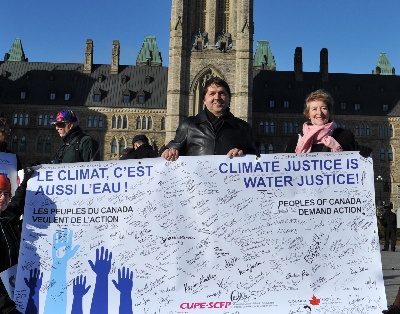
During the mid-day break, participants rallied on Parliament Hill, saying bold action on climate change can’t wait any longer, and that countering the global water crisis must be part of the solution.World leaders will soon travel to Copenhagen for the UN Climate Change Conference on December 7-18.

CUPE and the Council of Canadians will bring a banner signed by summit delegates to Copenhagen.

“Our government’s climate record speaks for itself, said CUPE National Secretary-Treasurer Claude Généreux. We rank 59th out of 60 countries. And it keeps getting worse. A prime example is the pollution and destruction spewing out of the Tar Sands.”“That’s why we must stand our ground. Together. For water, for the planet, and for our children’s future. The message on our banner makes it crystal-clear: ‘Climate justice is water justice,’” concluded Généreux.

Delegates also participated in workshops and heard an afternoon panel focusing on organizing to win.

The conference opened last night with a party celebrating Water Watch’s birthday. CUPE members, including a number of water and wastewater workers, also held a lively afternoon caucus to share their experiences and strategize about CUPE’s water work.

Couldn’t make it to the summit? Listen in at cupe.ca in the coming weeks for podcasts from the weekend.

Saturday, August 01, 2009


LOCAL POLITICS-WINNIPEG:
THE DOOR TO PRIVATIZATION:
The issue discussed below may, to be punish, seem like "water under the bridge" now that Winnipeg City Council has voted to create its "arms length utility" that is predestined to enter into private/public partnerships with corporate interests interested in expanding into the municipal utility field. It is, however, useful to bring it up just for the record, and it may be especially useful should any of the municipal politicians who voted for this measure receive any "favours" from interested parties in the future. Here's Maude barlow and Meera Karunananthan on Winnipeg's "privatization by stealth" from the Public Values website.
LPLPLPLPLPLPLP
Municipal privatization: What Winnipeg can learn from elsewhere:
Corporatizing utilities brings risks to public, but rewards private interests.
by Maude Barlow and Meera Karunananthan, for the Canadian Centre for Policy Alternatives – Manitoba
July 21, 2009 — On July 22, the city of Winnipeg will be voting on a proposal to create an arms-length corporate water utility. (already passed-Molly)As far as Mayor Sam Katz and his allies on city council are concerned, the decision on the new corporate utility was made before the public ever had a chance to weigh in.

The city invested $1.25 Million to explore the idea and put $250,000 toward a public relations campaign to promote the creation of an arms-length corporate water utility.

Supporters on city council had committed to the issue even before hearing the concerns of the general public. Many participants in the so-called public consultation have reported that it was designed to promote the proposal rather than record public input.

Yet experience from around the world shows that the model being rushed through is likely to have detrimental impacts on access to water and public control over water services and resources.

The corporatization of Winnipeg's water and waste utility is the first step toward greater privatization. An arms-length corporation would limit the ability of elected representatives to oversee operations and make decisions in the public interest. Experiences in other cities like Edmonton have shown that corporate utilities whose primary function is to make profits can lead to the sale of public assets, a loss of public control and transparency, rate hikes and lower quality services.

It is time to slow things down and examine the serious threats posed by the proposed model.
Mayor Sam Katz sticks to the soundbite that the utility is 100 percent city-owned while downplaying the fact that the city is seeking partnerships with private corporations for water and waste services.

The corporatization of electric and water utilities in Edmonton have proven to pave the way for the sale and privatization of vital services.

There was a blurring of lines when councillors acted as shareholders rather than as protectors of the public interest by hatching a deal to sell off $5 billion of publicly-owned assets behind closed doors. Rather than maintaining the public interest, the mandate of Epcor, the arms-length corporate utility is to increase profits. This has had impacts on communities outside Edmonton as the corporation makes its profits through the privatization of utilities in communities throughout the continent.

Similarly, in Europe, "Municipal Corporate Utilities " were first sold as a compromise between fully public and fully private control of water systems. Big water companies used their public utility assets to raise money to move into poor countries in the global South where they operate on a for-profit basis, charging high rates and denying service to those who cannot pay. Human rights and social justice organizations in the global South argue that some of the worst private water companies operating in their communities are tied to so-called public utilities in Europe and use this status to gain access to water contracts in the South.

The City is also seeking partnerships with corporations for waste-water plant upgrade.

Experience in other parts of Canada and the rest of the world show that these arrangements mean that the public takes all the risk while the private corporations use their contracts to leverage capital accumulation for private investment and expansion.

It is important to note that many of the companies bidding for the Winnipeg contract are big transnationals whose sole motive is profit and growth.

One company, American Water, is the largest investor-owned US water and wastewater utility. The corporation has a history of imposing exorbitant rate hikes on communities where they operate. In Hingham and Hull Massachusetts, the corporation doubled rates over a five-year period claiming the funds were needed to build a new treatment facility. Evidence has shown that the costs of the facility were inflated by American Water to increase profits.

Another company, Black &Veatch, is an American engineering giant which claims to be in the "Top 500 Largest Private Companies in the US.." They have a huge water division and claim that "20 percent of the world's population served by community systems drinks potable water through systems designed, constructed or supported by Black & Veatch".

If the City of Winnipeg chooses an American company, that company will have rights under NAFTA to sue for compensation if a future city council decides to return to a public system or bring about legislation that would restrict its profits.

Also on the list is Veolia Environment - the "environment" arm of the French giant Veolia - which has 272,000 employees, 70,000 of whom work only in water and has annual revenues of US$34 billion, and with Suez, controls almost two-thirds of the global private water services sector. Veolia is very controversial in the global South, where, along with Suez, it has jacked up water rates, broken contracts and cut off water to people who cannot pay.

These big corporations are for-profit, private companies required to find profits for their shareholders and will be forced to raise water rates for this purpose.

Councillor Harry Lazarenko's motion to ensure that privatization is not sought without a referendum does not allay concerns about the loss of public control over water services, hikes in water rates and the global impacts of creating a for-profit utility. The potential harm should be carefully weighed and publicly debated - not rushed through without full public consultation.
Ed. note: on July 22, Winnipeg City Council voted in favour of forming an arm's length corporate utility. See links below for more information.

Maude Barlow is the national chairperson of the Council of Canadians, Senior advisor on water to the President of the UN General Assembly and the author of 16 books including Blue Covenant: The Global Water Crisis and the Coming Battle for the Right to Water.
Meera Karunananthan is the national water campaigner at the Council of Canadians
Links and sources

Sunday, May 03, 2009


CANADIAN POLITICS:
THE GREAT FEDERAL THIRST:
This one would almost be funny if it wasn't such an egregious example of government waste. All the blah, blah about plastic containers and the environment aside, the whole bottled water industry is notorious for being an incredible scam. Bottled water is generally no better than the average tap water. In a lot of cases (perhaps the majority) it actually is tap water, run out of the tap in one place and sold in another. Then there is the "bizarre factor". Molly has a vision of Sneaky Stevie doing an Uncle Scrooge imitation and swimming in his vault loaded with plastic bottles of water. Or maybe they just use the stuff to fill Stevie's swimming pool. In any case, here's the Story from the Canadian Union of Public Employees (CUPE).
$$$$$$$$$$$$
Feds spend millions on bottled water: report:
A report from the Polaris Institute and CUPE Nova Scotia shows the Canadian government is spending more than $7.2 million on bottled water.

Bottled Watergate: Why is the Federal Government spending millions of tax dollars on bottled water? draws attention to the federal government’s growing dependence on bottled water.

After the report was released, the government itself revealed it had actually spent more than $10 million in the last three years and $15 million in the last five years.

Findings include:
**Since April 2006, the Government of Canada has spent more than $7,296,738 on 131 separate contracts to buy bottled water
**Seven federal departments in eight provinces have bottled water contracts
**The same amount of money could have been used to pay for 2,918 indoor or 584 outdoor water fountains
**The same amount of money could have been used to upgrade a water treatment plant in a First Nations community

“Bottled water may serve a purpose in situations where potable drinking water is not available, or in certain emergency situations, but it is not a substitute for the tap nor is it a long-term solution,” says Joe Cressy, Polaris Institute campaigns coordinator. “The solution is publicly-delivered tap water”.

“It is deeply troubling that the Canadian government is spending millions of dollars on bottled water,” says Danny Cavanagh, President of CUPE Nova Scotia. “Water fountains, accessible taps, water treatment plants – just think what the Government of Canada could do if it properly invested $7.2 million.”
**See also: the information NDP MP Bruce Hyer uncovered when he asked what the federal government spends on bottled water

Sunday, March 22, 2009


INTERNATIONAL POLITICS/CANADIAN LABOUR:
CUPE SUMS UP WORLD WATER FORUM:
The following is the summing up statement of the Canadian Union of Public Employees (CUPE) on the recent World Water Forum in Istanbul Turkey.
,,,,,,,,,,,,,,,,,,,,,,,,,,,,,,,,,
Water justice movement stronger as forum ends:
Trade unionists from around the world made their mark at the fifth World Water Forum, and are leaving Istanbul with stronger and broader connections to the global water justice movement. They exposed the forum’s bankrupt agenda of privatization, and are demanding that policies about water be decided in a transparent, open and participatory space.

CUPE 1978 member Kim Manton and general vice-president Kevin Rebeck were among the 55-person Public Services International delegation attending the fifth World Water Forum in Istanbul, Turkey this week. The forum, a trade fair for the privateers, is organized by the unelected and unaccountable World Water Council. High registration fees and a tightly-controlled agenda mean grassroots voices are all but frozen out.

The PSI delegation members, many of them water workers, intervened at the official forum to challenge the pro-privatization messages that dominated the event. Their work helped turn public solutions – relegated to ‘side events’ at the forum – into the main event. They also deepened their connections with the many environmental, indigenous and social justice groups brought their struggles to Istanbul.

Manton says the week has left her moved, inspired and motivated. “I can’t wait to get home so that I can share the global water struggle. I promise to take Hasan’s story of his arrest in the protest on Monday to Canada. I know that when Virginia turns the tap on in Soweto and no water comes out, she will not feel alone,” she says. “I am committed to take the international fight back home and ensure that this trip builds new connections. Happy World Water Day! Water Warriors Unite!”

Rebeck says “There is no more basic fight around the world today than the fight for access to water. Our arguments for accountable, community controlled public water and sanitation keep growing stronger, as the examples of private sector failure pile up. We need to continue the push and support our global partners where communities and workers are dying. Together we can win this battle.”

Manton and Rebeck joined other PSI members at three separate alternative forum events, including an international People’s Water Forum [link to other story] that drew nearly 700 people. The event n showcased success stories of of public and community-led water governance structures, the application of local indigenous water conservation techniques and other alternatives to the models of large-scale water privatization and high technology solutions promoted by the World Water Forum.

Over the course of the week, nightly activist meetings allowed workers and the broader movement to strategize, share, and support each other. The sometimes-raucous meetings have forged many friendships and alliances.

Speaking at a major labour-NGO press conference yesterday, PSI utilities officer David Boys summed up PSI’s participation at the forum. “The divide remains deep, between the people who want quality water and sanitation and the bankers and corporations who control the World Water Council. Their vision is the same one that brought us the financial crisis – a shrinking government, unregulated markets and corporate profits. Our vision is governments that deliver quality public services, financed by fair taxation, with decisions made under conditions of transparency, accountability and participation. The divide has not been bridged here in Istanbul.”

CUPE worked closely with its Canadian allies, the Council of the Canadians and the Polaris Institute, over the week.

“It is becoming increasingly evident that the World Water Forum and everything it represents is a cause of the world water crisis and not the solution,” says Maude Barlow, Council of Canadians chairperson and senior advisor to the President UN General Assembly. “The World Water Forum is morally bankrupt, financially bankrupt and bankrupt of ideas.”

Saturday, March 21, 2009


CANADIAN POLITICS/INTERNATIONAL POLITICS/CANADIAN LABOUR:
WATER IS A HUMAN RIGHT:
The following appeal is from the Canadian Union of Public Employees (CUPE). They were present at the recent World Water Forum in Istanbul, Turkey and were witnesses to the suppression of protesters at same. What they are asking is that you email our dear comrade leader Sneaky Stevie to demand that water and access to same should be a human right.
,,,,,,,,,,,,,
Steven Harper needs to hear that water is a human right‏:
CUPE and public water activists from around the world are protesting the corporate-driven World Water Forum in Istanbul right now and they need your help.
Email Steven Harper about water as a human right


Canada's delegates at the World Water Forum need make a strong stand against privatizing water and for public control of water as a means of protecting the right to water for all.


They're not going to do it unless they get the word from the Prime Minister.


So please send an email to Steven Harper right now while the forum is still going on, so that Canada can be part of the solution, as opposed to the other thing.


,,,,,,,,,,,,,,,,,,,,,,,,,,,,,,,,,,
THE LETTER:
Please go to THIS LINK to send the following letter to our dear comrade beloved leader Steven Harper.
,,,,,,,,,,,,,,,,,,,,,,,,,,,,,,,,
As labour and social justice organizatıons from Canada attending the fifth World Water Forum in Istanbul, Turkey from March 16 to 22, we are writing to express our concern about Canada's failure to recognize the human right to water.

We also must share our objectıons to the forum’s corporate mandate, whıch is fundamentally ıincompatible wıth solvıng the global water crisis.

Canada must support the recognition of water as a human right in the Forum's ministerial statement, and in domestic law. The only way to guarantee the universal right to water is to ensure that water remains a public trust that is publicly controlled and delivered.

We also demand that Canada support the call for this to be the last World Water Forum.
Discussions to determine water policy must be conducted openly and transparently in a democratic space free from corporate influence, using the United Nations framework.

The World Water Forum is a corporate-driven event that has allowed transnational water corporations to influence public policy, while the voices of civil socıety and labour, includıng the people who rely on or lack public water and sanitation services, are excluded.

The world’s water companies would like to see water defined as a human need, enabling them to control and sell water to the highest bidder for profit. Enshrining water as a human right protects vital water and sanitation services from privatization, ensuring access for all.At every World Water Forum meeting since 2000, Canada has refused to assert water as a human right. In March 2008, Canada played a key role in blocking a motion by Germany and Spain to have water recognized as a human right at the UN Human Rights Council.

A growing list of countries are choosing to distinguish themselves from Canada and the United States by recognizing the right to water. We call on Canada to join them, and play a positive role in ending the global water crisis.

I request a response to my concerns.

Thursday, February 05, 2009


LOCAL POLITICS:
WINNIPEG'S WATER SUPPLY:
In the past few weeks there has been debate about a new contracting out scheme for Winnipeg's water supply. Molly, anti-statist that she is- has her own opinion on this, and that opinion is not in favour of such a thing. The present city administration's plans are hardly designed to reduce the role of government in the lives of citizens. What they are designed to do is offer an opportunity for "friends of friends" to profit by a presently public utility. This is typical of conservative ideologues the world over. The math goes basically like this:

*Government operations are "inefficient" (true).
*So, lets hire/contract with somebody from the private sector (rather than
considering the coop model).
* Such private contractors "will" be more efficient and therefore reduce
the cost of the service (Sometimes true).
*Such savings will compensate for the fact that the profit of the private contractor will now be paid out of the public pocket.

Well...it is not a foregone conclusion that all private
business is automatically more efficient than a public entity. Even so,
the cost of providing profit to the friends of the politicians can, and usually does, outweigh the so-called savings from privatization. The record of such things across the world hardly inspires confidence in the ideological
pronouncements of the proponents of such things. Then there is the "multiplier effect". If, by some turn of good fortune, the private contractors do indeed provide a service at a cost lower than that of the fees they extract from the public purse it is hardly ever (perhaps never)
due to some magical "efficiency" that they possess. It is pretty well always due to their paying their workers less. When you calculate the multiplier effect of this loss in terms of local resources (the old "one dollar spent equals three dollars generated") then the loss to a community would be pretty well guaranteed to be greater than the gain in most
situations. But at least some people benefit by such deals ie the friends (traceable and otherwise) of the politicians who set up such things.

Such is the situation with Winnipeg's water supply.
Here's an article from the Canadian Union of Public
Employees (
CUPE) about what is happening here and the opposition to it.

............................

Is Winnipeg’s Water being
Privatized?:
Over 150 people attended a presentation on Friday night, to learn more about recent City Council decisions that could lead to privatization of city water treatment.


In November, the Mayor and eight Councilors voted “to explore” setting up “a new arm’s length business model to operate city owned utilities.” They also approved using a business (a public private partnership) method to “design, construct, finance and operate” water and waste control centres.


Tony Clarke of the Polaris Institute and co-author of Blue Gold (with Maude Barlow, Council of Canadians) spoke about situations around the world where water corporations have taken over water treatment and distribution systems, to disastrous effect. “It’s time for citizens to become custodians of their water – if we don’t we are going to be facing a huge water crisis in the future.”


Lynne Fernandez of the Canadian Centre of Policy
Alternatives (Manitoba) provided background on the City Council decisions and what these could mean for Winnipeggers. She noted that though the Council is saying it is only exploring different delivery options, they have already changed to a more business-like approach for dealing with public water needs.


In the audience was a cross section of the public. Questions focused on how P3s could function and what citizens could do to stop the slide towards privatization.


A coalition of community, student, faith, environment and union groups are criticizing the City’s actions. They are calling on City Council to consult the public on such serious issues and to be more transparent with all P3 projects the city is planning for public infrastructure. The event was sponsored by: CUPE Manitoba, Canadian Catholic Organization for Development and Peace, Canadian Labour Congress, Canadian Federation of Students, Manitoba EcoNetwork, Canadian Centre for Policy
Alternatives
, Winnipeg Citizens’ Coalition, Council of Canadians, Winnipeg
Labour Council and the Canadian Union of Public Employees, Local 500.


Note www.cupe500.mb.ca for more
information on the Local’s Positively Public campaign.

Friday, November 21, 2008


WINNIPEG NEWS:
WILL WINNIPEG'S WATER GO PRIVATE ?:
There's been a controversy here in the Peg in the last little while about whether to change Winnipeg's water utility to a stand alone corporation that would be open to private participation. Sort of a privatization by stealth. Needless to say this has evoked opposition. Here, from the Canadian Union of Public Employees (CUPE) is one view.
............................
Winnipeg opens door to privatized water:
Winnipeg city council is on the road to privatizing the operation and management of its drinking water and sewage treatment.

Council has decided to explore setting up a Municipal Corporate Utility (city-owned but arms length corporation) to operate water, sewage and possibly energy services. City council also voted to use a “strategic partner” (otherwise known as privatization through a P3) to finance, design, build and operate two water and wastewater plants.

CUPE 500 and a broad coalition of community, environmental, student and church groups opposed the move and called on the city to build on existing public capacity.

CUPE 500 president Mike Davidson spoke on behalf of the city’s municipal workers at the Nov. 19 council meeting, detailing the dangers of privatization and showing why public works best for the city’s water services.

The radical shift in how water services are governed and delivered is based on a flimsy “proof of concept” report from pro-privatization consultants Deloitte & Touche that doesn’t stack public against private and objectively compare them.

Earlier this year, Deloitte also advised that the city’s Disraeli bridge should be upgraded as a P3. The consulting firm is a sponsor of the country’s main privatization lobby group.

Winnipeg city councilor Jenny Gerbasi opposed the plans, calling them a “drastic move away from public control of core city services” that “is on the fast track”. She and three other pro-public councilors raised questions of accountability and direct control.

Gerbasi moved a motion for public hearings – which have been non-existent – as well as a full and open comparison of public and private plans.

But council voted to barrel ahead instead of listening to the arguments for staying public, including University of Winnipeg professor Christopher Leo’s warnings about what happened to a similar scheme in Utica, NY.

The corporate proposal for Winnipeg includes selling water services to neighbouring communities. Leo points to the results of Detroit’s attempts to market its water regionally. Winnipeg’s water marketing plan ignores regional resource-sharing and support that could happen publicly.

The coalition opposing water privatization isn’t going away. CUPE will keep working with the broad cross-section of citizens and groups that want to keep the city’s water public, challenging the city’s blinkered plans at every step.

Sunday, November 16, 2008


AMERICAN LABOUR:
THE TERMINATOR HASN'T COME TO END THIS SITUATION:
The following is an appeal from the United Farm Workers about a continuing situation in Conan's Kingdom of California. Read it and see how the families of farm workers in that State are put at risk by the continued failure of the state government to act. Sign the petition demanding clean water for farm worker families.
.........................
Farm worker families put at risk while Governor Schwarzenegger's bureaucrats ignore the situation:
Back in early September we told you about the approximately 200 farm workers and their families who live in government housing in Los Banos CA, who don’t have access to safe drinking water. Their current water supply is contaminated with arsenic, copper and radionucleotides.

The Department of Fish and Game has a pipeline that could immediately provide safe water to these families, but they refuse to allow these families to use it.

More than 5,000 activists like you responded by contacting these bureaucrats, telling them to allow the community to connect to the city water supply. On Sept 11, Fish and Game responded they would commit to immediately start making the connection. However, nothing has happened.

Fish and Game is again inventing political roadblocks to stall the process.

These families continue to be put at risk by having no alternative but to use the contaminated water. Families do get a ration of bottled water. However, the amount is not enough to have clean water for household chores and practice good hygiene.

This toxic situation has to end. The migrant housing center is in the process of closing for the season, marking three years that the health of these farm worker families has been ignored by Gov. Schwarzenegger’s administration.

Sign the online petition today and tell the Governor that we won’t stand for this anymore. The Governor needs to tell his Department of Fish and Game to be a good neighbor and stop forcing kids and their families to use contaminated water. Ask him to assure the public and the farm workers that there will finally be safe water for the residents when this migrant camp opens for the season again in April 2009. Worker representatives will hand in this petition to the Governor’s office on December 1, right after the Thanksgiving holidays.
...............................
Please go to THIS LINK to sign the following petition.
..............................
The Petition
Send this petition to:
Governor Arnold Schwarzenegger
cc: Department of Fish and Game
Governor,
It's time for action.
Two hundred farm workers and their families who live in government housing in Los Banos don't have access to safe drinking water. Your administration's Department of Fish and Game has a pipeline that could immediately provide safe water to these families, but they refuse to allow these families to use it.
Fish and Game has promised to take action on this situation. However, for the past three years nothing has happened, and families continue to be put at risk as they have no alternative but to use the contaminated water with its unacceptable amounts of arsenic, copper and radionuclide. The migrant housing center is in the process of closing for the season, marking three years that the health of these farm worker families has been ignored by your administration. .
The residents of the Rafael L. Silva Migrant Family Housing Center in Los Banos, the Housing Authority, and Merced County have been acting on good faith for the last three years. They have taken numerous measures to appease Fish and Game's concerns. They were told their efforts would result in safe drinking water for the residents of the Los Banos Migrant Camp.
However, for every step advocates took in the direction of solving the problem, the Department of Fish and Game took a step backwards and found another stumbling block.
Drinking bottled water only solves half the problem--given that arsenic, copper, and radionucleotides are actually absorbed into the skin when bathing. Children accidentally drink the water when bathing and at times drink the water when they are thirsty.
It is crucial that the residents have access to safe drinking water. In fact, it's a human right.
We the undersigned call upon you to make your Department of Fish and Game quit putting up political roadblocks and allow the Los Banos Migrant Camp to connect to their existing water line that receives City of Los Banos water.
Please get back to me and assure me that there will finally be safe water for the residents when this migrant camp opens for the season again in April 2009.

Friday, July 18, 2008


INTERNATIONAL POLITICS:
WATER, WATER EVERYWHERE AND ALL OF IT PRIVATE PROPERTY:
Well not exactly. The following article from the Canadian Union of Public Employees (CUPE) tells about how many communities worldwide are fighting back against the privatization of public utilities such as water supply and waste disposal. It also tells about how many communities, fed up with the profiteering, inequity and inefficiency of such private companies are taking back water supply into municipal control.
Molly has to admit to conflicting feelings on this matter. It is certain that any decent society has an obligation to provide the necessities of life to all members of that society, and it is also certain that the best way to provide such necessities is via collective enterprise. In the anarchist tradition this may be municipal/community (the classic anarchist communist solution), syndicalist (the anarchosyndicalist solution) or cooperative (the mutualist solution). At the present time only the first and the third solutions have living examples to point to, and these examples are mired in the statist and market economy matrix in which we live. All of these models have things to recommend them and also problems with their implementation.
The idea of "remunicipalizing" such enterprises is what the following article talks about. All this would be fair and good, but it begs the question "what sort of municipality". One branch of the "anarchist family", formerly known as "libertarian municipalists" and now as "communalists" feel that this is the proper way to go to build a free and just society. They claim that local government is, at least theoretically, amenable to democratic control while larger forms of government are not. Whatever somebody like Chomsky might say Molly thinks that history has proven the latter contention to be 150% right. As to the municipality, well all that I can say is that it depends upon which municipality we are talking about. In some cases, such as that of Paris, such a municipality is far less likely to afford opportunities for true democracy than a large number of smaller countries are.
Then there is the matter of "the market" or, more broadly, how are things going to be paid for. Molly is not a dogmatist in terms of economics. She thinks that a free, anarchist society will have a number of economic forms operating side by side, but she also thinks that basic necessities should be provided communally, and preferably "free". How much is this possible ? It depends upon agreement in society in general to subsidize the provision of such services. In an anarchist society such agreement would have to be voluntarily obtained, not enforced by the state as it is today (can we say "taxes ?). Boy, that's a lot of negotiation !
In the interum, before the "dawning of the millennium" we are left with the societies that we live in today. Molly's preference for the provision of such services in the here and now is the cooperative/mutualist method. This method partakes of the advantages of both the government and the private models, and it reduces the disadvantages of each. Governments can indeed be inefficient and bureaucratic, but so can private enterprise- in spades. I also think that the history of privatizations under neo-conservative governments shows very plainly that the idea that this will result in "lower costs to the consumer" is just as much an ideological lie as the leftist contention that "socialists" in power will result in greater equality.
In the here and now what do we do ? I think that it is generally (but not always) a good idea to oppose privatization where the product is an essential of civilized life, or life period. In the "plus and minus" balance municipal control (and, less frequently control by larger units of government) is best for the end user of these services in both a cost and benefit sense. I would prefer that there were more cooperative alternatives and that the municipal entities were far more democratic than they are today, but that is not the situation we are in, merely the goal of decades of struggle on the part of an anarchism that has a clear vision of where it wants to go. The opposition to privatization is not, I have to emphasize, "anarchism". It is merely a stop gap measure that is best at this time. The illusion that it represents an "anarchist program" should be deflated. It is "anarchist tactics" at best, in the hope that we can put something better forward in the future.
But enough of my lecturing. Here is the article. Check out the links to the Transnational Institute and the Corporate Europe Observatory. Very valuable resources.
...............................

Water systems going public around the globe:
A new web site is tracking the growing number of communities around the globe that are reversing privatization and taking back control of their water systems.

The Transnational Institute and Corporate Europe Observatory launched the water remunicipalization tracker last month. The site is a database of successful campaigns to end privatization of water and wastewater systems. Paris is the latest city in the rising tide of remunicipalizations.

In June, Paris Mayor Bertrand Delanoë pulled the plug on contracts with two of the largest water multinationals, ending a century of privatization. Water services will return to full public control when the contracts with Suez and Veolia expire Dec. 31, 2009.

Other communities in France are rising up against the profiteering of private water corporations, following the lead of Grenoble citizens, who took back their water in 2000.

The multinationals aren’t just on the run in France – they database shows they are in trouble on virtually every continent. The web site aims to help public water advocates share experiences and lessons learned.

CUPE added the story of Hamilton’s water fight to the database. Hamilton’s water and wastewater services were brought back in house in 2005, and have scored top marks for performance and cost savings ever since, including the elimination of nearly $600,000 in ‘incentive payments’ that a private contractor would have received if it had been able to deliver the same high level of service as the public operator.

Other community water and wastewater systems where privatization was prevented from taking hold – including Kamloops, Whistler, Vancouver and Halifax, are also shining as public operations.

These public water developments lend fresh momentum to ongoing water fights in Canada, where federal and provincial pressure to privatize is forcing P3s on local governments.

CUPE is working to stop a new water treatment system in Saint John, New Brunswick from being privatized through a public private partnership (P3). The union is also part of a coalition campaigning to keep Victoria, British Columbia’s new sewage treatment system public.

Thursday, March 22, 2007


WORLD WATER DAY:
Today is World Water Day. this was originally established by an initiative that grew out of the 1992 United Nations Conference on Environment and Development in Rio de Janeiro in 1992. The first "year" was in 1995 when the theme was 'Women and Water' . Since then every year has featured a theme on the intersection between water and society. This years theme revolves around "access to water". To see more about this go to the website of World Water Day where you can download a wealth of information on various themes throughout the years. Molly has an interest in this subject because she once worked in water quality chemistry.
Molly

Wednesday, September 13, 2006

A Water Tower Obsession:
I've taken to looking for water towers on top of every building I drive by these days, and I think I may have spotted one. It sits on top of an ancient building in downtown Winnipeg, and I can't think of anything that it could be other than a disused water tower. I'm going to keep trying to find out exactly what it is.
As an aside I have a book titles 'The Works: Anatomy of a City' by Kate Ascher. It is a description of the technological details of New York City. The sheer magnitude of the many systems that have to be kept running on an almost minute by minute basis in the case of New York in order to keep the city "somewhat" habitable and many of its millions of inhabitants alive til the next dawn should give pause to any advocate of the romantic concept of "revolution". Cities like New York cannot endure chaos.
In any case New York does have a system of water towers. The author estimates the number at between 10,000 and 15,000. Nobody seems to know the exact number. Interesting, that fact. More modern buildings tend to rely of basement located pumps. this is despite the fact that the water towers are more reliable. Pumps do fail after all. They are also certainly more efficient in terms of energy consumption.
Having mostly been familiar with metal water towers out here on the prairies (mostly in small towns), I was astonished to find out that NY's towers are generally made of wood. This seems like a rather inexpensive mode of construction. No adhesive is needed as the wood swells to block leaks, and galvanized steel hoops hold the wood in place. The insulating properties of wood are also quite good. Three inches of wood has the same insulation factor as 30 inches of concrete. I would still wonder about freezing in the conditions of a Western Canadian winter however.
New York also has a system of reservoirs, divided into collecting, storage and distributing reservoirs. Amazingly NYC has only the same number of distributing reservoirs that Winnipeg has- four, but these reservoirs are, of course, much bigger. To gauge the size of this system Ascher cites the statistic that the reservoir system of NYC covers an area greater than that of the State of Deleware.
Water towers ! Seems to me that cities could do with more. Looking at NYC I can see that the cost of construction would be far less than I imagined. I'm sure that there are many engineering problems, particularly in a cold dry climate like the Canadian prairies, but I doubt that these would be insoluble. Construction of neighbourhood systems of water supply, coupled with methods of water collection and conservation (if a desert like Indian Rajasthan can do it why not Canada ?) might make many cities less dependent on megaprojects for water needs. I doubt that such a system would suffice for all years. This year in Manitoba, for instance, was particularly hot and dry. But they could make cities independent from the need for further expansion of the centralized systems they presently employ.
More on water in the future.

Saturday, September 09, 2006

Another Little Ad:
Anyone paying attention to the ever-expanding links list on the left may have seen 'The Making of Medicine' that I have added under the scientific links section. This Swedish produced site - in English- is much more than a simple text history of medicine, and it's well worth checking out for a number of good reasons.
Ad over.
As to Winnipeg's lack of water towers I think I know the reason. The city has four reservoirs to supply various parts of the city. The pressure generated by the large amounts of water stored in this reservoirs is sufficient to compensate for the fact that they are not as elevated as the usual water tower. I wonder what happens in American cities.
An aside,
Scientific American always has a 'Working Knowledge' section in each edition dealing with various practical technologies. In the September edition that I have mentioned previously the title is 'Tall Task', and it is on water towers and their role in the water supply system of towns and cities. What I find odd is the mention of rooftop water towers in cities. To be honest I've never seen such things in prairie cities. But now I am on the lookout for them here in Winnipeg. If they aren't there why ? Are they an affectation of American rather than Canadian cities ? Are they unnecessary in prairie cities ? A question to ponder.

Friday, September 08, 2006

Water,Water, Water:
The August 25th edition of Science Magazine, the journal of the AAAS (see links on the left). focuses on 'Freshwater Resources'. There is a special section containing articles on the question of freshwater availability and safety in an increasingly thirsty world. The titles in this section are:
a)A Thirsty World
b)Global Hydrological Cycles and World Water Resources
c)The Challenge of Micropollutants in Aquatic Systems
d)Waterborne Infectious Diseases-Could They Be Consigned to History ?
e)Seeking sustainability:Israel's Evolving Water Management Strategy
f)Running Out of Water- and Time
g)Desalination freshens Up.
In addition other sections of the magazine contain articles on hydrological megaprojects in China and India. There is also an article on the freshwater cycle in arctic regions and a book review of 'When The Rivers Run Dry:Water- The Defining Crisis Of The Twenty-First Century, by F. Pearce; reviewed by S.L. Postel. The later contains not just the usual doom and gloom but also success stories such as, "In India, a vibrant grassroots movement to capture rainwater is replenishing aquifers. Water tables have risen so much in Rajasthan, Pearce writes, That five ancient rivers have returned to the map"
If this movement is indeed as grassroots as the reviewer says it bears looking into as a decentralized alternative to the governmental megaprojects that either upset water balance or attempt to improve it.
The editors of Science devote their editorial statement in this issue to the water question. More later-Molly