Showing posts with label Council of canadians. Show all posts

Thursday, October 21, 2010


CANADIAN POLITICS:
PROTEST CETA IN OTTAWA:

CETA, the Canada -EU Comprehensive Economic and Trade Agreement, is one of those things that has the habit of sneaking up on you gradually. Only at the last moment do you realize that you are in an inescapable trap. Canada has had ample experience of this in the past with NAFTA, and now the federal government wants to tie us to yet another democracy destroying contract.

The following item from the Canadian Union of Public Employees (CUPE) echoes a call from the Council of Canadians for a demonstration in Ottawa on the 22nd against this agreement. As a public service union CUPE is, of course, most concerned with the way that this agreement will be used to further privatization of public services. As an organization with a nationalist agenda the C0C is most concerned with the loss of Canadian sovereignty that such deals represent. Most important, in my point of view, is the weakening of the potential for significant decentralization in Canada as our polity becomes hamstrung by international restrictions. In any case there are many reasons to oppose such a deal. Here is the notice from CUPE.
CETACETACETA
CETA: Treat or Trick?

Just in time for Halloween, Canadian and European Union trade negotiators are in Ottawa next week putting together a monster free trade pact. But this Harper-era trade deal is no treat. It's a trick that threatens workers, First Nations, municipal democracy, our public services and more.

People in both Canada and Europe want public services that are owned and operated by democratically elected governments and run on a not-for-profit basis. There is no place for trade deals that prohibit keeping our services and infrastructure public and keeping our tax dollars flowing back into our communities.

Don't let Harper create a trade monster. Help us chase CETA out of town!


What: rally against CETA organized by The Council of Canadians

Where: Old Ottawa City Hall, 111 Sussex Drive

When: Friday, October 22, 12 - 1 p.m.


For more information:


Tel: 613-233-2773
Email: inquiries@canadians.org

Read more about CETA on the CUPE Privatization Watch Webpage.

Saturday, July 31, 2010


LOCAL EVENTS WINNIPEG:
CLIMATE CHANGE AND THE PROVINCES FORUM:


Here's an upcoming public forum to be held here in Winnipeg on August 4. I have to say that this sort of thing makes me somewhat "itchy" and not just because its sponsors such as the 'Council of Canadians' are in most other circumstances advocates of centralization in the Canadian federation. It's also because their presumed "strategy" of reducing carbon emissions via delegation of responsibility to the provinces would only get 'self-interested support' in an unequivocal manner in two Canadian provinces - Québec and Manitoba. Their invocation of Ontario is, in my mind doubtful even with Ontario's commitment to nuclear power thrown in for good measure, and as for the other provinces..forget it. I could go on and on about the "political illusion" here, but I'll leave that to the readers' imagination. I also think that arguments about provincial/federal responsibilities in terms of power generation are very much beside the point as the real argument is local/municipal versus all other levels of government. The old anarchist argument about localism versus statism. All that aside here's the promo for the meeting.
WWWWWWWW
Public forum on Trade threats to provincial leadership on climate change

------------------------

Location Buchwald room, Millenium Library .
251 Donald St.
Winnipeg, MB

------------------------
Wednesday, August 4

7:00 – 9:00 pm

Buchwald Room, Millennium Library ( 251 Donald Street )
...


Faced with federal impotence on the climate file, Canada 's provinces are taking independent steps to reduce their carbon consumption. At the same time, new international trade agreements, such as the Canada-EU Comprehensive Economic and Trade Agreement (CETA), that the provinces are actively negotiating alongside the Harper government threaten to undermine these new provincial efforts to mitigate climate change.


The Ontario Green Energy Act, which prioritizes locally produced renewable energy, is one example of the kind of forward-looking policy the provinces should be adopting. But European trade negotiators are putting enormous pressure on federal and provincial governments to get rid of local content or sustainable sourcing requirements that are necessary to help Canadian communities and companies transition away from dirty energy, and create good, green jobs. Efforts to phase-out tar sands production are also compromised by these trade agreements.


On the eve of the 2010 meeting of the Council of the Federation in Winnipeg, come learn more about this provincial contradiction -- between a need to move further and faster than the Harper government on climate change and a willingness to compromise environmental policy in trade deals -- and why the provincial governments need to reject any trade deals with Europe or other countries that threaten their shift toward sustainability.


Featuring:
Steve Guilbeault, Co - Founder and Deputy Director, Equiterre
Brendan Reimer, Prairies & Northern Territories Coordinator, CCEDNet
Stuart Trew, National Trade Campaigner, Council of Canadians


Presented by the Council of Candians Winnipeg Chapter and Climate Action Network Canada - Reseau action climat Canada

Thursday, July 22, 2010


INTERNATIONAL POLITICS HUMAN RIGHTS:
WATER AS A HUMAN RIGHT:


Most of take our access to clean safe abundant water for granted. This is not, however, the case in poorer countries nor even on many reservation here in Canada. In a time when there are increasing disputes between countries for access to water and when there is a global push to sell off public utilities to the private sector the movement to declare access to water as a human right is particularly timely. Here's a notice from the Canadian Union of Public Employees (CUPE) asking you to add your voice to this movement.
WWWWWWWW
Water is a human right: Push for Canadian action


On July 28, the United Nations General Assembly will take a landmark vote on recognizing the human right to water and sanitation. CUPE members can help push Canadian representatives to support this vital resolution.

The resolution would recognize “the right to safe and clean drinking water and sanitation as a universal human right”. The resolution calls for increased financial, technological and capacity-building support to countries in the global South, to build the public services that will make this human right a reality.

The Council of Canadians’ Blue Planet Project has launched an online week of action to build support for the resolution.

Today, 1.2 billion people don’t have access to clean drinking water, and 2.6 billion don’t have access to basic sanitation services. For years, the Canadian government has blocked efforts at the UN to recognize these services as basic human rights.

CUPE has written a letter to Foreign Affairs Minister Lawrence Cannon as part of an action organized by Public Services International, the public sector trade union federation we belong to.

CUPE has also signed an open letter supporting the UN resolution.

What you can do

Now it’s time to add your voice, by sending a message to Canada’s UN representatives and Prime Minister Stephen Harper.

**Send an email to Canada’s representatives at the United Nations, Ambassadors John McNee and Henri-Paul Normandin.
**Send an email to Prime Minister Stephen Harper calling on the Canadian government to support water as a human right.

WWWWWWWW
THE LETTERS:
Here are the letters that the post above asks you to send. First of all go to this link to send the following letter to the Canadian ambassador to the UN.
WWWWWWWW
Dear Ambassador,

I am writing to express my support for the United Nations General Assembly resolution clearly recognizing the human right to water and sanitation.

I believe it is critical that the United Nations General Assembly demonstrate leadership in focusing priorities on securing water and sanitation for the 1.2 billion people without access to clean water and the 2.6 billion without access to basic sanitation. Everyone must be able to enjoy these fundamental rights.

Access to safe clean drinking water and sanitation is essential for the health and dignity of people around the world. This resolution comes at a time when communities around the world face the impacts of climate change and a global water crisis.

As you know, under Target 3 of Goal 7 of the Millennium Development Goals (MDGs), Environmental Sustainability, states pledged to “Halve, by 2015, the proportion of the population without sustainable access to safe drinking water and basic sanitation.”

I am hopeful that passing the resolution will make water and sanitation high priorities at the UN Summit on the MDGs being held September 20-22, 2010 in New York, U.S. It will also focus attention on water before the Rio +20 summit in 2012, another critical moment for the global community to come together for our common future.

When the General Assembly considers this resolution, I respectfully ask that your country provide its support for a clearly stated resolution declaring the human right to water and sanitation.

I would also encourage your state to co-sponsor this historic resolution and send a further signal of your commitment to these fundamental human rights.

Sincerely,
WWWWWWWW
And if you go to this link you can send the following letter to our beloved comrade leader Sneaky Stevie Harper.
WWWWWWWW
Prime Minister Harper,

I am writing to demand that Canada support the resolution put forward by the Bolivian Mission at the United Nations, which calls for water to be recognized as a human right.

This resolution would recognize the right to water and sanitation for the 1.2 billion people without access to clean water and the 2.6 billion without access to basic sanitation.

We are concerned that Canada along with a handful of states including the United Kingdom, Sweden, the United States and Australia, are attempting to block the process by watering down what is currently a strong proposal by Bolivia to address global injustice when it comes to access to water and sanitation.

It is essential that the resolution specifically declares “the right to safe and clean drinking water and sanitation a universal human right.”

Your government claims it is committed to maternal and infant health, yet you have obstructed the official recognition of water as a human right at several key UN meetings. Every eight seconds a child dies from drinking dirty water. Access to safe clean drinking water and sanitation is essential for the health and dignity of communities around the world.

People living in Canada want their government to show leadership on water issues by recognizing this human right and by taking an active role in dealing with the global water crisis. It is time for Canada to stand on the right side of history and support this very important call to have water and sanitation declared human rights.

Sincerely,

Sunday, November 29, 2009


WATER/CANADIAN LABOUR:
AND NOT A DROP TO DRINK:
Molly has blogged on the subject of water in the past. Here's a report from the Canadian Union of Public Employees (CUPE) on an ongoing (at this time) conference in Ottawa, talking about this matter.
▼▼▼▼▼▼▼▼▼▼
Blue Summit tackles key water issues:
The opening day of the Blue Summit highlighted major challenges to public water systems and resources, and drew lessons from winning campaigns.

The two-day conference has drawn more than 300 participants from across the country and internationally, including a group of more than 80 CUPE delegates from every province.
CUPE and the Council of Canadians organized the summit, being held in Ottawa, to mark the 10th anniversary of the founding of Water Watch.

CUPE national president Paul Moist’s opening speech celebrated how the water movement has grown over the last decade.

He stressed the importance of working in coalition at the community level, as well as nationally and internationally. Key to that work is strengthening solidarity with First Nations communities, to support their struggles for safe drinking water and proper sanitation services.
The economic crisis creates a moment for change, says Moist.

“We don’t accept a society built on greed and private profit, we want a country and a world built on public services and community values, and we won’t rest until that happens,” he told the plenary.

An opening panel moderated by Morna Ballantyne set the stage for the conference by examining the state of Canada’s water.

Council of Canadians national chairperson Maude Barlow dismissed the Canadian government’s “bogus arguments” for continuing to oppose the right to water at the United Nations. The real reason, she says, is it would conflict with the government’s position that water is a tradable good under NAFTA.

Canada is actively promoting new trade deals – such as a Canada –European Union agreement under negotiation - that put our water services in jeopardy, says Barlow. The Canada EU deal is “more dangerous than NAFTA in terms of everything we hold dear in this country,” she said. This deal, along with changes to the Agreement on Internal Trade, are part of a ‘perfect storm’ of trade deals which seek to open up the $100 to $200 billion in provincial and local spending on public services, including water.

Water policy expert Ralph Pentland outlined how Canada is “in a state of general confusion and gridlock just when a sense of national direction is urgently needed.” He emphasized the need for strong legislation and a national water policy to protect Canada’s water resources.

Assembly of First Nations water expert Irving Leblanc painted a stark picture of the challenges facing many First Nations communities. Poverty, underfunding, a massive infrastructure deficit and the absence of legislation dealing with on-reserve water and wastewater issues have combined to create a First Nations water crisis.

Over 120 First Nations communities live with undrinkable water today. Some of those reserves haven’t had safe water for nearly 15 years, Leblanc told the plenary. He called for full consultation and participation in a planned federal First Nations safe water act – something which has not yet happened.

CUPE researcher Blair Redlin reminded delegates that Canada’s public water and sewage systems were established in the wake of widespread public health problems in the late 1800s and early 1900s. These fledgling services were initially privatized, but were taken over by governments when they failed to deliver.

Redlin criticized how the federal government forces communities to privatize by making funding contingent on P3s. Corporatization of some public utilities is a growing concern he said, pointing to the activities of Edmonton-based EPCOR as well as recent moves to corporatize Winnipeg’s water services.

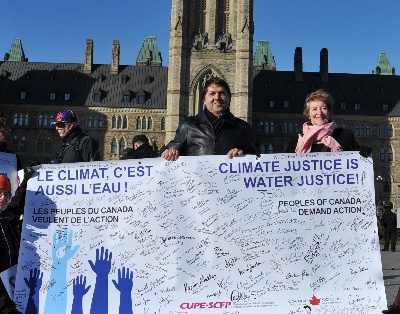
During the mid-day break, participants rallied on Parliament Hill, saying bold action on climate change can’t wait any longer, and that countering the global water crisis must be part of the solution.World leaders will soon travel to Copenhagen for the UN Climate Change Conference on December 7-18.

CUPE and the Council of Canadians will bring a banner signed by summit delegates to Copenhagen.

“Our government’s climate record speaks for itself, said CUPE National Secretary-Treasurer Claude Généreux. We rank 59th out of 60 countries. And it keeps getting worse. A prime example is the pollution and destruction spewing out of the Tar Sands.”“That’s why we must stand our ground. Together. For water, for the planet, and for our children’s future. The message on our banner makes it crystal-clear: ‘Climate justice is water justice,’” concluded Généreux.

Delegates also participated in workshops and heard an afternoon panel focusing on organizing to win.

The conference opened last night with a party celebrating Water Watch’s birthday. CUPE members, including a number of water and wastewater workers, also held a lively afternoon caucus to share their experiences and strategize about CUPE’s water work.

Couldn’t make it to the summit? Listen in at cupe.ca in the coming weeks for podcasts from the weekend.

Tuesday, June 03, 2008


CALGARY:
DEMONSTRATION AGAINST THE CORPORATE TAR SANDS:
For non-Canadians who may read this board the Alberta Tar Sands is Canada's largest energy project, perhaps the largest in the western hemisphere. It is estimated that there is more oil locked in the sands of the Athabasca region of Alberta than there are under Saudi Arabia. The problem is that they are more difficult to extract than the "drill and pump" reservoirs traditionally associated with the oil business. So difficult in fact that they may meet a natural limit in that the area simply doesn't have enough of the water needed for the process. So difficult in fact that nuclear power has been proposed as a solution for the energy needed for extraction. For those unfamiliar with the project(s) there is a Wikipedia article of the subject which also names all the present corporate players.
The environmental costs of the tar sands project are as large as the corporate scale. Many, from locals to people far away, have taken up opposition to the project. Here are three examples for those interested in reading further on the subject:
This coming June 16 a coalition of organizations including the Council of Canadians, Sierra Club, Forest Ethics, Keepers of the Athabasca and Greenpeace will be on hand to demonstrate against a Oil and Gas Investment Symposium being held in Calgary Alberta by the Canadian Association of Petroleum Producers. Here is the announcement from the Council of Canadians. It should be understood that Molly doesn't agree with the overall politics of the CoC, but their efforts in this cause are laudable.
.................................
On June 16th a coalition of efforts, including the Sierra Club, Forest Ethics, Keepers of the Athabasca and Greenpeace will be hosting an activity in Calgary to draw attention to the devastation from the Tar Sands for the environment and downstream communities.

***
Rally Against the Canadian Association of Petroleum Producers -
Investors in the Destructive and Toxic Tar Sands!
Environmental and Human Rights Abuses Ignored While Profits Soar
Hey folks!
As Alberta quickly gains an international reputation as a climate criminal, the Canadian Association of Petroleum Producers is holding an Oil and Gas Investment Symposium in Calgary from June 16-18.

PLEASE JOIN US on June 16, 2008, at 11am in front of the Hyatt Calgary
The event will bring together over 85 companies and 375 investors from Canada, the USA, and around the world - many of these folks being active and big funders in the Tar Sands, with others looking to expand into that market. This year, a bunch of different groups are looking to send them a clear message: Don't Invest in the Toxic Tar Sands!!!

While people living in communities downstream from tar sands developments continue to experience devastatingly high rates of rare cancers, while Alberta's lands and waters are contaminated with cancer-causing toxins and are transformed from pristine Boreal forest into what former Alberta Premier Lougheed refers to as a "moonscape," investors in the industry and corporations continue to make record profits.

Just weeks after 500 ducks died landing on a toxic tailings pond in Alberta's tar sands region, and Alberta Premier Ed Stelmach announced his government's intention to launch a $25 million advertising campaign to depict Alberta as an "Environmentally-friendly" province to the rest of the world, investors in the most destructive project on Earth are gathering to promote their interests and ensure the tar sands continue to expand, at the expense of the environment and the health of downstream communities!

We want these companies and investors, as well as the public to know that when you invest in the tar sands, you are investing in one of the dirtiest and deadliest energy projects in the world, as well as promoting human rights abuses and environmental destruction. And we want them to know that there will be no more business as usual when it comes to the tar sands, as Canadians mobilize to stand in solidarity with downstream communities to say No New Approvals and demand action and justice now when it comes to the critical issues of community health, the environment, and the water.

PLEASE JOIN US on June 16, 2008, at 11am in front of the Hyatt Calgary (Steven's Avenue entrance) and stand with us as we send a message to investors in the tar sands that their money is NOT safe, and is funding massive environmental and human rights violations!
Sheila Muxlow
Prairie Organizer
Council of Canadians
#34 - 9912, 106 Street
Edmonton, AB T5K 1C5
Toll Free 1.877.729.4500
Office Phone 780.429.4500
Fax 780.429.4501
Mobile Phone 780.233.2528

Washing one's hands of the conflict between the powerful and the powerless means to side with the powerful, not to be neutral. ~Paulo Freire