Showing posts with label calender. Show all posts

Sunday, December 27, 2009


INTERNATIONAL ANARCHIST MOVEMENT-JAPAN:
2010 JAPANESE ANARCHIST CALENDER AVAILABLE:
Hey, here's another item that proves that Molly isn't only focused on the cold and frozen North. The following came Molly's way via the Asian Anarchist Network. It's originally from the Japanese CIRA (the Japanese section of the international centres for anarchist documentation and research)via the Irregular Rythym Asylum Blog. I hope that that will be enough references for anyone. In any case the following calender highlights an attempt to assassinate the Japanese emperor earlier in the 20th century. Ah- every anarchist's dream, "to assassinate the emperor" and thereby "make a difference" with a simple act without complications. It's too bad that reality rarely is so simple. In any case here is the advert for the calender.
@@@@@@@@@@
CIRA Japana 2010 Calendar Out Now!‏
Hello comrades, Please check this out.
Best,
cat bloc
CIRA Japana <http://www.cira-japana.net/> 2010 Calendar Out Now!

CIRA Japana <http://www.cira-japana.net/> presents the 2010 calendar with a theme of the 100th anniversary of the High Treason Incident <http://en.wikipedia.org/wiki/High_Treason_Incident>.

The High Treason Incident

<http://en.wikipedia.org/wiki/High_Treason_Incident>, also known as the Kotoku Incident, was a socialist-anarchist plot to assassinate the Japanese Emperor Meiji in 1910, leading to a mass arrest of leftists, and the execution of 12 alleged conspirators in 1911.


To commemorate the people’s struggle against the Emperor in the early 20th century, this calendar highlights the key figures of the High Treason Incident <http://en.wikipedia.org/wiki/High_Treason_Incident> and international campaigns of prison solidarity for the victims. You will see valuable pictures of activists in the early socialist movements in Japan with English thumbnail for each month.


Here are the topics of the months:

[Jan] Shusui Kotoku: a prominent political thinker and anarchist

[Feb] Sugako Kannno: a feminist journalist and anarchist

[Mar] Gudou Uchiyama: an anarchist monk and his secret publication

[Apr] The High Treason Album/International prison solidarity

[May] The Commoners’ Society (Heimin-sha): the centre for socialists in the early days[Jun] A protest against fare rises of the Tokyo City railways[Jul] Suppression of free speech against the Commoners’ Daily[Aug] The Commoners’ Summer Seminar[Sep] The pollution in the Ashio copper mine and socialists[Oct] The post-war campaign on the restoration of honour of victims[Nov] Other High Treason Incidents: Daisuke Nanba, Park Yeol and Fumiko Kaneko, and Lee Bong-chang[Dec] Movements against the emperor system in the post-war Buy your copy now! 1200 yen plus postage.You can order by Paypal:http://irregularrhythmasylum.blogspot.com/2009/12/100-cira-japana-2010-calendar.html If you want more than 2 copies, let us know by email: irregular@sanpal.co.jp

Wednesday, December 31, 2008


PERSONAL:
MOLLY GETS MAIL- PART 3:

This blog(and the cat behind it) has received quite a few holiday greetings this season. I'm only reproducing a few of these here, those with the best graphics. The following from the United Farm Workers has its own charm as they offer a downloadable calender for 2009. See graphic above. I don't know about all the Obamamania shown in this calender. I guess it's appropriate that it comes the day before New Years, as they will be one mother of a hangover for all those who expect miracles from the new US Administration. That, however, is their privilege. Far be it for this cat to advocate any sort of prohibition.
..........................
HAPPY NEW YEAR!
In appreciation of your support we want to offer our supporters a FREE UFW downloadable 2008 calendar. Please click on the image below to download!
Si Se Puede!

http://www.ufw.org/pdf/2009calendar.pdf
United Farm Workers, P.O. Box 62, Keene, CA 93531 www.ufw.org

Saturday, March 22, 2008


HOLIDAYS:
THE PASCHAL FULL MOON:
Yesterday, at 6:40 pm UT (1:40 pm here in Winnipeg in the CDT zone), the 'Paschal Full Moon' arrived. This is the full moon that is taken as the event from which the day that Easter falls on is decided. There has actually been a long history about the setting of the date of Easter, and I hope to deal with this tomorrow on Easter Sunday. In traditional western Christianity Easter is traditionally the first Sunday after the first full moon following the Vernal Equinox. In actual fact the date of this full moon is not taken from reality but rather from a set of ecclesiastical tables known as a "Computus". The date of the "full moon" as given by these religious devises may differ from reality by up to two days. Ah, the miracle of faith !
The Paschal full moon has a few other names, derived from native American traditions. These include the 'Full Worm Moon', the 'Full Crow Moon', the 'Full Crust Moon' and the 'Full Sap Moon '. See 'The Moons of 2008' earlier on this blog for the names of the full moons of this year. You can also find the exact time of any full moon by consulting the tables on the Time and Date website.

Thursday, February 07, 2008


HOLIDAYS:
HAPPY CHINESE NEW YEAR !!!


Today is Chinese New Year, the most important festival in the Chinese calender. The year we are entering is the Year of the Rat, or , more properly, the year of the Earth Rat. Because the Chinese calender is a combined lunar/solar calender the length of each year doesn't correspond to that of the Gregorian calender. This year will last from Today until January 25, 2009 when we will enter the Year of the Earth Ox. The Chinese years, which occur in a cycle of 60 years are often named for a corresponding element (Earth, Metal, Water,Wood and Fire) and then with one of the 12 animals of the Zodiac with their corresponding Chinese names. These are as follows:


1)zi (rat)
2)chou (ox)
3)yin (tiger)
4)mao (hare,rabbit)
5)chen (dragon)
6)si (snake)
7)wu (horse)
8)wei (sheep)
9)shen (monkey)
10)you (rooster)
11)xu (dog)
12)hai (pig)


The Chinese signs of the Zodiac obviously don't correspond with those we know here in the West. As an interesting side note traditional Chinese astronomy recognized only 28 constellations. For more on Chinese astronomy see HERE. Because of the discrepancy between a lunar year and a solar year the Chinese calender uses "leap months" to reconcile the difference. A regular month has either 29 or 30 days. Every 2nd or third year a "leap month" is added. This has the same number as the preceding month. Thus it ends up that a "regular year may have either 353, 354 or 355 days. A leap year has either 383, 384 or 385 days.


There is some argument about exactly which year this is in the Chinese calender. The most popular theory is that it is year 4705. This stems from the idea that the calender was instituted by Emperor Huang Di in the 61st year of his reign (2637 BCE). Others date the calender from the first year of his reign (2697 BCE). Because these dates are exactly 60 years apart they make no difference in terms of the naming of the years.
CHINESE SEASONS:
The Chinese Zodiac is used only for calculating years and has no reference to the months of a year. In Chinese astronomy seasons begin and end not at the solstices and equinoxes but at the midway point between these msolar events (see diagram at the left). The months of the year are usually simply numbered, with zhengyue ("principal month") being the first, and the others simply following the numbers ie "eryue" (second month), "sanyue" (third month),etc.. They can alternatively be named partially after plants. The list is as follows:
1)First Month
2)Apricot blossoms
3)Peach blossoms
4)Mei ripens
5)Pomegrnate blossoms
6)Lotus blossoms
7)Orchid blossoms
8)Osmanthus blossoms
9)Chrysanthemum blossoms
10)Good month
11)Hiermal month
12)Last month
The celebrations of Chinese New Year begin today and continue on (for a variable amount of time depending on the country) until the Lantern Festival (this year on february 21). For the "days of Chinese New Years" and other information on thgis holiday season please see the archives at this blog for February 2007. Included there are 'Happy Chinese New Year' (Feb. 18/2007), 'The Days of Chinese New Years' (Feb. 19,2007) and 'More on Chinese New Years'(Feb. 24,2007). For a reference that shows you how to convert from Chinese to Gregorian calender dates see HERE.
Finally, here's the story of how the months got their names. Supposedly the animals were quarreling over who should get precedence in the naming of the 12 years of the cycle. The gods decided to hold a contest to determine the order. The animals lined up on a river bank, and their order in the calender would be determined by the order in which they swam to the other side. The cat was, understandably, disturbed by this contest because he feared water. The ox, meanwhile, wondered how he could find the other shores because he had poor eyesight. The sneaky rat suggested that he and the cat jump on the ox's back and guide him across. On thye way over the rat pushed the cat off into the water. Just as the ox was to come ashore the rat jumped off and became the first to reach the shore. Thus the first month was named after hi. The ox finished second. The lazy pig came in last. The cat finished too late to have any place in the calender. from this point forward the cat vowed to be the eternal enemy of the rat.

Saturday, September 22, 2007


WELCOME TO FALL:


THE AUTUMNAL EQUINOX:


Tomorrow morning at 4:51 am CDT (9:51 UT) the fall equinox will arrive.You can convert this to your own time zone using the Time and Date site. The equinox is defined as the time when the Sun is directly above the Earth's equator. This usually occurs around March 20th (the Vernal Equinox) and September 22nd (the Autumnal Equinox). At this time the Sun crosses celestial equator. The equinox is also the time of year when the celestial equator intersects with the ecliptic. The equinox is a point in time, not the name of a day. The day when daylight and nighttime are "most nearly equal" is referred to as the Equilux. while the equinox falls on September 23rd this year the equilux will actually be September 26th.


The time of the equinox isn't fixed. Each year they fall about 6 hours later. This is partially corrected by the leap year every four years which resets the time of the event. The reset isn't perfect however, and there is a slow drift of the time of the equinoxes (and solstices) to earlier times in the year. The shift amounts to a full day over the course of about 70 years. This shift is largely compensated by the century leap year rule of the Gregorian calender.


As we approach the equinox the rate of change in the length of a day increases. If you follow the time periods of daylight you will notice that they change most slowly around the times of the solstices but change most rapidly at the equinoxes. At the poles this means that the rate of change is instantaneous. The equinox marks the transition from 24 hrs sunlight to 24 hrs darkness. The further you travel from the poles the slower the rate of change. At the equator the rate of change is mere seconds per day. This apparent "midnight sun" in its full effect can be seen up to 100 kms from the poles. The time from the solstice in June to the September equinox is 94 days. The time from the December solstice to the March/Vernal equinox is only 89 days. This discrepancy arises because the orbit of the Earth is elliptic rather than perfectly circular. This means that the rate at which the Earth orbits the Sun also varies. It is faster towards the spring(northern hemisphere) when the Earth is closer to the Sun.


The actual times of daylight and night are not equal at the time of the equinox. This is not just because the equinox is a point in time. It is also due to other factors that contribute to the day being longer than the night at this time of year. First of all, the Sun is not a point source of light. It is a disc, and sunrise and sunset are defined from the point of view of the upper edge of the disc. The discrepancy is at least a minute on both ends of the day. There is also the effect of light refraction when the Sun is near the horizon. This makes the Sun seem to be a little bit more above the horizon at both sunrise and sunset. This effect adds almost seven minutes to the daylight. If you take twilight into account the "day" at the time of the Equinox would be almost an hour longer than the night. As you go towards the poles this difference increases, and the time of the equinox has much more day than night.


INTERESTING EQUINOX FACTOIDS:

There are a number of other interesting things about the equinoxes:


*Equinoxes have a temporary disruptive effect on geostationary communications satellites. This happens because there is a point in time at the equinoxes when the Sun is directly behind the satellite from the point of view of receiving stations on Earth. The Sun's radiation overwhelms the much weaker signal from the satellite with noise. The duration of this effect varies. it may last only a few minutes, but it may persist up to an hour.


*There are a number of other names for the two equinoxes rather than spring/Vernal equinox and autumnal/fall equinox. These names suffer from the fact that they are obvious references to matters only in the northern hemisphere. South of the equator the situation of the seasons is precisely the opposite. Some have proposed using 'March Equinox' and 'September Equinox'. This is familiar to those who use the western solar based calender, but lunar calenders such as the Jewish or Muslim calenders have the equinoxes falling in different months from year to year. The equinoxes were once named in astrology as the 'First Point of Aries' and the 'First Point of Libra'. Because of precession these astrological signs are no longer the constellations where the equinoxes actually occur. Today they are the 'Pisces Equinox' and the 'Virgo Equinox'. One hardly ever hears such terms in common usage. Finally, there are the 'Northward Equinox' and the 'Southward Equinox', referring to the direction of the apparent motion of the Sun at each equinox. These terms are also rarely used.

*There is a persistent folk legend that the equinoxes are the only time of the year when you can stand an egg on end. This myth has been thoroughly debunked by the owner of the Bad Astronomy Blog who devotes a lot of his efforts to exposing hoaxes, myths and misconceptions in the area of astronomy. In actual fact you can stand an egg on end at any time of year. It just takes a little practice and skill. See the article at http://www.badastronomy.com/bad/misc/egg_spin.html

*Because the Sun is not a point source of light it actually takes the Sun about two and 1/2 days to cross the equator. The equinox is defined as the time when the midpoint of the Sun's disc is over the equator.

*A couple of good references on things equinoxal:

1)Details about the length of day and night at the equinoxes.

2)Calculation of length of day.

3)Table of times for equinoxes, solstices, perihelion and aphelion in 2000-2020.

COMING SOON AT MOLLY'S BLOG: SHINE ON HARVEST MOON: WEDNESDAY,SEPTEMBER 26TH

Wednesday, September 12, 2007


TO OUR JEWISH READERS:
HAPPY ROSH HASHANAH:
Molly loves holidays. Sundown today began the 2 day festival of the Jewish New Year, Rosh Hashanah. According to my little orthodox reference, Judaism 101, this is the first and second day of the Jewish month Tishri, and the name Rosh Hashanah means "head of the year" or "first of the year". Molly is more than familiar with this holiday amongst others because her wonderful schedule book lists many such religious holidays, and I try to plan around them for the clients' convenience. I love my schedule book !!! It's so good. In addition to sectarian and international holidays it gives me the phases of the Moon, amongst many other things. Well worth the $80. I can remember a recent Jewish client who was astonished that I would dodge a Jewish holiday because the schedule said it was wrong. "But you don't observe Rosh Hashanah?". Nope, and I don't even observe Ramadan, so let's set a different date for your convenience. Hey, it's better than a computer any day. One quick glance tells you all.
The Jewish religious year is, like the Muslim year, based on a lunar year, and so the dates of the Jewish holidays vary tremendously from year to year. If you want to learn more about the Jewish New Year see the reference above or go to the Wikipedia article on same. Molly's only profane question on this matter is whether Irish Jews get to fill the ram's horn with whiskey(inside Jewish and Irish joke).
Anyways, have a good New Years, and all the best from Mollymew.

Saturday, June 30, 2007


DOES JUNE HAVE A BLUE MOON ?:
People living in different parts of the world may get confused when searching the internet for the term "Blue Moon". The present definition of this phenomenum is when two full moons occur in the course of one month. Parenthetically, the term "black moon" is when a month has no full moon. This can only occur in a February because the lunar cycle is slightly longer than a regular 28 days(about 29.5 days). The moon in such a month is, however, so close to visibly full that the casual observer will "think" there is a full moon in such a month even though there is not.
Today's full moon arrived at 13:49 GMT (8:49 Winnipeg time- daylight savings time). Is today's full moon a "blue moon" here. No...because the last full moon was on May 31st at 20:04. It was May that had a blue moon here and elsewhere in the western hemisphere.
But it is a little more complicated than that. The eastern hemisphere does have a blue moon this month because there are full moons on both June 1st and June 30th there. The point where this ceases to be true is two time zones heading west across the Atlantic. Not the best place in the world to set up a telescope. But let's go further. Near the Pacific international date line the month that has a blue moon is neither May nor June. It's July. Auckland New Zealand for instance has a full moon at 01:49 July 1st and another at 12:48 July 30th. If you want further details on this go to the Blue Moon Page and hunt for the "longer answers". The Wikipedia encyclopedia has a more general article on the whole matter of blue moons.
But in any case the Moon is full, and it's time for Molly to hop in her little cruise ship, 'Selena', and go sailing down the lunar seas on her long interupted lunar voyage.
MARE FRIGORIS: THE SEA OF COLD:
Look at the above lunar map. Mare Frigoris is labelled # 6 in that diagram. It is the northernmost (highest "up") major lunar feature. It lays just north of the Mare Imbrium (see later) and stretches eastward (to the right) above the Sea of Serenity. Like the other lunar "seas" Frigoris is dark because its basin is filled with lava that flowed after impacts on the early Moon by other bodies. This sea is bounded on the south (below) by the Montes Alpes on the east (right) and the Montes Jura on the west (left) and the Montes Teneriffe in the middle.. The mountains of the Moon are generally named after other mountain ranges on Earth. If you look a point just to the left and down from the number six in the above diagram you will see a dark smudge. This is the crater named Plato. Lunar craters are named after people with an emphasis on astronomers, scientists, explorers and other political and religious people from the past. There are hundreds of recognized names for lunar craters. Plato essentially marks the division between the Juras/Teneriffes to the left and the Alps to the right. Plato, about 100km wide, is extremely dark in colour and thus is one of the easiest lunar craters to spot if you are using binoculars that are less than ideal. Less easy to spot is the crater Cassini just south (down) from the Alps where this mountain range runs into the Montes Caucasus which bound the Sea of Serenity on its northwest. in the approximate middle of the Alps there is the 'Alpine Valley' that seems to bisect the mountain range in half. This is a shock ray from the impact that created the Mare Imbrium to the south.
That's it for now. The little pea-green ship Selena is now pulling up to dock. Stay tuned for when we sail again for the Sea of Rains.

Thursday, June 21, 2007


HAPPY SUMMER SOLSTICE (AND MIDSUMMER YET TO COME):

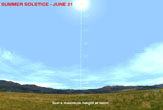
Today was the day of the summer solstice in the northern hemisphere (winter solstice south of the equator). The term "solstice" may refer to either the exact time of the sun's furthest point away from the equator or it may refer to the day on which this occurs. In the first sense the solstice is already well past. It occurred at 18:06 UTC (Greenwich Mean Time). Here in Winnipeg this would have been at about 13:06 (ie 6 minutes after 1pm). If you are interested about when the event occurred in your locality look it up on the Time And Date.Com site. This site also provides information on such things as sunrise, sunset, phases of the moon and even weather.

In the second sense there are still a couple of hours left to go in the solstice "day" (night now). This day is 16 hours and 21 minutes long here, actually about two seconds shorter than yesterday. NO...the solstice day was NOT the longest day of the year this year. This occurs because the exact time of the solstice doesn't always correspond with the exact point of midday in a given location. Sometimes the exact time of the solstice can even fall in the middle of the night. The solstice is not even always on June 21st. in 2008 and 2012 it will fall on June 20th (though very close to midnight-only one minute off in 2008).

The cause of the seasons, of which the solstices and equinoxes are the arbitrary dividing points, is the fact that the angle of rotation of the Earth is about 23.44 degrees from the perpendicular to its orbital path. It keeps this orientation throughout its orbit with the result that at any given time (except the equinoxes) one or the other hemisphere will be tilted towards the sun and hence be warmer than the other.

At the time of the northern solstice the sun appears to be directly overhead for all places 23.44 degrees north of the equator, known as the Tropic of Cancer, while during the southern solstice the same is true for any point 23.44 degrees south of the equator, known as the Tropic of Capricorn. The points in between this latitudes are known as the "tropics". The names for the tropics are actually misnomers as they stand for the constellations from ancient times when astrology was formulated. Due to precession the Sun is now in Taurus during the northern solstice and in Sagittarius during the southern one. The change of constellations makes the names more one of convenience than anything bearing any relation to reality.

The severity of seasonal change fluctuates over long time periods (thousands of years) because the axial tilt of the earth varies from 22.1 degrees to 24.5 degrees. The greater the tilt the more dramatic the seasonal changes.

In East Asia most calenders divide the year into 24 "solar terms". "Xiazhi" (Ha chi) is the 10th solar term. It begins when the sun reaches the celestial longitude(the highest point the sun reaches in the sky) of 90 degrees and ends when it reaches 105 degrees. Xiazhi literally translated is "summer solstice". In our calender this corresponds roughly to the period from June 21st to July 7th.

The time of the "northern sun" during the summer solstice can only be seen from places north of 66.56 degrees north, the Arctic Circle. At exactly this latitude the Sun touches the horizon at midnight but never truly sets. At the north pole the Sun would appear to rise and set in exactly the same place at the time of the solstice- in the south. But don't forget that all directions are south at the pole. The Sun would indeed appear to reverse course across the sky, but it wouldn't appear the same as if it did so at lower latitudes.

There are two interesting terms related to the twilight as one approaches the poles during midsummer. When one reaches latitude 50 degrees north the Sun never gets further than 16.56 degrees below the horizon. this is known as "astronomical twilight" when it is impossible for astronomers to do any work with any great precision. It is also called the "grey nights". Above 60 degrees latitude the Sun never gets more than 6.56 degrees away from the horizon at the summer solstice. This is known as "civil twilight" or "the white nights".


MIDSUMMER CELEBRATIONS:

Many traditional holidays clustered around the times of both the summer and winter solstices. The time of most of the summer festivals in western cultures, however, is no longer June 21st but rather June 24th. The difference is due to the calendar reform of Pope Gregory XIII. The old Julian calendar moved the date of the solstice forward about 3 days every four centuries. The Gregorian calendar, on the other hand, moves a little bit from year to year but only advances on the average a day for every 3,000 years. The old pagan solstice festivals had been christianized as the Feast of St John the Baptist, and this day kept its separation from the actual solstice at the time of the Gregorian reform.

The Feast of St. John is unique is that it is celebrated on the presumed date of the Saint's birthday. All other saints' days are celebrated on the day of their presumed death. The Roman Catholic Church has declared St. John's day as "Solemnity", the highest designation of a feast day. For more on St. John the Baptist and his celebration see the article in the Catholic Encyclopedia. Many of the European customs that surround MidSummer Day derive from older pagan customs, but far less is known about these than many modern "mythologizers" imagine. The actual reconstruction of verifiable rather than fanciful knowledge about pagan European religions is rather austere and sparse compared to the free flights of fantasy engaged in by many people who imagine they are recreating said religions. It's doubtless true that there were midsummer bonfires and, in some countries, midsummer trees (like the Yule trees, the spring trees or the maypole at different times of the year). The Romans had the feast of the Vestalia when married women were allowed to enter the shrine of Vesta, Goddess of the Hearth, where only the vestal virgins were allowed to enter at other times. Yet, even for the names of ancient deities, let alone detailed accounts of the religious practices of preChristian Europeans there are few reliable sources, and these are vastly outnumbered by the endless tomes of pop-religion in the New Age sections of bookstores today. As a matter of fact you'll rarely find them on the shelves of any bookstore. Tacitus, Bede and Caesar simply don't have the "pizzazz" that modern carbonated pop-religion delivers.
The religious practices of Native Americans are known a little better, and some of their midsummer festivals have been described in much greater and more accurate detail than those of ancient Europe. Native Americans have also left perhaps even more stone structures (some are known as "medicine wheels") that are just as accurate astronomical calculators as the better known megalithic structures of Europe such as Stonehenge. As an interesting sidelight June 21st has been officially known as 'National Aboriginal Day' in Canada since 1996.
In France La Fete de Saint-Jean is a Catholic festival held in June 24th (midsummer) and features large bonfires. The first Canadian celebration took place in New France in 1638, according to the Jesuit Relations. Ludger Duvernay, the Quebecois editor of La Minerve began the campaign to have this day declared the official holiday of French Canada in 1834. Pope Pius X declared St. John the Baptist to be the official patron of French Canadians in 1908. June 24th became an official holiday in Quebec in 1925, and in 1977 it was renamed the National Holiday of Quebec, though it is still usually referred to as St Jean-Baptiste Day.
Midsummer festivals in Portugal are actually held at various times depending upon the area. Lisbon, for instance, celebrates it on St. Anthony's Day (June 13th), but other places hold to June 24th. In Brazil, however, June 24th is the universally celebrated day, and it has become much more popular there than back in Portugal. The "Festa Juanina" is particularily popular in northeastern Brazil, actually rivalling Carnival in popularity.Two cities in the northeast of the country, Caruara and Camina Grande, are in competition with each other for the title of "Biggest St. John's Festival in the World". Caruara presently holds the Guinness title.
In Ireland many towns hold midsummer festivals on the weekend nearest to the 24th. In Italy the day is particularly popular in Florence (lasting from June 21st to June 24th) as he is the patron saint of Florence. In Poland, especially in the north, midsummer is celebrated on June 23rd. It begins at 8:00pm and lasts all night. Traditionally wreaths were thrown into the Baltic or into rivers and lakes.
The name for St. John in Russia is Ivan Kupala. It is celebrated on June 23rd (Gregorian calendar) and July 6th (Julian calendar) in both Russia and Ukraine. As in Poland wreaths are thrown into bodies of water and bonfires were/are lit as well. Mussorgsky's 'Night on Bald Mountain' was actually inspired by Ivan Kupala day festivals rather than Halloween. Bonfires were also traditional in the Baltic countries of Latvia, Estonia, and Lithuania, despite Soviet disapproval in the case of the latter country. Wreaths in Latvia were worn rather than tossed into water. In Latvia this is known as the Feast of Jani. In Estonia bonfires are once more featured and the festival is very similar to that of Finland to the north (Estonian and Finnish are related languages). Finland also features the ever present bonfires and also a summer pole tradition borrowed from Sweden. Before the conversion to Christianity the day was known as Ukon juhla, after the Finnish god Ukko. The day is known as Juhannus in Finnish and "midsommer" for the Swedish minority in Finland.
In Sweden Midsommarafton (Midsummer Eve) and Midsommardagan (Midsummer Day) are celebrated beginning on the Saturday that falls between June 20th and June 26th. It may rival Christmas in importance in this country. A "maypole" is raised on the Friday following the beginning of the festival , decorated with flowers and greenery, and dances are held around this pole. The years first potatoes,pickled herring sour cream and (hopefully) strawberries would be on the traditional menu. Old traditions about decorating houses and barns with greenery persist even though the old superstitions about this bringing luck are mostly forgotten. Midsummer in Sweden is considered the start of the summer holidays, something like the May long weekend in Canada and is a great time to party. In Norway the day called "Jonsok" or "Sankthansaften" is celebrated on June 23rd. Once more there is the midsummer bonfires.
The Danish name for St. John's Eve is "Sankt Hans aften", and it takes place on the evening of June 23rd. Once more it is time of bonfires and parties even though it is no longer an official holiday. Midsummer festivals in Great Britain gradually petered out during the Reformation and in subsequent centuries. Midsummer bonfires are still being lit in some places in Cornwall, however, and neo-pagans have their annual get together at Stonehenge, though, as previously mentioned, this has little connection with traditional midsummer festivals.
Sorta a great loss to Molly's point of view even if she has little sympathy with the necromancy of trying to revive that which is dead and dolling it up in the illusion that it is a recreation of the past. Better to create entirely new traditions without pretense.
Anyways, merry solstice and a happy midsummer.


Tuesday, March 20, 2007


WELCOME TO SPRING:
Today, at 00:07 UTC (19:07- 7:07 pm Winnipeg Time) the change of seasons has occurred, and it is now officially spring (yah, cheer, rah).
Molly spent the better part of today driving around and listening to the founts of all wisdom on the radio try their best to give the right time, almost always failing. The actual time is easily looked up, and if readers from other localities are interested in when it occurred in their time zone they can use the Time and Date.com site under our 'Other Interesting Sites' section to calculate the time difference between UTC and their time zone.
The equinoxes, from the latin equus(equal) and nox (night), are the two times each year when the sun spends an equal amount of time above and below the horizon. In actual fact the day at this time is longer than the night because the sun is not a "point" source of light, and when the centre of the solar disc is below the horizon the upper edge is still visible. Also refraction means that the sun's rays reach the ground even when the whole disc is below the horizon. At the equator this means that the day is about 14 minutes longer than the night at the equinox, and as you go towards the poles the difference becomes greater and greater.
The Spring Equinox has several alternative names ie the March Equinox, the Vernal Equinox, the First Point of Aries (an obsolete astrological term because precession has led to a total disjuncture between astrology and the actual position of the constellations), the Pisces Equinox (present position of the equinox) and the Northward Equinox. It should be noted that the term "equinox" refers to a moment in time, not a day. The rate of change of daylight versus nighttime is greatest at the time of the equinoxes. At the equator the rate of change is zero while at the poles the equinoxes mark the change from 24 hours of night or day to its opposite. The equinoxes fall about six hours later every years but are "reset" by the leap year inserted in the Gregorian calender. This itself varies as the Gregorian calender is not 100% accurate. Small changes also occur due to the gravitational influence of other bodies in the solar system, particularly the Moon. Because of the shift of the time of the equinoxes (and solstices) the present most common day for the Vernal Equinox is March 20th (as it is this year). Older people such as Molly have the date March 21st stuck in their minds because the equinox did indeed come earlier back in the days when Molly was a wee kitten.
The Spring Equinox has been associate with a great number of Spring festivals in many cultures and many ancient cultures devoted considerable effort in building "observatories" to calculate the exact time. In ancient German religion the vernal equinox was the time when Ostara, the goddess of fertility and the Moon mated with the solar god to produce a child due to be born 9 months later on "Yule". In ancient Greece this equinox marked the return of Persephone from the Underworld. The Mayans in Central America celebrate a spring festival that dates back a thousand years to the ancient "return of the Sun Serpent". the ancient cultures of the Middle East (Babylonian, Sumerian, Elamite and Persian) considered this day as their "New Years' Day", and this is still preserved in the Iranian and Bahai calenders. This marking of New Years at this time is common to many other countries in Central Asia such as Afghanistan, Azerbaijan, etc. and is a holiday in many countries where it is not accepted as the date of the New Year.
In Saxon mythology, from which many modern day Wiccan myths are derived, the goddess Eostre (from whom derives the word "estrogen") had her feast day on the full Moon following the vernal equinox. The present Christian calculation of "Easter" (also derived from her name) as the first Sunday after the full Moon on or after the Spring Equinox was derived from the appropriation of this festival. One interesting legend about Eostre is that she once found a dying bird on the ground one winter and in order to save it she transformed it into a rabbit. But the transformation wasn't complete, and the rabbit retained the ability to lay eggs which it would decorate and leave as gifts for Eostre. Now you know from whence comes the Easter Bunny.....
Christianity also borrowed from the ancient pagan religions to place the Feast of the Annunciation on the date of March 25th by the old Julian calender. This led to the further appropriation of Yule, December 25th, some 9 months later in imitation of the old Teutonic calenders, as the time of the birth of Jesus.
Elsewhere, Japan has the day of the Spring Equinox as a national holiday. In many Arab countries this equinox is celebrated as Mothers' Day. Earth Day was originally celebrated on March 21st, but more recently it has been moved to April 22nd. A few other pieces of trivia follow.
In some European countries legend has it that the equinox is the only time when one can successfully balance an egg on its end. during the equinox geostationary communication satellites may temporarily "go down" as the radiation of the Sun directly behind them disrupts their signals. The actual day when daytime and nighttime are closest to equal is referred to as the "equilux" as opposed to the equinox. This is usually three or four days "towards the winter" ie it fell three days earlier this year as opposed to the equinox.
For those who enjoy total trivia there is a table of times for the spring equinox from 1452 to 2547 at http://ns1763.ca/equinox/eqindex.html .
ANYWAYS, HAVE A GOOD SPRING
MOLLY

Sunday, February 18, 2007


HAPPY CHINESE NEW YEAR:
Today is the first day of the 15 day celebration of New Years according to the traditional Chinese calender. Also known as the Spring Festival, it is the most important celebration in the Chinese year. In pinyin it is referred to as "Nongli xinnian". Traditionally it begins on the first day of the first lunar month in the Chinese calender, and it ends on the 15th day. This 15th day is referred to as the Lantern Festival (pinyin yuanxiaojie - Mandarin). This is considered to be year 4705 in the traditional lunar calender, though there is considerable dispute about when the actual Chinese calender began. It is possible that it began with month 1 during the Xia dynasty, month 12 during the Shang dynasty or month 11 during the Zhou dynasty. The final fixing of the New Year was established by Emperor Wu of the Han dynasty in 104 BC. Intercalary months were added to keep the festival in line with the solar year at various times. Today Chinese New Year falls anywhere from January 21st to February 20th. The date of Lichun is a traditional Chinese solar term marking the beginning of spring, and usually falls on either Feb 4th or 5th. Yes, the Chinese have both a lunar and solar calender.
In ancient myth the man-eating beast from the mountains, the Nian, could enter houses to prey on humans. It was said that this beast, something like a Sasquatch with a toothache, could be scared away by loud noises and the colour red. Hence the origin of a lot of the customs of Chinese New Year, from the traditional firecrackers and fireworks to the wearing of red clothes. Sad to say firecrackers have been banned in most countries today for "safety reasons", an example of where "social management" is hardly confined to western managerial societies. Molly can remember them from her youth, and she never suffered anything more than a slightly burned hand. They were always coloured red in those days, by the way. But, once more, "the people" have to be protected from themselves by their supposed betters. Too bad- I always liked firecrackers.
Back to the subject. Chinese New Years is a statutory holiday in many countries in the world. In the Peoples' Republic of China the first 7 days are stats, in Taiwan the first 5 days, in Hong Kong and Macao the first 3 days, in Malaysia and Singapore the first 2 days and in Brunei and Indonesia the first day only. The Vietnamese usually celebrate their New Year of Tet on the same day as the Chinese, but because of the time zone difference between Beijing and Hanoi it is occasionally on a different day. This year it was a day early, on February 17th. Korea officially follows the Gregorian calender, but the date of the lunar New Year is a three day holiday(as opposed to one day for Jan 1st). The Japanese have the first three days of the Gregorian calender as holidays. They changed the date of their celebrations in 1873.
More on Chinese New Years tomorrow the second day of the celebration.
Molly.
PS:
Hopefully more on Carnival and the upcoming Shrove Tuesday as well.

Thursday, December 21, 2006


HAPPY MIDWINTER SOLSTICE:
Midwinter Solstice ("solstice"- the sun stands still) occurred yesterday, Dec 21st at 7:22 EST (6:22 CST here in Winnipeg). The solstice is defined as the EXACT moment in the year when the Sun reaches its greatest northerly (the Summer Solstice) or southerly (the Winter Solstice) point in its annual movements. The effect is due to the annual tilt of 23.5 inclination of the Earth as it revolves around the sun. This is separate from the "wobble" of the Earth that is responsible for "precession", the reason why astrology is so at variance with astronomy in terms of the positions of the constellations. As the Earth revolves around the Sun first one and then the other hemisphere is presented towards the sun. The hemisphere tilted away from the Sun experiences winter, and the other experiences summer. The definition of "solstice" is the minimal noontime height of the Sun. This means that "somewhere" on the Earth at the times mentioned above the Sun is EXACTLY in its lowest position at noon in the sky. Counting backwards from Manitoba this would place the event somewhere over the mid to Eastern Pacific.
Throughout human history people have seen the Winter Solstice as a cause for celebration, a promise that the lean days of winter will end, even if the "hungry moons" are yet in front of them. The Chinese have traditionally celebrated the DongZhi Festival around Dec. 21st. One of the traditional activities in South China that occurs during the family get-togethers around this Festival is the making and eating of Tangyuan, balls of glutinous rice, that symbolize reunion. In North China people typically eat dumplings on DongZhi. This relates to a "Good King Wencelas"ort of story from Chinese tradition. According to this Zhang Zhongjing of the Han Dynasty saw the poor suffering from chilblains on their ears on a cold winter day. He ordered that dumplings shaped like ears should be distributed amongst the poor to keep them warm. Zhang named the concoction "qu han jiao er tang" or "dumpling soup that expels the cold".
The first monotheistic religion to institute a midwinter festival were the Zorastrians of ancient Iran/Persia. This festival, called Yalda, is still celebrated in modern Iran under an Islamic guise. It is traditionally celebrated on December 21st to hail the victory of light over darkness, of Ahura Mazda over Ahriman. Throughout the night fires would be burnt to help in the struggle of light over darkness. The next day the festival of Daygan was celebrated to mark the victory of Ahura Mazda. There would be acts of charity (Christmas gifts ?) and payers to Mithra (the equivalent of the Son in the orthodox Christian trinity). During this festival there was a temporary suspension of the hierarchy of Iranian society. Masters and servants would exchange roles. A "mock king " was crowned just as in some medieval festivals.
The Persian custom merged with and influenced the Roman celebration of Saturnalia. In Rome they followed the custom of inverting the social order. Children became the heads of the families. Businesses and courts were closed. Masters served slaves. Cross dressing and masquerades were common. The Romans accepted the proto-Christ figure of Mithra under the heading of 'Sol-Invictus' (the "invincible sun"). Mithra contained a good portion of the Christian mythology, from a proto-trinitarian aspect down to the nitty gritty of a virgin birth. The popularity of Mithraism paved the way for the ability of Christianity to spread amongst the Roman population. The general outlines of the myths were well known. It should be noted that the festivals of Saturnalia and Sol Invictus were totally separate events.
In Iran today the religious significance of 'Shab e Cheleh' has been lost under the influence of Islam. It is still, however, a time when family and friends get together to feast and play.
Then we come to the traditional Yule celebrations of Northern Europe. These go under various names in various languages; Geol, Jol, Jul, Julfest, Mitwinternacht. These are the festivals of Nordic and Germanic people from which many of our Christmas traditions are derived. Yule logs were lit to honour Thor, God of Thunder. Feasting would continue until the Yule Log burned out which could take as much as twelve days. A sacrifice of a pig to the God Freyr became the origin of the Christmas ham, first a Scandinavian custom but later to spread across the world. In Norway the expression "jul" is still the most common way to express Christmas.
Linguists have debated the origin of the various terms that signify "Yule" in English. It may relate to the idea of "wheel" as in the "wheel of the year". It may be connected to the adjective "yellow" as in the colour of the Sun. In may even be a borrowing from Finnish. The actual details of northern pagan yuletide festivals are rather obscure beyond the fact that it was a time for feasting. This has led to a divergence amongst modern neo-pagans. "Germanic neo-pagans" attempt to reconstruct the actual historical festivals insofar as there is evidence. Others, best descibed as Wiccan or 'New Age', pay little or no attention to what is actually known about pagan religion, Germanic or Celtic and attempt to create new solstice festivals with more than a little "poetic licence".
The existence of neo-pagans has added a little spice to an annual Christmas ritual amongst Christian believers in North America. This ritual would, of course, appear to be utterly insane to the vast majority of Christians living outside of North America-as it is to me as an ex-Roman Catholic sharing the prejudices of the vast majority of Christians who see the American evangelicals as "primitive". It, however, plays out every year without fail, though not with the vehemence surrounding Halloween. Almost all Christian festivals are "take-offs" on previous pagan festivals. It is a matter of "1/10th education" amongst certain fundamentalist sects to know about the pagan origins of Christmas traditions, whether they be Saturnalia or Germanic/Scandinavian traditions. The nine-tenths of the matter that they DON'T know is the origin of Christian theology in Roman mystery religions, the way that the accepted Bible came to be, and the destruction of alternative forms of Christianity.
So...each Christmas they denounce the traditional forms of celebration from a position of pseudo-erudition. One can also see a great contrast between the early missionaries to Northern Europe and the pseudo-missionaries of modern evangelism. In those ancient times missionaries struggled to adapt the ideas of Christianity to the customs of the people that they preached to with a full and EDUCATED knowledge of the difference between "form" and reality. The truth of what they did, usually without the military support that modern evangelicals enjoy courtesy of their close relations to the American Empire and its neo-fascist clients (see Guatamala), is plain and evident in the present, where the symbols that they expropriated are in the minds of 98% of the population NOTHING but Christian symbols.
The Roman festival of Saturnalia is one of the "origins of Christmas" that fundamentalists denounce. One really wonders whether it is because of the pagan connection (they hardly denounce the Trinitarian concepts inherited from paganism whereby polytheism can be said to be monotheism) or because of the social "loosening" that accompanied Saturnalia. This loosening of social hierarchy later got transferred to 'Carnivale' celebrations in Christian cultures while the Christmas season retained only its festival and gift-giving aspects. Saturnalia was originally only a day long festival but it later became a week long occasion for celebration despite the efforts of more than one Emperor to restrict its duration.
There are two different explanations as to why Dec. 25th was chosen by Christians in the 4th century as the birthday of Christ. One is that it is (was) the winter solstice on the Julian calender in use at that time. The second, however, is that it was an extrapolation of a Jewish idea of the "integral age" of the prophets ie that they died on the same day as their conception or birth, combined with a miscalculation of the date of Jesus' death. All these complications,however, are alien to the tiny view of the world held by "kindergarten Christians" who attempt to denounce the season each and every year.
Meanwhile there are many other midwinter celebrations across the world. The pre-christian Slavs celebrated 'Korochun' (Karachun, Krachun) in a manner similar to Halloween in Western European tradition. The Slavs burned fires at cemetaries to keep their dead warm on this most evil night of the year, lit wooden logs at crossroads and organized feasts in honour of the dead. On Dec. 23rd the old Sun Hors was resurrected as the new Sun Koleda. There are also numerous midwinter festivals documented amongst North American natives.
In summary midwinter has always been an important event for humanity. It transcends our own time and place. So...
Happy Midwinter Solstice From Mollymew

Friday, September 22, 2006

Today in History:
1692: The last 8 women hanged for witchcraft in Salem MA today. Coincidentally today is the fall equinox and therefore the time of the Wiccan festival of Mabon. A good time to "hang around". This years actual harvest moon will be coming up soon in early October. It usually falls in September, but this year the one in Oct. is closer to the equinox. Each full moon has a traditional name, but this year there will be a stutter as the hunters' moon becomes the harvest moon.
1792: Legislation passed in the French National Assembly establishing the new revolutionary calender. Came into force in 1793. There was a week of ten days and 12 months of 3 weeks each. The left-overs- well have a good party. This would be the first day of the month of Vindemaire- fine wine. But who's counting.
1862: Lincoln's Emancipation Proclamation put forward. Due to take effect on jan. 1st, 1863, but only in states "in rebellion" against the federal government. Seems there was something missing here.
1871: Japanese anarchist Shusui Denjiro Kotoku(1871- 1911) born. Executed in connection with a plot against the emperor.
1903: Patent issued for the ice cream cone. No kidding ! How cool ! More licks, less drips.
1912: Mexico- the anarcho-syndicalist Casa del Obrero Mundial founded.
1973: Spain: Anti-fascist anarchist guerrilla Salvador Puig Antich arrested because of his part in the anti-Franco campaigns of the MIL (Iberian Liberation Movement). Later garroted by the Francoist government on March 2, 1974.
1975: Your Personnel Department Sucks Dept.: Sara Jane Moore attempts to kill US President Jerry Ford. The interesting part is that she a paid informant for both local police and the FBI
1985: France admits planting bomb that sank the Rainbow Warrior in New Zealand. Not, definitely not, absolutely not part of any international terrorist conspiracy. Who us, Non, absolutement Non.