Thursday, January 29, 2009


CANADIAN POLITICS:
HARPER BUDGET FAILS THE POOR:
The long awaited federal budget has been delivered. The short lived 'Coalition' is dead, replaced by what the leader of the federal NDP describes as a "new coalition", one of the Conservatives and Liberals. While the smaller parties have declared their intent to vote against the budget the Liberals, under Ignatieff, have given their support. Their only real condition- that regular accounts of the progress of the plans be given regularly to Parliament. This, of course, is pretty well what is already done anyways. It was no surprise that the Conservatives, almost breathlessly, announced their support for the meaningless Liberal "amendment".


Meanwhile there is much to criticize in the budget document. Would increased spending rather than a tax cut have been more stimulatory ? Would a cut to the GST have been a better option than than minor cuts to income tax ? Has access to EI really done enough to protect those who will be losing their jobs in the recession. Molly has discussed various approaches to the federal budget before on this blog, including those of labour, economists and her own ideas. Here's a press statement from the Ontario Coalition Against Poverty (OCAP) reflecting on what is missing from the budget in terms of Canada's poorest citizens.
..............................
Statement on the Federal Budget‏:
Today’s budget will do little to help low income Canadians. Harper’s government has made some attempt to placate the opposition, but his efforts will only help a shrinking fraction of the population. The spending strategy is described as Timely, Temporary, and Targeted. Indeed it is. It’s too little, too late, for too few. While 75 billion dollars are given to the financial sector, there are only scraps left for the poorest in our society.


In line with the ongoing Harper agenda, the budget emphasizes tax cuts, instead of making real investments in housing, infrastructure and people. He crows about investing in social housing and unemployment insurance. The budget says that it will invest 2 billion into social housing. Sounds great. But the cost of repairs to Ontario's housing are estimated at about $1.2 billion. And 60,000 people are on the waiting list for social housing in Toronto alone. Given that much of the infrastructural funding is dependent on cost-sharing with the cash-poor provinces and municipalities, the figures are misleading. Harper claims that he’s making things easier for laid off workers by adding 5 weeks to employment insurance. Given that 60% of Canadians aren’t eligible, this will do little for the majority of those suffering in the economic downturn.
As factories close and businesses go bankrupt, more and more Canadians will need help. Unfortunately the tax cuts, benefits and incentives will do little for them when they’re evicted, unable to obtain employment insurance, or scraping by on welfare and food banks. A budget that would really address the needs of the increasing ranks of poor Canadians would raise the welfare rates, expand employment insurance in a serious way, build new and quality social housing invest in transit, education and health care. This budget doesn’t even try.
An economic recession that leads to layoffs, evictions and poverty is not the time for bailing out the corporations and playing political games. It’s the time to organize in our communities to support one another, and to fight to ensure that the poorest, the most vulnerable, are not abandoned yet again.

Wednesday, January 28, 2009


CANADIAN LABOUR:
TORONTO POLICE ATTACK YORK UNIVERSITY STRIKE SOLIDARITY DEMO:
A solidarity protest in support of striking teaching assistants at Toronto's York Univerity was temporarily disrupted yesterday as police moved to arrest four demonstrators. Here's the story from the point of view of the Inside Toronto magazine.
..........................
NORTH YORK: Strikers clash with police during rally:
By CLARK KIM
January 27, 2009 5:39 PM
Legislation details
According to reports, the following are highlights of the proposed back-to-work legislation debated at Queen’s Park this week to end the strike at York University.
It would:
**End the strike immediately.
**Impose daily fines of up to $2,000 per
person against scofflaws who continue to strike.
Send unresolved contract
matters to arbitration
**Enable CUPE Local 3903 and the university to agree
to an arbitrator, but allow the government to name one if they are not able to
achieve a consensus choice
**Force arbitration to end within 90 days
**Empower the arbitrator to take into consideration the university’s ability
to pay, the economic situation of the province and the competitiveness of the
settlement when compared with other contracts.
What started as a peaceful rally by the striking York University workers turned violent as they marched to Queen's Park Tuesday morning to protest the back-to-work legislation put forward by the provincial Liberal government earlier this week.

About 200 members of the Canadian Union of Public Employees (CUPE) Local 3903 gathered at the Ontario Ministry of Labour office near University Avenue and Dundas Street where the rally began.

More than 3,300 union members including teaching assistants, contract faculty and graduate assistants have been on strike since Nov. 6, effectively shutting down the campus and cancelling classes for 50,000 undergraduate students.

The protesters marched to the Legislature building with the MPPs debating the back-to-work bill that could end the strike and have classes resume Monday.

"It's about a fundamental right of labour," said Noaman Ali, a teaching assistant and graduate student at York University.

Calling the back-to-work legislation "reprehensible," he called on the province to instead force the university administration to come back to the bargaining table to resolve the labour dispute.
The demonstration, however, was disrupted when an altercation took place between a police officer and a union member who allegedly ignored police orders to stop blocking traffic.

Other protesters got involved in the confrontation with police, resulting in at least four union members taken into police custody, according to CUPE 3903 representatives.

The crowd voiced their anger toward the officers on duty, shouting, "Let them go," and chanting, "Free, free, free our colleagues."

"I have a right to be here," said Gita Hashemi, a contract faculty professor at the university. "Our members have a right to be here."

One witness said he saw the incident unfold and called the police officer's actions "appalling."
"One person was grabbed and thrown to the ground," said Ted Myerscough, a research project co-ordinator, who was looking down from the ninth floor of his work building on University Avenue. "I was just outraged."

The march eventually proceeded with the union and its supporters reaching Queen's Park where provincial NDP leader Howard Hampton addressed the large crowd.

"A bargaining contract is better than one that's imposed," said Hampton, whose party didn't give unanimous consent for the back-to-work legislation.

That prevented the expedited passage of the bill and it appears almost certain that the resumption of classes at York will be delayed until next week.

While the legislation is being debated, Hampton urged Premier Dalton McGuinty to call York University president Mamdouh Shoukri and request the administration meet with the union to "bargain and negotiate."

CUPE 3903 spokesperson Tyler Shipley applauded Hampton for his support.

"We want to make sure this thing ends with a negotiated settlement on our terms," Shipley said. "This fight is not over."

But in a statement by the administration released later in the afternoon, Shoukri said negotiations were at an impasse.

"York's bargaining team spent over 40 days in negotiations with CUPE 3903 beginning in July of last year," he said. "After six months, which included 11 weeks on strike, the union's last offer was still more than double the university's offer for settlement. That is an impasse by any standards."

The back-to-work legislation is the only certain way to get students back to class as soon as possible, he added.

"The parties are in deadlock and the summer term is now in jeopardy," Shoukri said. "We need to get these students back to class immediately."
...........................
Here is a first hand report from one of the union members involved. The following comes via the Ontario Section of the Anarchist Black Cat discussion board.
.........................
Toronto Police Attack Peaceful Protesters:
Tues January 27, 2009
Today at 15:38 I am writing this to share with you what really happened at the CUPE 3903 protest against back-to-work legislation at the Ministry of Labour and Queen's Park today. Most major news networks are referring to the events of today as "protesters clash with police" or "one arrested at CUPE 3903 demonstration", and so on.
The organizers of the protest began by getting all of the necessary permits to have the rally, and did notify the city and the police in accordance with the law. We began the rally at the Ministry of Labour, and upon completion we marched down University Avenue to our final destination, Queen's Park. During the protest we listened to speeches, yelled chants, and sang songs amidst journalist-provocateurs which we responded to by yelling our chants even louder, or ignoring all together.
When we were marching down University Avenue the police kept screaming at us to get off the road, when our permit proved that we had a legal right to be there! We only stayed on the side of the street designated to us, and refrained from stepping onto any private property because we wanted our demonstration to be peaceful! After screaming at us, some police officers started to shove some of the marshalls. When one girl yelled at a police officer for shoving her, he responded by yelling "Stop resisting you stupid bitch!" and hit her in the face with his baton. Bleeding, she was dragged by two male officers to the police station. Police officers then arrested four other protesters, two of which I saw being held on the ground, their faces being crushed into concrete and piles of sharp ice and gravel. One protester's forehead was bleeding from being forced down into the ice. As he was lifted up and put into the back of the police car the officer yelled to the crowd that the protesters were armed!! The police officer had confiscated his CUPE flag, so was the officer referring to a large pink flag being a lethal weapon? Ridiculous! While the police were forcibly restraining the protesters, we circled the police, shouting "LET THEM GO! LET THEM GO! POLICE BRUTALITY! POLICE BRUTALITY!' A group of us then sat in front of the police car that was holding the protester who had a bloody forehead as a means of peaceful resistance against police brutality. The police then felt a need to call in backup of at least 10 more police cars, plus a troop of cops on horses to intimidate us. From my understanding a good portion of these events were caught on film on video tape, and it is my hope that we have enough evidence to help our colleagues who were unjustly injured and arrested today.
When we tried to continue the march to Queen's Park, the police blocked the road with their cruisers, not allowing us to pass. This happened in front of a hospital and they then had the audacity to accuse us of obstructing emergency vehicles when it was their cruisers that were blocking the road!! Finally the police unblocked the road so that we could pass and continue on with our rally.
We did make it to Queen's Park to finish the rally, and were met with support from CUPE Ontario who are going to pay the lawyer fees for those who were abused by uniformed police officers, and the NDP caucus who have been the only party in Ontario to fight against back-to-work legislation. We did find out that that McGuinty is supposed to be calling York administration back to the bargaining table today, in a last ditch effort to end the strike without back-to-work legislation!!
It is my hope that those who were injured by the police today video tape their injuries and send the pictures to the media, put them of facebook, and put them on youtube to show the public how Toronto police are guilty of brutality!"
Apparently, passerbys agreed. A number of construction workers joined in at the impromptu rally outside 52nd division and here's a quote from one of the articles:
"One person was grabbed and thrown to the ground," said Ted Myerscough, a research project co-ordinator, who was looking down from the ninth floor of his work building on University Avenue. "I was just outraged."
..........................
Finally, as I prepare to put this blog to bed comes news today that CUPE Local 3903 has decided not to try and challenge the back to work legislation being prepared by the Ontario government. members of Local 3903 plan to return to work on Monday. Taken in its broadest context this means that the strike has essentially been lost. There is an inevitably hard road to travel in any strike in the public sector as trike breaking legislation is an ever present possibility. rumour has it that striking transit workers in the Ottawa area are also to be legislated back to work in the near future. Molly has no quick and easy answers to this problems, though it is obvious that winning any public sector strike depends much more on winning the battle for public sympathy than a strike in the private sector does. That is where the questions should be asked. Anyways, here from the Strike Site of Local 3903 is the announcement.
.........................
YORK UNIVERSITY WON’T BARGAIN:
CUPE 3903 TAKES HIGH ROAD, HOLD’S LAWSUIT, TO ALLOW RESUMPTION OF CLASSES:
JANUARY 28, 2009 , TORONTO, ON – After waiting in vain for the past critical day and a half for York University to negotiate an eleventh hour settlement, the union representing striking contract professors and teaching, graduate and research assistants says it is shifting gears and preparing for members to return to the classroom.

“It is obvious that the York administration has no desire, indeed has never intended to reach a negotiated settlement,” said CUPE 3903 spokesperson Tyler Shipley. “We have done everything in our power to stand up for the quality and accessibility of education at York in this round of negotiations but, for now, it’s time to get our students back to class. Our local has decided not to pursue a legal challenge to Premier Dalton McGuinty’s back-to-work legislation at this time.”

CUPE 3903 Chair Christina Rousseau noted that the local’s 3300 members “have fought a courageous fight against an administration who put their own narrow vision ahead of the interests of students, academic integrity, job security and workers rights.”

Shipley added, “Our members have shown tremendous determination, but they are tired of waiting for York to take the process seriously. Undergrad students are looking for some assurances. We aren’t going to let the university’s game continue. It is time for someone to take responsibility for getting campus life back to normal.”

The Liberal government should not imagine that back-to-work legislation resolves any of the key issues in the strike, particularly the reliance of universities on underpaid, contingent workers to do most classroom teaching.

“Our concerns are not going away, they are systemic and go well beyond the York campus,” noted Shipley, adding that the local will continue to address the trend to insecure teaching jobs, the need for minimum funding guarantees for graduate students, and the value of coordinated bargaining through other channels.

“These issues are still alive at York and across the province. We’ll be working with our sister locals to make sure they are addressed in ways that protect the interests of workers, students and hardworking parents who are being asked to shell out more tuition fees every year,“ said Rousseau. “Unless administrators change their priorities and the Ontario government invests in our universities, they should brace themselves for more job actions in the coming years.”
-30-
For more information, contact:
Tyler Shipley, CUPE 3903 Spokesperson, 647-295-1674
Christina Rousseau, Chair, CUPE 3903, 416-347-4502
DOWNLOAD a PDF version of this release.

-->
Comments Off -->

Tuesday, January 27, 2009


AMERICAN ANARCHIST MOVEMENT:
Z-SCHOOL-SPRING SEMESTER:

The folks down at Z Communications will soon be opening registration for their online course at what they call the ZSchool. Here's the announcement.
.......................
ZSchool Sign Up Time!‏:
February 1 we will open ZSchool for registration for the Spring semester of courses - which will begin March 1.


ZSchool is a major undertaking in which we will try to provide, semester by semester, a growing online learning experience. We hope you will take a look at the ZSchool venue and consider the possibility of taking a course, both to help the project and for your own learning.


The March offerings are listed with descriptions in the ZSchool venue - and by title immediately below.


Each course will run for ten weeks. Each course will cost $100 unless you are a Z Sustainer (which you can do for as little as $12 a year) in which case each course will be only $50.


It is, in other words, a very good time to sign up if you haven't already! Here are the Spring Courses:

Michael Albert: Paths to Parecon
Chris Spannos: Participatory Society 1
Cynthia Peters: Family, Children, and Sex - Kinship Vision
Patrick Bond: Economic Justice Advocacy
Andrej Grubacic: Anarchisms Past and Future
Marie Trigona: Workers' Self Management in Latin America
Milan Rai: Clash of "Civilizations" / The Growing Fear of Islam
David Peterson: Critical Perspectives on Corporate Media
Tony Christini: Liberatory Literature
Andre Vltchek: Indonesia 1965 to Today
Michael Albert: Parecon/Parsoc 2

ANARCHIST MAGAZINES:
WORKERS' SOLIDARITY 107 NOW ONLINE:
Here's a potpourri of announcements and other matters from the wide world of anarchist magazines. First of all from Ireland comes the announcement of the 107th edition of the Irish 'Workers' Solidarity', now online.
........................
Ireland's anarchist paper Workers Solidarity 107 online:
Workers Solidarity 107, the Jan/Feb edition of the Irish anarchist paper is now online for you to read or download. This is the online version of the paper, 10,000 printed copies of each edition are also distributed for free in Ireland, if your interested in helping with distribution contact us.


Click on one of the links below for a PDF version of the northern or southern edition of Workers Solidarity 107.
Workers Solidarity 107 Southern Web Edition 0.91 Mb
Workers Solidarity 107 Northern Web Edition 0.92 Mb
Anarchism and the WSM
November saw WSM public meetings about anarchism in Cork and Dublin, with 40 people at one and about 60 at the other. With the crisis and a growing employers’ offensive on wages there is a greater openness to radical ideas, and we will be holding more meetings around the country over the next couple of months.


November also saw big numbers turn out for demonstrations against the education cuts. A leaflet by WSM education workers asked “why do we keep inviting Fine Gael and Labour TDs to speak at our rallies. When they were in government, they were every bit as mean as Fianna Fáil, every bit as good at cutting services in order to keep down the tax bill of the rich. When in opposition they make promises, when in government they stick the boot in.


“Surely we should be looking to others in the same situation as ourselves. Surely we should be looking to join up with other working people who face the same attack on their jobs and services.” The government’s cuts strategy is an attack on the standard of living of all working people, a united resistance where “an injury to one is the concern of all” is the best response.


December saw 15 year old Alexandros Grigoropoulos shot and killed by police in Athens in December. WSM spokesperson Siobhan Rattigan said that “While Greece was preparing for the December 10th general strike against making working people pay for the economic crisis, Alexandros was killed in cold blood. That is how a ‘special forces’ police officer answered anti-police slogans that a small group of school students were chanting.


Far from frightening people it sparked off riots throughout the country. A General Strike was called for the following day, and 10,000 marched on the Greek parliament. Schools all over Greece were occupied by their students, and a 3-day strike declared by the High School Teachers’ Union.


In Dublin WSM members helped to organise a protest outside the Greek embassy. A Greek anarchist addressed the crowd and explained that “the special forces are trained by the old guard, the military who were in power. They are not respected by the people, and neither is the government which mirrors our own with its corruption and ineptitude. That is why Greece is in the grip of its greatest social upheaval in decades.


We were on the streets again that month, joining protests against the Israeli slaughter in Gaza. A joint statement from our sister organisations in Palestine/Israel, South Africa, Italy and Canada summed up our rulers' attitude:


"Hundreds of dead and thousands of injured, sacrificed on the altar of Zionist expansionism and fundamentalism. In Europe, the foreign ministers of every EU country talk about an "exaggerated", though "legitimate", reaction on the part of Israel, reversing the true situation with an operation that would make the most cynical illusionist feel proud by making the aggressor, the State of Israel, appear to be the victim."


On a happier note, December also saw the first of the WSM’s monthly radio shows on Dublin community radio station NEAR 90.3FM. If you miss the live programme you can download it from http://www.archive.org/details/RadioSolidarityShow1FromTheWorkersSolidarityMovementIreland
In this issue.
..Make Them Redundant
Billionaire investor Warren Buffett commented on the US financial crisis that “it’s only when the tide goes out that you learn who’s been swimming naked, and Wall Street now looks like a nudist beach.” Well when it comes to Ireland, the receding tide of the global economy has revealed that not only were our business and political elites swimming naked, they were engaged in a great big orgy as well.
Moving From Protest to Success
The Education Cuts announced in October’s Budget have unleashed a wave of protest across the country. During the months of November and December approximately 120,000 people took to the streets of Dublin, Galway, Tullamore, Cork and Donegal to register their anger at the government’s attempts to make schoolchildren pay for the financial crisis. Cowen, Lenihan and O’Keefe have been left in no doubt about the level of popular opposition to these cutbacks. In addition thousands of 3rd level students have also taken to the streets and participated in marches, pickets and blockades to protest at the proposed re-introduction of fees.
Lower Pay, Less Jobs - Whose National Interest?
WSM member Joe King, a clerical officer in the public sector, responds to the calls for pay cuts and redundancies.
A Quick Guide to Social Welfare for the Newly Jobless
Workers Solidarity’s Vincent O’Malley spoke to his local Citizens Information Centre about some of the obstacles facing people who have lost their jobs.
You Can't Eat a Flag
A recent report produced by ‘Belfast Healthy Cities’ into the direct link between wealth and class confirms what most of us already know - class pervades every aspect of our lives from the cradle to grave.
Loansharks Prey on 40,000 Across the North
A major financial company with 40,000 customers in the North has admitted that it charges 183.2% interest. This is no backstreet loanshark operation, Provident Financial is a completely legal and government regulated firm.
Organising in Challenging Times
The Grassroots Gathering is a twice-yearly coming together of anarchists and libertarian socialists who are active in political groups and campaigns up and down the island of Ireland. The second of 2008's Gatherings was held in Cork on 14th-16th November. The 90 or so attending, combined with the quality of the discussions, left its organisers very pleased with the weekend. It showed that there's a lot of life left in the Grassroots Gathering as a show-case for trends and thinking among Ireland's libertarian left.
What the hell is a social centre?
Mark Malone spoke to Workers Solidarity about Dublin’s social centre. He is a member of the WSM and also of the Seomra Spraoi Collective.
Thinking About Anarchism - The Selfish Gene?
Anarchists want to change the world. Instead of the present order – capitalism – with its focus on inequality and profits for a few, we want to build a new society based around the principles of participatory democracy, freedom and production for need not profit. For anarchists the type of society we want to build is best summed up by the slogan: ‘To each according to their needs, from each according to their ability’.
That's Capitalism!
One child in eight in less developed countries gets no primary schooling, according to UNESCO. Of the approximately 75 million children who receive no primary schooling, about 55% are girls. In sub-Saharan Africa one-third of all children receive no schooling.
..............................
And then from the antipodes, a particularly interesting excerpt from the Australian Mutiny magazine- also online.

.............................

Australia, Sydney, anarchist zine Mutiny #34
- 20 theses against green capitalism:
No to false solutions!
Climate Justice Now!
----
1. The current world economic crisis marks the end of the neoliberal phase of capitalism. `Business as usual' (financialisation, deregulation, privatisation...) is thus no longer an option: new spaces of accumulation and types of political regulation will need to be found by governments and corporations to keep capitalism going.
2. Alongside the economic and political as well as energy crises, there is another crisis rocking the world: the biocrisis, the result of a suicidal mismatch between the ecological life support system that guarantees our collective human survival and capital's need for constant growth.
3. This biocrisis is an immense danger to our collective survival, but like all crises it also presents us, social movements, with a historic opportunity: to really go for capitalism's exposed jugular, its need for unceasing, destructive, insane growth.
4. Of the proposals that have emerged from global elites, the only one that promises to address all these crises is the `Green New Deal'. This is not the cuddly green capitalism 1.0 of organic agriculture and D.I.Y. windmills, but a proposal for a new `green' phase of capitalism that seeks to generate profits from the piecemeal ecological modernisation of certain key areas of production (cars, energy, etc.)
5. Green capitalism 2.0 cannot solve the biocrisis (climate change and other ecological problems such as the dangerous reduction of biodiversity), but rather tries to profit from it. It therefore does not fundamentally alter the collision course on which any market-driven economy sets humanity with the biosphere.
6. This isn't the 1930s. Then, under the pressure of powerful social movements, the old `New Deal' redistributed power and wealth downwards. The`New New' and `Green New Deal' discussed by Obama, green parties all around the world, and even some multinationals is more about welfare for corporations than for people
7. Green Capitalism won't challenge the power of those who actually produce most greenhouse gases: the energy companies, airlines and carmakers, industrial agriculture, but will simply shower them with more money to help maintain their profit rates by making small ecological changes that will be too little, too late
8. Because globally, working people have lost their power to bargain and demand rights and decent wages, in a green capitalist setup, wages will probably stagnate or even decline to offset the rising costs of `ecological modernisation'
9. The `green capitalist state' will be an authoritarian one. Justified by the threat of ecological crisis it will `manage' the social unrest that will necessarily grow from the impoverishment that lies in the wake of rising cost of living (food, energy, etc.) and falling wages
10. In green capitalism, the poor will have to be excluded from consumption, pushed to the margins, while the wealthy will get to `offset' their continued environmentally destructive behaviour, shopping and saving the planet at the same time
11. An authoritarian state, massive class inequalities, welfare given to corporations: from the point of view of social and ecological emancipation, green capitalism will be a disaster that we can never recover from. Today, we have a chance to get beyond the suicidal madness of constant growth. Tomorrow, by the time we've all gotten used to the new green regime, that chance may be gone
12. In green capitalism, there is a danger that established, mainstream environmental groups will come to play the role that trade unions played in the Fordist era: acting as safety valves to make sure that demands for social change, that our collective rage remain within the boundaries set by the needs of capital and governments
13. Albert Einstein defined `insanity' as "doing the same thing over and over again and expecting different results." In the past decade, in spite of Kyoto, not only has the concentration of greenhouse gases in the atmosphere increased -so, too, has the rate of increase. Do we simply want more of the same? Wouldn't that be insane?
14. International climate agreements promote false solutions that are often more about energy security than climate change. Far from solving the crisis, emissions trading, CMD, joint implementation, offsets and so on, all provide a political shield for the continued production of greenhouse gases with impunity
15. For many communities in the global South,these false solutions (agrofuels, `green deserts',CDM-projects) are by now often a greater threat than climate change itself
16. Real solutions to the climate crisis won't be dreamt up by governments or corporations.They can only emerge from below, from globally networked social movements for climate justice
17. Such solutions include: no to free trade, no to privatisation, no to flexible mechanisms. Yes to food sovereignty, yes to degrowth, yes to radical democracy and to leaving the resources in the ground
18. As an emerging global climate justice movement, we must fight two enemies: on one hand climate change and the fossilistic capitalism that causes it, and on the other, an emergent green capitalism that won't stop it, but will limit our ability to do so
19. Of course, climate change and free trade aren't the same thing, but: the Copenhagen-protocol will be a central regulatory instance of green capitalism just as the WTO was central to neoliberal capitalism. So how to relate to it? The Danish group KlimaX argues: A good deal is better than no deal - but no deal is way better than a bad one.
20. The chance that governments will come up with a `good deal' in Copenhagen is slim to none. Our aim must therefore be to demand agreement on real solutions. Failing that: to forget Kyoto,and shut down Copenhagen! (whatever the tactic)


By Tadzio Mueller and Alexis Passadakis(12/2008). Alexis is a member of attac Germany's coordinating council, Tadzio a part of the Turbulence editorial collective. They are both active in the emerging climate justice movement,and can be reached at againstgreencapitalism (at)googlemail (dot) com


The Copenhagen COP15 conference is a big summit in December 2009, to negotiate a new international treaty on climate change. It won't offer any real solutions to the world's ecological crisis; a mass blockade and direct actions to stop it are being planned...The Mutiny Zine Collective does not necessarily agree with all the above points, however we do think that solutions to climate change can only come with a revolutionary rejection of capitalism.
........................
Returning once more from Botany bay to the Auld Sod the Irish Workers' Solidarity Movement is also relaunching their theoretical publication 'Red and Black Revolution' as 'Ideas and Action'. This, of course, was the title of a US publication, put out by the American Workers' Solidarity Alliance from 1981 to 1997. Here's the announcement from Ireland.
.......................
Ideas & Action - A new movement magazine:
In the world today there is no body of revolutionary theory that provides a fully convincing picture of where we are or a program for the future. The left is trapped in a cycle of state ideology and reactions to state ideology.


Our old publication - one more to come


For the past 14 years Ireland's Workers Solidarity Movement has published 14 issues of our theoretical journal Red and Black Revolution as an attempt to break this cycle and develop a contemporary anarchist understanding of the world we are in. It was sold at anarchist bookfairs in London and Dublin but otherwise faced the same problems as many other non-commercial publications, notably the closure of independent bookstores and an increased use of online media. This has meant that sales of the magazine shrunk while online readership of the articles soared. As we publish in order to be read rather than to be sold we embraced rather than shrunk from online distribution even though it cut further into sales.


The WSM Autumn conference concluded that the production for sale model of our magazine was over. We also wanted to make significant changes in the look and feel of what we produced and to explore new methods of getting contributions. So we have 'killed' Red & Black Revolution and will be producing a new printed publication, 'Ideas and Action', which will be distributed for free at all major 'hubs' of movement activity and discussion in Ireland and Britain. We are also currently looking at methods of distribution both online and in printed form elsewhere in the world with a particular focus on countries where English is the main language.


Our initial print run will be 5,000 and we'd expect online access to be at least as successful as that for Red & Black Revolution, some of whose articles have been downloaded by more than 100,000 people.


This new magazine aims to document contemporary struggles that will have bearing on how future movements take shape. We also want to engage with the best impulses of traditions other than our own in order to develop a coherent contemporary anarchist analysis that builds on the best the movement has to offer. With this in mind the editorial staff is keen to solicit articles from people other than our members in order to develop our anarchist politics through engagement with fellow travellers in the struggle against capitalism.


So, if you have any suggestions for articles or if you have unpublished book reviews lying around please email ideasandaction AT gmail.com
DISTRIBUTORS WANTED
The impact of good political literature is greatest when people get to talk and share their reaction to what they read. One of the chief aims of Ideas and Action is to generate discussion and action within both the wider working class and the existing social movement networks. Free distribution will help with this but we need your help.


The editorial staff of the journal is looking for organizations, institutions and individuals to contact us if they are interested in distributing this journal. Can you leave copies at your local social centre or union hall? Are you and your friends interested in distributing it at movement events in your locality? Do you and your friends read and discuss political material together?


While we are some time off our first issue, it will appear Summer 2009, we are also calling on potential distributers at home and abroad to organise launch events and discussions as each new issue comes. In this way we hope each issue will be a tool of collective political development not only for the editorial group but for a large network of individuals and organizations.


If you are interested in becoming a distributor of our new journal please contact us at ideasandaction AT gmail.com


Related Link: http://www.wsm.ie/rbr

Monday, January 26, 2009


INTERNATIONAL LABOUR-HONDURAS:
SOLIDARITY WITH THE 'JERZEES DE HONDURAS' WORKERS:
The following appeal directed to the Russell Athletic company is from the United Students Against Sweatshops.
...........................
Russell: Stop Threats of Violence Against Honduran Workers!:
Worker activists in Honduras are about to lose their jobs and are being threatened with violence! In 2007, workers at a garment factory called Jerzees de Honduras, won a hard-fought struggle for union representation - an unprecedented victory in an industry where workers' rights are rarely respected.
Unfortunately, Russell Athletic has moved to destroy the union at Jerzees de Honduras by announcing that they are closing their factory. Just recently, human rights groups have received credible reports of union leaders being threatened with violence, which workers believe is directly related to the closure of the factory. Russell has been asked, at a bare minimum, to delay the closure of Jerzees de Honduras until mechanisms are in place to ensure the safety of of union members and leaders - yet Russell to date, has not been willing to do something as simple as this! The closure of Jerzees de Honduras is a direct result of the predatory business practices of Russell, and such behavior cannot be tolerated. Tell Russell Athletic that they must, by whatever means necessary, ensure that threats against workers immediately stop, that the factory be reopened at full capacity, and its union members remain employed! YOUR ONLINE ACTION IS URGENTLY NEEDED - ALL IT TAKES IS A FEW CLICKS...
..................................
THE LETTER:
Please go to THIS LINK to send the following letter.
................................

Send a letter to the following decision maker(s): Russell Athletic
Below is the sample letter:
Subject: Stop Threats of Violence Against Union Leaders & Keep Jerzees de Honduras Open!
Dear [decision maker name automatically inserted here],
I am writing today to express my outrage over the planned closure of the Jerzees de Honduras factory in Honduras, and recent reports of violence against union activists. As I am sure you are well aware, the workers of Jerzees de Honduras, with support of students and universities in the United States, recently won a hard-fought struggle for union recognition. Jerzees de Honduras had become one of the few unionized factories in Russell's supply chain, and workers began to negotiate what would have been a historic collective bargaining agreement.
Unfortunately, due to a lack of commitment by Russell Athletic, these gains were never able to materialize. As a direct result of your company's refusal to make a real commitment to a factory where labor rights are actually respected, the workers of Jerzees de Honduras are about to lose their jobs. In addition to devastating the workers and their families, this act of cutting and running on the part of Russell will hav e a terrible effect on the municipality of Choloma as a whole. The Jerzees de Honduras factory is one of the primary sources of employment in Choloma, and the loss of these jobs will be felt by every member of the community.
By cutting and running from one of the only factories in your entire supply chain in which the right to freedom of association is respected and upheld, you have shown not just a lack of commitment to the basic principles that are supposedly protected by your company's code of conduct, but also a complete disregard for the lives of the workers off of whose labor you profit. Given that this is not a unique case and that your company has a history of cutting and running from factories where workers attempt to exercise their rights, I am left to wonder what your stated concern for workers' rights really means.
If your company is to exhibit a real commitment to ensuring that your goods are produced under dignified working conditions, and if the se standards are to be more than just a public relations ploy, then it is imperative that you reopen Jerzees de Honduras at full capacity as soon as possible, and ensure that the union workers remain employed. Additionally, I am absolutely appalled to hear of credible threats against the lives of union activists connected to the closure of Jerzees de Honduras. Russell Athletic must do everything within its power to ensure that these threats of violence cease immediately, or your company will be seen by me, and the rest of the international community, as a corporation that blatantly disregards both the safety of workers and their rights to freedom of association in your supply chain.
Sincerely,
cc:Berkshire Hathaway CEO Warren E. Buffett
FLA CEO Auret van Heerdan
FLA Executive Director Jorge Perez-Lopez
FLA President and CEO Auret van Heerden
NGO & University Representatives to the FLA Board of Directors

Sunday, January 25, 2009


INTERNATIONAL POLITICS-ICELAND:
ANOTHER OPINION ON ICELAND:
The following is from the Act Up In Saskatchewan site. I reprint this here, note because I agree with the author's politics-I obviously don't- but because it gives a little more background on the events in Iceland than I have published here so far. As an ex-member of the NDP Molly has a certain lingering sympathy with left social democrats, of which the "greenie" version are one example. The sympathies of the author of the piece below are pretty obviously of that sort. All that I can say here and now is that the adherents of such politics are, in my view, childishly naive. That's all well and good. I can think of adherents to the anarchist name, especially in the USA, who are even more so and who add moral turpitude to their list of faults. As to the province of my birth-Saskatchewan- the best that I can say for their "greenies" (leaving aside the subcultural nature of their beliefs) is that they can maintain a certain "purity" because they, unlike other Green parties in other parts of the world, have not even advanced 1/10,000th of the way to any political influence. Let them advance 1/1000th of the way and you will see the same sort of retrograde motion that Green parties in Europe have performed. In actual fact the "greenies", based as they are on subcultural conviction (and a class basis of managers that they cannot admit) have far less sociological basis to prevent them from giving in to the temptation of "opportunism" than traditional class based social democratic parties have had."Ideas", after all, are much more subject to change than "interests". Anyways, enough ranting. Here's the article.
..........................
Protests Bring Down Iceland's Government:
Contributed by John W. Warnock
Sunday, 25 January 2009
The financial crisis has claimed its first victim. On Saturday Iceland’s government resigned and called elections for May 9, two years early. Protesters, who have been in the street since October 2008, began large rallies at the Parliament on Tuesday, demanding the resignation of the coalition government. On Saturday, Prime Minister Geir Haarde announced they were giving in to public opinion.


Large demonstration began the week when Parliament resumed from a long break. Commentators said they were the largest protests in the country since 1949, when people objected to the government’s decision to join NATO. Women shouted and banged on pans. Eggs, paint, firecrackers and yogurt were thrown at the Parliament building. A large bond fire was set in front of the door of Parliament. When the prime minister exiting the building, his car was surrounded, rocked and covered with paint. The police replied with pepper spray and batons.


In this small country of 320,000, thousands turned out for demonstrations during the week. They carried signs proclaiming “Yes We Can!” Banners stated: “USA is getting rid of Bush – We want to get rid of you!”
Financial deregulation
Following the policies of Tony Blair’s government in the UK and Bill Clinton’s in the United States, the government of Iceland deregulated the financial industry. This was part of a general move to embrace free market economics. The three major banks in Iceland put a high priority on expanding abroad, going deeply into the shaky derivatives market.


The bubble collapsed in October, with foreign debts rising astronomically to almost ten times Iceland’s gross domestic product. Following the pattern set by Labour Prime Minister George Brown in the UK, and the George Bush-Democratic Congress in the United States, the banks were bailed out by the government and the taxpayers.


Icelanders went to the banks to withdraw their money, and the banks said no. They went to the store to buy groceries and found that the shelves were bare. No one would ship anything to Iceland without being paid cash up front. Like a poor Third World country, the government went to the International Monetary Fund and begged for a bailout. It was granted with the usual free market free trade conditions.
Iceland’s coalition government
Since the election of 2007, Iceland has been ruled by a “grand coalition” government of the right wing Independence Party and the centre-left Social Democratic Alliance. In a public opinion poll taken on Saturday, support for the Independence Party has dropped from 37% to 22%. Support for their coalition partner, the Social Democratic Alliance, has fallen from 27% to 19%. The surprise has been the growth of the Left-Green Movement, which received 14% in the 2007 election but is now at 33% in the polls. The party has announced that it is willing to lead a coalition government after the May 2009 election. They are the only party which wants to renegotiate the agreement with the International Monetary Fund.
Rise of the Left-Green Movement
Political parties were re-aligned in Iceland in 1999. The Social Democratic Alliance was formed when the Social Democratic Party merged with parts of three smaller parties. They are described as a “centre-left” party and follow the general policy position of the Tony Blair/Gordon Brown “New Democrats” in Great Britain.


Because of their ideological support for the social democratic version of neoliberalism (well known in Saskatchewan), supporters from the Women’s Alliance and the National Movement broke with the new party. They joined with the Left Green Alliance to form the new Left-Green Movement.


The Left-Green Movement is a Green socialist party, with a strong feminist orientation. They are affiliated with the Nordic Green Left Alliance of similar parties. Their four basic principles are:
(1) Conservation and protection of the environment.
(2) Equality and social justice.
(3) Commitment to promoting labour and the labour movement.
(4) An independent foreign policy, with no military alliances. Their general policy position is similar to that of the New Green Alliance, the original Green Party in Saskatchewan.
This week the European Union warned governments that popular opposition to existing governments over the financial collapse and the onset of the deep recession is rising and there will be more social unrest and radical political activity. Mass protests are now taking place in Latvia, Lithuania, Hungary, Bulgaria and Greece.


INTERNATIONAL POLITICS-ICELAND:

NEW ELECTIONS IN ICELAND BUT PROTESTERS WANT MORE:
In the face of continued protest the government of Iceland has agreed to hold new elections, given that the present administration has lost credibility. Protesters have rejected the May 9 election day offered by the government and are continuing to demand an immediate resignation of the government and elections to follow soon after. This is the first instance of the fall of a government due to the present economic crisis, but undoubtedly others are soon to follow. The Icelandic anarchists are participating in the protests (see previous posts on this blog), but they have hardly been able to stamp an anti-authoritarian mark on what has happened so far, unlike in Greece. What this says to Molly is that this is a time for the making of serious plans as to how anarchists participate in mass movements and exactly how much we can influence them towards libertarian solutions to the present crisis. Here's the story of the latest events in Iceland from the Reuters news agency.
Protesters demand Iceland government quits now:


By Kim McLaughlin
REYKJAVIK, Jan 24 (Reuters) - Thousands of protesters called on Saturday for Iceland's government to step down immediately, dismissing the prime minister's promise to resign and call an early election.
Prime Minister Geir Haarde, sick with cancer, said on Friday he would quit under the cloud of the country's economic collapse and called for a May 9 election.
Police estimated as many as 6,000 demonstrators stood on the square outside Iceland's Althing parliament, some carrying signs demanding "a new democracy".
It was the fifth straight day of protests, and the demonstration was a big as any since regular Saturday protests started in October.
Haarde voiced "contempt" on Saturday for some of the actions by banks that triggered the country's financial crisis.
Iceland, one of the richest countries in the world per capita in 2007, plunged into crisis in October when it fell victim to the global credit crunch. Its currency collapsed as its financial system imploded and unemployment in the island nation of 320,000 is surging.
"How is it possible to sit at home and not protest against the complete misuse of power we have had to suffer as a nation?" teacher Sigrun Bragadottir told Reuters.
"The rampant greed was completely out of control and the corruption overwhelming. I want someone to at least apologize and take some responsibility."
SHIFT TO THE LEFT
Haarde shocked the island nation on Friday when he said he would not seek re-election and called for a vote on May 9. Opinion polls predict a sharp shift to the left at elections.
Haarde told national radio on Saturday he had not stepped down because of the plunging popularity of his coalition and said he hoped to run the government until the elections, despite his health problems. He said he was going abroad, probably to the Netherlands, for surgery to treat a malignant tumour of the oesophagus.(Molly Note-This is a matter of "dueling tumours". The head of the government's social democratic coalition partner has also "bowed out" for health reasons ie a brain tumour )
He also commented for the first time on media reports of wrongdoing in Iceland's banks in the run-up to last year's crisis, when all major banks were nationalised after collapsing under the weight of billions of dollars of foreign debt.
"I would like to use this opportunity to state my disbelief and contempt for some of the things that have been coming into the daylight in regards to the banks," he said, but declined to comment on whether the actions of the banks had been criminal.(Nice avoidance-Molly)
To stay afloat last year, Iceland negotiated a $10 billion aid package crafted by the International Monetary Fund and effectively froze trade in its currency.
Polls show that Haarde's Independence Party, which has run Iceland in coalitions for more than 17 years, will likely be the big loser in an election and that there has been a strong shift in favour of the opposition Left-Green and Progressive parties.
Protests turned violent in the early hours of Thursday, with demonstrators pressing for Haarde, the central bank governor and other senior officials to go. Police used teargas for the first time since 1949 against demonstrators.
Saturday's demonstration was peaceful but student Astridur Halldorsdottir said she wanted a new government, with new parties and new people.(Here's the "in". No doubt the leftist parties will be at least as incompetent in their handling of the economic crisis as the present coalition is. This is the time to prepare the criticism of the new political elite)
"No more banana republic here. I think it is ridiculous how little information we get about what is being done do improve the situation," she said, carrying a big sign with an Icelandic flag and the word "Sale".
Haarde and Social Democrat Foreign Minister Ingibjorg Gisladottir, head of the junior party in the ruling coalition, were set to discuss the election date over the weekend. (Additional reporting by Kristin Arna Bragadottir and Omar R. Valdimarsson; Editing by Dominic Evans)

LOCAL EVENTS-WINNIPEG:
POLLOCK'S HARDWARE MEMBERS DAY:
It's coming soon. Pollock's Hardware Co-op is having its membership appreciation day next Saturday. Come on down to show your support for your local hardware co-op, the Winnipeg alternative to the big box stores. Sign up if you're not already a member. Here's the announcement, along with other things soon to be happening there.
..........................

Member's day‏:
To all our Members and Friends of Pollock's Hardware Co-op, a belated Happy New Year and hope you are all keeping warm. Just a short newsletter today to let you know what we're up to at your favorite hardware store:
1. First Annual Members' Day - Saturday January 31 all day. This is an appreciation day for all of our supporters. Bring your membership card for 10% savings on everything in the store. Refreshments will be served and keep an eye out for in-store specials.
2. Toboggans & Sleighs - we'd sold out of these before Christmas and placed another order. We hope to have them in any day. We have a big mountain of snow in our parking lot that you can play in too, no extra charge!
3. Red Green Books - We'd sold out of these before Christmas too, but we have them in stock once again.
4. Lock Re-Keying Service - this is a new service, available just on weekends for now.
5. Toilets - We will be participating in the provincial rebate program to encourage water conservation. We'll be selling dual-flush toilets and offering an installation program through our partnership with BUILD. More details to follow.
6. Coming up: Perennial Swap & Flea Market in Pollock's parking lot, on Saturday May 23 (after the long weekend). See Jodi or Mike for details or to book a table. All proceeds will go to a local charity.
7. Sunday March 1 - we will be closed to count inventory.

Saturday, January 24, 2009


INTERNATIONAL LABOUR-PAKISTAN:
UNILEVER/LIPTON WORKERS FIGHT FOR SECURE EMPLOYMENT:
Here's a call for solidarity with Pakistani employees of the Unilever Corporation who have been held, often for decades, as "temporary employees", denying them the rights associated with permanent status. The following is from the IUF.
.............................
Unilever Lipton Tea Workers Challenge Disposable Jobs Regime, Demand the Right … to Work for Unilever!:
Supported by the IUF-affiliated National Federation of Food, Beverage and Tobacco Workers of Pakistan, over 700 contract agency workers at Unilever's last directly-owned and operated Lipton tea factory in Pakistan are stepping up their campaign for permanent job status. The workers will be launching a series of national and local actions, and urgently need your support.
While Unilever worldwide is funding its hugely expensive share buyback and super dividend program through massive subcontracting and selloffs, Pakistan management has set new standards for exploiting precarious employment through disposable jobs. Unilever Pakistan's tea factory in Khanewal, Punjab province, produces two of the biggest packaged tea brands in the country, Brook Bond and Lipton. Lipton is among Unilever's top "billion dollar brands", the 2 dozen brand products that generate 75% of corporate revenue.
Until August 31 of last year, Unilever had a second Lipton factory, in Karachi. That plant employed 122 permanent workers, and 450 casuals. But that was too many permanent workers for Unilever, so the plant was abruptly closed and production transferred to a former warehouse nearby - with 100% outsourced, temporary staff.
Unilever's Khanewal factory employs 22 permanent workers, union members who are covered by a collective agreement. But another 723 workers are hired through six contract labour agencies.
The small number of permanent workers receive a monthly base wage of PKR 18,000 - some USD 226. The basic wage for those providing disposable, "temporary" work is PKR 6,000 if they're lucky enough to work a minimum 26 days. Otherwise the daily wage is PKR 232 - less than three dollars a day. Where permanent workers receive double for overtime/holiday work, agency workers simply receive the basic hourly wage. Disposable workers have no annual or medical leave. From one week to the next, they do not know their assignments or work schedules - or whether they will have work.
The majority of these workers have worked for more than 10 years at the Khanewal factory, with an average of 15 years and some as long as 30 years. But since they're not formally employed by Unilever, they are barred from joining a union of Unilever workers and bargaining with Unilever as their employer.
All of these workers should by law have been granted permanent jobs as soon as they completed 9 months of continuous employment. More than a decade later - and in some cases three decades later - they are still contract agency workers. These workers should not only have permanent employment status in accordance with the law, but they should be directly employed by Unilever. The labour hire agencies supply labour exclusively to the Unilever Khanewal factory. The agencies hold bogus addresses in the nearby town but in reality operate their offices inside the Unilever factory itself.
Two Lipton workers dismissed in August after 30 years of working at Unilever's Khanewal tea factory at minimum wage received no social security, medical benefits or pension. Workers like these built the profits which allowed CEO Niall Fitzgerald to retire from Unilever in 2004 with a GBP 17 million golden handshake.
Determined to build a more secure future, and to avoid the victimization which was the fate of workers involved in earlier struggles challenging precarious employment at the factory, the contract agency workers formed the Unilever Mazdoor Union Khanewal. Supported by the IUF-affiliated National Federation of Food, Beverage and Tobacco Workers of Pakistan, the union is assisting contract agency workers to file petitions in the Labour Court to secure their right to permanent employment. The union has organized rallies and demonstrations and publicized their struggle, but so far without success - the contract workers have not been made permanent, and Unilever has reacted viciously to similar efforts to end the company's disposal employment regime at other production sites. At the company's consumer product factory in Rahim Yar Khan, for example, where Unilever's employment practices are yet again the subject of a formal IUF submission to the OECD, Unilever fired close to 300 workers who announced their intention to struggle for permanent employment status. International support is urgently needed as the Khanewal union gears up for a new round of public action to press their case.
The Lipton workers are fighting for the right of workers everywhere to decent work - secure employment, a living wage, health and retirement benefits, and the right to join a trade union with a collective bargaining relationship to their real employer.
To support their struggle CLICK HERE to send a message to Unilever. Tell corporate management that the Lipton Khanewal temporary workers must be given permanent employment status - and the way to implement this is through direct negotiations with the affiliated National Federation of Food, Beverage and Tobacco Workers of Pakistan.
Copies of your messages will be sent to Unilever corporate and Pakistan management, to the union, and to the IUF secretariat.
You can give additional support by taking a moment to visit: http://www.unilever.com/sustainability/.
Scroll down the page to a section on the lower right entitled "Sustainability during the credit crunch" (as if sustainability varied with interest rates!). There you can "vote" yes/no to the question "Do you consider sustainability in your product purchasing decisions?" This is followed by " "Please tell us what actions you are taking to make the world more sustainable", with fields for name/message. Please take a moment to send the following response, or a message of your own: "Sustainability is about investing in sustainable jobs - over 700 workers at the Khanewal Lipton factory are disposable workers hired through labour hire agencies, with no employment security and inferior wages and benefits though many have worked continuously for decades. Make the Khanewal workers permanent through direct negotiations with the National Federation of Food, Beverage and Tobacco Workers of Pakistan!"
................................
THE LETTER: Please go to one of the highlighted links above to send the following letter to Unilever management.
..............................
To Mr. Paul Polman,
CEO Unilever
Your website claims that 'Unilever people are doing jobs that contribute to the environment and society.' Yet over 700 workers at the Khanewal Lipton factory who make one of your 'billion-dollar brands' are not 'Unilever people' - they are disposable workers hired through labour hire agencies, with no employment security and inferior wages and benefits though many have worked continuously for decades. Make the Khanewal workers permanent through direct negotiations with the National Federation of Food, Beverage and Tobacco Workers of Pakistan! Yours sincerely,

INTERNATIONAL POLITICS-GREECE:
UNREST PERSISTS IN GREECE:
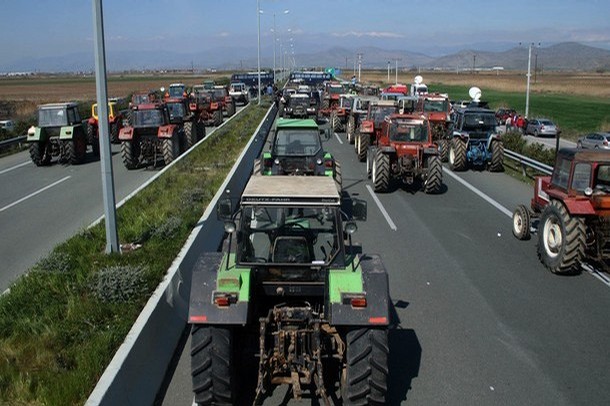
Unrest continues to persist in Greece. This week Greek farmers have been staging protests and road blockages over the low price of their products. At the same time fresh clashes have broken out between anarchists and the police in Athens. Here's what's presently happening with the farmers' protests via the AFP news.
...............................
Greek farmers pledge to maintain highway blockades:
ATHENS, Greece (AFP) — Thousands of Greek farmers on Saturday hunkered down for a fifth day of highway blockades in an ongoing tug-of-war with the government over the low price of produce.

The farmers, who are demanding higher prices for cotton, corn and wheat than those set by the European Union, threatened to escalate their protest despite a 500-million-euro (646-million-dollar) package offered by the state last week.

"We're not leaving unless the government clarifies how the money will be divided per crop," a farmer union member told state TV channel NET at a roadblock in Promachonas near the Greek-Bulgarian border.

Hundreds of tractors continue to occupy key junctions on the Athens-Thessaloniki highway and other roads in northern Greece, effectively slicing the country in two.

The disruption is expected to spread to the Peloponnese on Monday where farmers intend to block the bridge over the Isthmus of Corinth, one of the two road access points to the southern peninsula.

The farmers have also blocked border routes to Bulgaria and Turkey where freight traffic has slowed to a trickle, with the protesters only making exceptions for perishable goods and medical emergencies.

The Bulgarian government on Friday formally protested to the Greek embassy in Sofia, noting that the blockade compromises free travel and trade principles enshrined in the two countries' common European Union membership.

On Friday night, a group of Greek farmers attempted to cross the border into Bulgaria for unspecified reasons but were blocked by Bulgarian police, the semi-state Athens News Agency (ANA) reported.

A similar farmer protest cut Greece in half in 1997 for several weeks, forcing the government to sabotage the tractors, puncturing their tyres at night to get traffic running normally across highways.
...........................
Meanwhile in Athens and Patras anarchists and others continue to clash with police. Here's the story of today's events from the Reuters news agency.
...........................
Anarchists clash with Greek police in Athens march:
ATHENS (Reuters) - Anarchists threw fire bombs and clashed with Greek police in Athens on Saturday during a march to parliament by more than 1,000 demonstrators protesting over the police killing of a teenager last month.

"About 150 anarchists who broke away from the rally threw rocks at the police who responded with teargas," said a police official, who declined to be named. "Later, they threw fire bombs at the offices of the defense minister."

The anarchists set on fire a newspaper kiosk and a bus station and caused minor damages to four banks in the center of the Greek capital. Police chased small groups of youths around the city center and detained at least two people.

Protests also took place in the southwestern Greek port of Patras, where three newspapers' buildings, a journalists union and three banks suffered slight damage.

Greece witnessed the worst riots in decades in December, triggered by the fatal police shooting of a 15-year-old boy and fueled by anger at economic hardships and government scandals.
On Thursday, a protest march against an acid attack on an immigrant cleaner, who was a union activist, caused vandalism by groups of anarchists, who clashed with police.
............................
Here's another take on the story from the British libertarian communist site LibCom.
..........................
Protests resume in Athens:
View Image Details]' jQuery1232839959738="17">
Protesters and riot police have clashed in central Athens today during a protest calling for the release of prisoners arrested during last month's riots, as farmers continued a week-long road blockade over prices.

The clashes occurred outside the University of Athens, as police charged with batons and pepper spray, while protesters used sticks and stones. Several hundred people were involved in the protests, and around 300 continued a march through the town centre. The International Herald Tribune reported that most participants were anarchists.

Also this week, around ten thousand farmers have been blocking major highways and border crossings with tractors over prices, after government talks broke down. Protests at Greece's third largest airport in Crete finished earlier this week, after the runway was blockaded by tractors and burning tires on Tuesday.