Showing posts with label morality. Show all posts

Tuesday, August 24, 2010


HUMOUR:
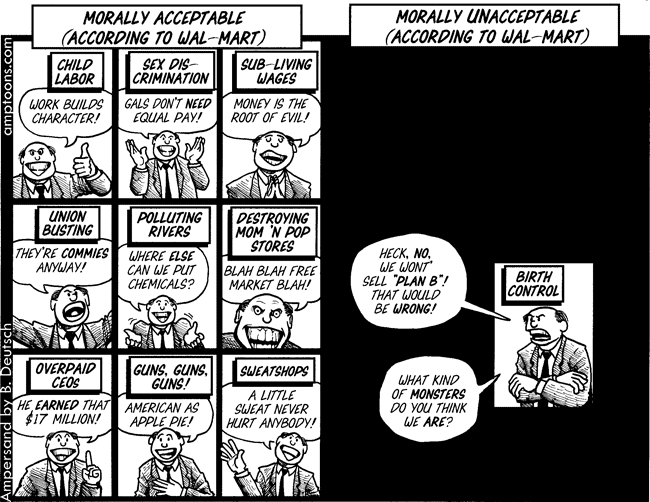
WHAT IS IMMORAL ?:

Sunday, August 09, 2009


BLOGGING:
ALMOST BOO-BOOED:
As regular readers of this blog know I am forever updating the Links section, both adding items and deleting dead links. A lot of this action is performed using scraps of paper on which I have written the items in question, and, as may be expected, the "to do" pile keeps getting shuffled like a pack of cards. Thus, earlier today, I accidentally added one item from the bizarre mutation known as "national anarchism". Like most such outré examples of ideological monsters this item came from the USA. There must be a lot of stray radiation in that part of the world. It is the throbbing heart of many sorts of "para-anarchisms", such as primitivism and post leftism, that hardly bear any family resemblance to anarchism elsewhere.
I guess that I should have checked before I listed, but, in the interests of efficiency I usually leave that sort of thing to the confirmation check after adding the link. I'm very glad I at least do this. The link to the great sewer minds has been duly removed. While being a pretty comprehensive listing of anarchists contacts of various sorts and persuasions this blog does have certain standards. What the so-called "national anarchists" have done is take justifiable doubt about such things as political correctness and identity politics (which can get pretty weird themselves) and attempt a strange marriage between two things that are obviously genetically incompatible, the mountain flower of anarchism and the dung beetle of fascism. Needless to say the children produced are quite monstrous.
No doubt this is an easy target. Sort of like something that a blind man could hit at midnight at the bottom of a coal mine. So far I can remember only one other item that I have removed from this list when I was advised of its real nature. If I recall correctly it was anti-Semitic. Some things, however, are much more subtle. Are there any of the links here that any readers find morally objectionable ? I say morally , not politically. No bitching about how some of the links here are religious please. Please advise me of such, and I'll look into it.

Saturday, July 28, 2007


BREAKING MOLDS:
Like many anarchists Molly has an attraction to things that are "different". Perhaps this personality trait precedes and predisposes a person for an attraction towards anarchism. Perhaps it only predisposes some of us to the ideology because "anarchism" is rather an amoeba of a noun. Some forms of anarchism are just as rhetorical, dogmatic and mindless as the most egregious example that anyone could adduce from any other political or religious belief system. Like any biological species anarchism always produces mutations, and some of these mutations are monsters. Molly certainly !!!! believes that a basic morality should precede political beliefs and that political beliefs should be judged in terms of this common human morality rather than the other way around. She also believes much more emphatically that facts should precede belief and never be deduced from an ideology as is the common practice amongst ideologues, anarchist and otherwise. Most of the worst examples of this that Molly is familiar with are Stalinist, primitivist or fundamentalist, though the present American government has some tendencies in this regard. Mostly, however, the neo-cons behave as if truth simply doesn't exist, like their leftist mirror images the post-modernists do. No need to deduce something that is irrelevant anyways. Speak emotion not fact.
Molly looks over her last few posts. There seems to be a pattern here. Molly is very pleased with the fact that at least some opponents of pesticides are in touch enough with reality to base their opposition on scientific fact rather than New Age dishonesty. Molly is also pleased that some Christians want to rescue their religion from the grip of the Anti-Christ in the USA, a distortion of the Christian message that gives everything to Caesar and nothing to God. So on and so forth down the list of posts. Molly is always attracted to something that is "contrarian". Get me drunk enough and I'll express the idea that I hardly ever agree with myself.
I'm presently reading 'Principles of Cancer Biology' by Lewis J. Kleinsmith, a very good book in my opinion. It's obviously designed to be either a 2nd or 3rd year biology text for both biology and non-biology students, though Molly can hardly imagine that non-science students would have the knowledge to absorb its concepts properly. As continuing education it's great. It's amazing how much progress has been made since I first learned cancer biology and left the fundamentals for the purpose of learning how to estimate the probabilities that a skin tumour is a basal cell carcinoma, a squamous cell carcinoma, a melanoma or some other benign event. It's always good to go back to first principles, and this book is great because each chapter contains not just a summary but also a self testing section. The references provided at the end of each chapter are, perhaps, less oriented towards useful reviews than I would like, but they are still very valuable.
How this connects with the subject of this blog is as follows. At the same time I have read an article in the May edition of Scientific American by Peter Duesberg. Duesbery was apparently the "first" to identify an oncogene in connection with virally induced cancer in 1970(Molly thinks that this "priority" is more complicated than that). In latter years, however, he has become something of a crank. He is the main (and perhaps only )reputable scientist who has questioned the HIV origin of AIDS. The editors of Scientific American were visibly falling all over themselves to provide an excuse for publishing this article by Duesberg. The basis of the article is that Duesberg disparages most of present cancer biology in favour of a rather ideological view of cancer being a disease of "aneuploidy" ie chromosome rearrangements.
As in most cases of questions that are open to free debate (unlike political ideology- which really should try and model the process of science, the most libertarian process on Earth today) the "truth" is a matter of "fuzzy truth". Duesberg is neither 100% right nor 100% wrong. Whether he is 1% right or 99% right or any point in between will be determined by further research. For those interested Duesberg's home page is at http://www.duesberg.com and his views on cancer are at http://mcb.berkley.edu/labs/duesberg . What Molly finds interesting is the fact that she is reading the orthodox view in Principles of cancer Biology at the same time as the dissident view from Duesberg. It's actually helpful to Molly in evaluating both. She finds orthodoxy much more open than the personality driven views of Duesberg, but she still believes that the truth is somewhere in between.
Science is forever "breaking the mold". This has been its history for hundreds of years. The new ideologies that attempt to criticize it are far more dogmatic, totalitarian,authoritarian and restrictive than their fantasies of "scientism" could ever be. Science is an human project that is much more "internationalist" than the politically correct rhetoric that imagines that it can criticize it. In its own clumsy way science lumbers on by dispute, contradiction and confirmation. No other human enterprise comes closer to the ideals of anarchism. Science is what anarchism should aspire to be. The perpetual breaking of molds is what science, good science rather than time serving, is all about. It should also be what politics is about. Molly is uncertain about just how "correct" Duesberg is in terms of cancer biology, but she is also dead certain that the evidence is sufficient to reject his view of AIDS. She judges this by "evidence", not by deducing it from a philosophy. Politics should be the same. Science is a decentralized but also interconnected enterprise, and it approaches the truth because of this. But also because of its methods. It has a beauty that is intrinsic to its nature. This is a beauty that its critics never have. It "breaks the molds" not via fashion and force but via truth and demonstration. More of life should be like that.

Wednesday, September 27, 2006

Excerpts From The Diary of An Obsessive Compulsive:
There are exactly two books that I can remember not finishing in my life. This from a guy who has read the Bible cover to cover, the Koran three times in three different translations (it's shorter than the Bible, but my Arabic is still confined basically to the alphabet) and the collected works of Aeschylus,Sophocles,Euripides, Shakespeare,George Orwell, and -yes- Edgar Allan Poe. Many authors are still on the list. Reading the collected works of Marx and Engels up to the end of 1848 may count as a "quit", but, trust me, I'll get back to it. Honest. Reading Capital to the end counts as a "plus" in my scorecard even though I read it with an expectation that was totally fulfilled; that Marx deserved little of his his historical following.
Anyways, the two books were1) 'Against Reductionism' which supposedly gave forth an "alternative view" of biology which was so full of nonsense that I quit about 1/3rd of the way through. It did NOTHING but spin words against the legitimate enterprise of biology, words that were- AT BEST- lies and were usually meaningless. My early introduction to "post-modernism" before it became fashionable. The second was 2)the Rig Veda. This may be under the category of the 'Collected Works of Marx and Engels' in that it is moldering in a corner on the main floor until the time I can get through "one more" hymn to Agni. The Bhagavad Gita and the Ramayana were much better reads from Hinduism. I actually loved the Ramayana. Watch out for monkeys.
All that being said my continued project to detail on this blog my reading of 'Breaking the Spell' is taking on the aspect of "slogging through" that I had during my reading of either the Bible or Marx. The book promised a "evolutionary psychology" view of religion, but it is rapidly turning into a simple apology for atheism, with the evolutionary aspect shoved well into the background. I've almost finished the book, but I doubt the wisdom of continuing to chronicle it chapter by chapter, even though I've bookmarked it for same.
But occasionally you may find gems in the worst trashpile. The gem that I recently found is the legal concept of "attractive nuisance". This is the concept in law that compels you to do things like fence your swimming pool and remove the doors from your discarded refrigerator. It's like "due care and attention" in traffic law. The assumption is that you have a "responsibility" to safeguard your property from actions on the part of other parties-such as children- that may lead to their injury IF such actions are "reasonable" despite whatever likelihood of injury may result. It's an interesting argument in law about what is "reasonable" and what lengths you have to go to to prevent injury. Each case may be unique.
It's ALSO interesting if we step outside of law into the realm of simple morality that law is supposed to represent. Anarchists have always criticized "the law" for representing either "class interests" or "the interests of power", but more rational exponents of the anarchist ideal recognize that there is a substratum of "civilized behavior" that is at least partially represented by "the law" that we cannot do without. The argument is over HOW MUCH of this restraint has to be "written down" by communities that replace the state and how much can be left to "human nature". In evolutionary biology the problem is framed in terms of "altruistic punishment", a mechanism that any cooperative society can't exist without. (blog "altruistic punishment" for references).
In terms of this blog, for those who may be naive to it, I will OFTEN criticize some VERY evil trends in modern anarchism. This is in the light of the author of 'Breaking the Spell' who puts the onus on the adherents of a religion to SAFEGUARD naive adherents from harm. The "nuisance" is "attractive", but it is NOT as "attractive" as the lure of say Islamic fundamentalism. The simple counting of half-ass "eco-terrorists" who "go rat" when they are caught in the USA in recent years shows JUST HOW SHALLOW A CERTAIN ANARCHISM IS AS A SUBSTITUTE FOR RELIGION. This is despite their megalomaniac claims to "greater knowledge and insight". The claim is more than falsified by the record of its adherents "discovering reality" under far less pressure than the adherents of other ideological systems.
No amount of pseudo-intellectual word spinning will eliminate this FACT. For myself I promise NO "great revelations". Neither do I promise the romance of "revolution", let alone the disgusting "romance" of taking revenge against an uncaring society that you feel superior to. My own personal anarchism is rooted in a simple belief that decentralism and personal power-such as workers' control- are better ways for a society to govern itself. I have faith in the continued efforts of ordinary people to form cooperatives and to challenge government decisions AND to organize in general. I believe that my faith is backed up by biological facts just like I believe that the tactics of "wandering riots" is NOT backed up by such facts. It may actually nowadays be a matter of manipulation of those who want to create cults for their own benefit. That's MY anarchism.
In any case that's where I stand today,
Molly

Thursday, September 07, 2006

Words as treacherous reptiles ie chameleons:
To clarify what I said about the original meaning of "direct action" in anarchist parlance I present the following quote from the piece entitled 'Direct Action' by Voltairine De Cleyre. She says,
"Every person who ever had a plan to do anything, and went and did it, or who laid his plan before others, and won their co-operation to do it with him, without going to external authorities to please do the thing for them, was a direct actionist. All cooperative experiments are essentially direct action. "
This says it very clearly. Most of the peaceable actions that anarchists have been involved in during the last century and a half, whether building unions, cooperatives, free schools, intentional communities, credit unions, cultural organizations, community organizations and so much more were direct action in this original sense. Where anarchism has gone "off the rails" and engaged in terrorism as in the days of 'propaganda by the deed' or in modern terms of hero worshipping Maoist thugs or play-acting at "tinker-toy terrorism" it is NOT "direct action". It is, at the high of hubris, the idea that one can terrorize ruling groups into giving up their power. With things that are really pinpricks in the social scale of things. This sort of nonsense has never worked, and it has been tried thousands of times by various actors-most of them non-anarchist. When something doesn't work once you can't say anything. When it fails 5 times in a row there is definitely a trend. When it fails 20 times in a row (such as Communist regimes) there is some sort of "law" involved- to the 95% confidence level. When, like terrorism, it has failed thousands or tens of thousands of times it is no longer a statistical law. It takes on the character of a "law of nature".
At a lower level of self delusion it is the idea that "exemplary actions" will inspire "the masses" (substitute your own word for other people here if you like) to rise up of the shining example given by the audacious revolutionaries. This was actually quite a common idea of "anarchism in its infancy". It might have had some superficial attraction in the days of the Bakuninist International in France and Italy. It lingered on for a longer time in the practice of the Spanish anarchists, but even there it ran aground on the hard shore of reality. It never worked even in peasant societies where the ground had been prepared by decades of educational activity. Let's say that again- it NEVER worked.
This delusion that all it takes is a spark has pretty much been abandoned by the mature anarchist movement of today. It lives on in the theory of "insurrectionalists" in countries such as Greece and Italy and in their anglosphere hero worshipers. Though I must say that backing this particular football team for North Americans doesn't begin to approach the mindlessness and moral turpitude of always being on the lookout for nationalist and Leninist teams to back. The present theory and practice of "insurrectionism" lacks the peasant society that made this strategy even moderately convincing in the 19th century and the early years of the 20th in countries such as Spain.
Then, of course, you come to the bottom of the barrel. Those who glorify plotting riots in which they always,always,always,always,always lose in the end under the delusion that you can influence not "the people/masses,majority,etc" but some vague "movement" that needs to be "radicalized". Or, to probe BELOW the bottom of the barrel, that the results simply don't matter, that getting the crap kicked out of you is either an absolute moral imperative or somehow really "fun and liberating" and "creates new ways of living". At this point we have left the domain of politics and entered some of the more strange demiworlds of religious cultism.
But to come back to the title of this little complaint. Words can be slippery things at the best of times, and they often change their meanings over time. The word "communism" is instructive. It originally meant nothing more than a social situation where the means of production were owned socially, not individually. The mechanism of this ownership was usually seen as a local group of residents, "the Commune". It took on an utopian dimension with the ideological triumph of Marxism and its left of "from each according to his ability, to each according to his need" from the more creative so-called "utopian socialists". The fantasy of an Hegelian end-goal of history, fueled by the totalitarian power of pseudo-explanation afforded by this dream became very popular and essentially obliterated the earlier vision which retained more than a slight "hint" of "punishing defectors". The ordinary people who incubated the earlier vision knew that they couldn't trust "their own" to not cheat, let alone the declasse intellectuals who came to seize power in Marxist Parties. But this bastard child of the German academy was able to exert a religious appeal that simple popular wisdom could never have.
Later even this utopian vision was overwhelmed by yet another meaning. In the time of Leninist success "communism" came to mean nothing more than whatever the ruling classes of communist states said it was- this week. Being as this "communism" involved mass murder on a scale that dwarfed even the Nazis, "communism" acquired an odious connotation that 90% of the world's population finds detestable.
The attempt by some to revive the term under such headings as "anarchist communism" or "anarcho-communism" may be understandable, but it runs up against the logic of history. The term "communism" no longer means what anarcho-communists want it to mean in either its original or utopian formulations. I know what it means, and I consider it one (but NOT the only one) of ways in which an anarchist society could order its economy. To be less utopian I also consider it ONE of the ways that anarchists could work towards reform of advanced industrial societies. It is part of an intelligent strategy for an anarchism that realizes its limitations. NOT the "whole pig", but an essential part. Some enterprise should be run by democratic vote of local residents- with due checks and balances such that such power was not absolute. Some enterprises are much better managed in different ways.
Incisive thinkers such as Murray Bookchin recognized that this historical debris existed. hence his desire to rename the essential ideas of anarchist communism as "Communalism". Even the term "anarchism" itself has very often distressed more than a few convinced anarchists. The reason is the same. It is something that has acquired meanings not just different from the original but often in direct contradiction to same. I've often felt the urge to describe what I believe as "libertarian socialism", but this is rather restrictive in that it fails to take into account an emphasis on individual liberty (here in the civilized world outside of the USA where "libertarian" is either a synonym for anarchism or a "whazzat" word). Most anarchists have responded by adding adjectives to their anarchism. Any Time Now calls itself "for social anarchism" or "a journal of social anarchism" just like "social ecology" did before its more pronounced split with anarchism. Fred Woodworth calls his opinions "ethical anarchism". Groups such as NEFAC and other platformists call what they believe "communist anarchism".
To the initiated this means that there are those who call themselves "anarchist" who are not "communist", let alone "social" nor "ethical". Anarchism has NOT been a religious cult such as Marxism that demands uniformity of belief, and its stance of rebellion has attracted not just some of the best over the years but also some of the worst. Their is a need for clearly distinguishing oneself in this whirlpool of ideas.
The term "direct action" is very much like words such as "communism" or "anarchism" It can easily come to mean nothing more than posturing at militancy rather than what it meant to the historical anarchist movement at its best. In such a case-"bugger the word". If it comes to mean something very much the opposite of its original it would be time to find new terms to describe achieving a goal by ones own efforts; not by pleading with authority OR by childishly trying to bully authority. Especially !!! not anything more than bragging about one's "militancy".

Thursday, August 31, 2006

I still find it amazing that this blog that was intended as nothing but a personal diary of my reading has gotten response. Some people must hate me deeply-good! May I assure readers that most of the posts here will be very boring posts about scientific matters. Seeing as I am five chapters behind in the latest book I am reading, let alone the journal articles which have piled up I beg your indulgence in wasting your time further...
In regards to those who believe that they can appear to be intellectual by using the word "nascent"...I actually know the meaning of the word. But despite this I looked it up in a dictionary to confirm. It means "incipient" or "newly born". Of course this is exactly !!! the opposite meaning that I ascribed it to in a description of Wayne Price's EX-Trotskyism. The proper term in such a case would be "residual". It describes a habit of thought that has carried over into anarchism that leads to some very unfortunate conclusions.
These "conclusions",however, are much less unfortunate than the habits of thought amongst post leftists who imagine that they can misuse "big words" that they don't understand to "prove" the profundity of their desired conclusions.
Yes, I think that Wayne is wrong in his application of a private morality to "prove" that one should be in "critical support" of Islamic groups. But THIS is orders of magnitude removed from "critical support" of various things that NA "post-leftists" have advocated in the past. Do child molesters, psychotic murders such as the 'Unibomber' or people that believe that "civilization should be abolished" ,etc,etc,etc ad nauseum "really" deserve any argument besides the observation that they are weird,disgusting and insane ? These sort of things are archetypes of things that can ONLY exist in a cult that has ONLY recruiting members to the cult as a goal. So-called "intellectual" (pseudo) arguments around these matters merely demonstrate how far removed their advocates are from reality and how much they have taken a PSEUDO-MORALISTIC stance ie a private morality of "appearing to be more radical than others" as a way of governing their actions.
This pseudo-morality will be enforced in the same way as real morality is enforced, by ridicule and aggression. The pseudo-morality of the left where "critical support" is afforded to undesirable real actors in the real world actually has less of fantasy involved in it than the "critical support" afforded to much more marginal thugs by those who have unrealizable dreams.
Well, I'll continue to stand against this sort of horseshit. If anarchism becomes nothing but the emotional justification for desiring a good fight, I'll try and repell the nonsense as long as I can, and when I fail I am no longer an anarchist. As any anarchist who is sane would say.

Sunday, August 27, 2006

"Lessons for the Anarchist Movement of the Israeli-Lebanese War"
The above is the title of a recent article by Wayne Price on the Anarkismo site (see links on this blog). The author takes, as is usual for anarchists, quite a moralistic tone. He speaks of a variety of left positions from "the liberals" who basically support the US and Israeli governments but "wanted them to clean up their acts" through to the so-called "radical Left" who "became a cheering squad for Hezballah, as well as Hamas, as it had for the fundamentalist-led resistance in Iraq".
The author then goes on to say that anarchists have generally recognized the "reactionary nature of both sides in the war", but he also goes on to say that "many have tended to equate the two sides, to treat them as equally bad". This is a bad thing !, or so he says. Price goes on to a discussion of various types of "non-class" issues in which anarchists come down on one side or the other and says that national liberation is one such struggle in which anarchists must "be on the side of the oppressed" while, of course, "being in political opposition to the misleaders of that people". If this reminds you of Trotskyist "critical solidarity" you are dead on. It is that very same thing, though translated into anarchist terms.
Not that this is wrong. To a large extent it may be very right, but it lacks realism. As I said it is couched in moralistic terms. What does such "solidarity" mean when outside of a few large organizations such as the Spanish CGT the attitude of anarchists, in "solidarity or otherwise" has no effect on the actual course of events ? If advocated by even a small minority of anarchists in a country under attack, such as Lebanon, it makes a lot of sense. Such people are engaged in a political struggle to propagate their ideas in their society, and publically announcing positions that look like treason to their people is like having a "malignant dogmanoma tumour". It shows that dogma has invaded the central nervous system and is replacing brain cells.
But the same could also be said of American anarchists who fixate on the evils of their country's imperialism. Very few anarchists, even ex-Trotskyists like Wayne Price, understand the whole concept of "revolutionary defeatism" as practiced by such masters as Lenin or, less skillfully, by the historical Spanish anarchist movement. Skillful practitioners of this tactic understand that there is nothing moralistic about it. They understood that it was to be useful in a situation where the suffering of the people in the country in which they operated, suffering due to foreign wars, could be translated into rebellion against the government that ordered the war.
Certainly Lenin, and to a lesser extent the Spanish anarchists, made noises about "national liberation", but neither ever considered the idea important enough to become a major focus of their propaganda. Neither did they make it a touchstone of "moral rectitude" that would determine one's commitment to the cause of either Bolshevism or anarchism.
That, unfortunately, is what Wayne Price proposes to do. He is to be commended for ending his article with the recognition that "the world is a complex place, with much interconnection and overlapping of systems of oppression" and that "we need concrete analyses of each situation". But perhaps we don't need "analysis" so much as we need intelligent planning. Wayne is an American anarchist. What does his advise consist of but to dog-tail the American left in its constant knee jerk reaction to oppose any adventure of the US government and to make excuses for the foreign opponents of these adventures.
This secret is revealed in Wayne's stunning assertion that both WW 1 and WW 2 were nothing but "wars among imperialist states"-where not choosing sides was applicable. World War Two- stop and think a minute. This says....."that all the opponents of the USA and Israel are better than the allies in WW2, that Nazi victory is preferable in all cases to any American victory anywhere and at any time.
It means a lot of such things, and I'd bet that Wayne wouldn't believe them in his better moments. What it does mean, however, is that Wayne, like too many anarchists, has chosen his audience from amongst the debris of "the Left". Not the general American population !
Only "the left" believes that have a "sophisticated analysis" of each and every event in politics is cosmically important, and that thinking out such an "analysis" and publishing it in obscure websites and journals- or yelling its slogans during two hours of a small demonstration- is action, in solidarity or otherwise. I would like to suggest that ceasing to act like American leftists is a key part of actually beginning to address normal people.
It is NOT remiss of an anarchist organization to NOT have a convoluted position on each and every war or other events. . Should a anarchist organization be "in solidarity" with an "oppressed people" it is far more effective for them to send one single quarter to an aid group that is unaffiliated with any political organization in the country that has been attacked than to spend hundreds of hours in debating and thinking and thousands of dollars propagating the "correct line" that evolves from this. Let the outsiders keep on guessing about "which side you are on". In too many cases all that you prove is that you are on the side of domestic opponents (such as the American left) who have thoroughly discredited themselves by a constant assumption that they are morally and intellectually superior to the ordinary person.
This puts you in the strange position of assuming that Nazis are better than the American government and that one should be neutral towards them but always opposed to any action of the government that most Americans still see as their own.
This fantasy is a moralistic one in that it tries to stake out a moral position of being seen to be on the side of the angels, no matter how that side is defined rather than assessing the practical possibilities of the time and place. Revolutionary defeatism is of use if it can conceivably lead to a revolt against the rulers of one's own country. Otherwise it is useless posturing to an audience- the left- that will never appreciate you anyways.