Showing posts with label Spanish general strike. Show all posts

Wednesday, January 19, 2011


INTERNATIONAL LABOUR SPAIN:
MEANWHILE IN BARCELONA:

As a follow up to the information posted here on the eviction of the Catalan CGT from their offices at 16-18 Via Laietana in Barcelona....


Well, the eviction was successful, but on Monday, January 17, according to an article in the CGT's newspaper Rojo Y Negro, 200 members of the CGT occupied a disused courthouse a few doors away at 8-10 Via Laietana. The irony and indeed the humour wasn't lost on me. If memory serves me well (which it doesn't always) the area of Via Laientana was once a rather important thoroughfare, but it has fallen on increasingly hard times, and I suspect there is a surfeit of abandoned buildings in the area. I like the courthouse idea, and it's even more amusing that the CGT militants didn't have to travel very far to set up new digs. I viewed a video of the occupation from the CGT Catalunya, and I must say it is heartening to see a broad mixture of people of all age groups participating and not a single weird looking bugger amongst them. The photo above shows the occupiers posing at the doorway and on the balcony. In the video the people are singing a rousing chorus of 'A Las Barricadas', the semi-official Spanish anarchist "anthem".


The Catalan authorities, however, failed to share Molly's fine sense of humour and irony. Neither were they appreciative of the musical talent on display. After some argument the police entered the building to evict the occupiers. According to report cited above about a hundred people were charged with "usurpación y desobediencia". Not being familiar with Catalan law I am inclined to translate this as "trespassing and obstructing (the police)". The latter charge is unclear as I suspect just how much you have to obey a police order is as vague in Catalonia as it is in Canada. It might be more or less serious.


According to the report above and another report at the main website of the CGT there will be a meeting in Madrid tomorrow, January 20, where the Spanish Labour Ministry will once more be pressed to provide a definitive solution to the demands of the CGT for union premises. These are demands that have the historical right behind them of a return of union assets that were seized under the fascist Franco regime. Furthermore the Ministry promised as far back as November 30, 2007 (same article) that the demands of the CGT in Barcelona would be accommodated. It should be noted that the CGT had been in residence at 16-18 Via Laietana for 21 years at the time they were evicted.


Tomorrow's meeting will coincide with a number of demonstrations being held across Spain in a run up to the planned General Strike on January 27 in Catalonia, Navarra, Galicia and the Basque country. These are the areas of Spain where the CGT and other unions to the left of the socialist UGT and the communist CCOO feel they have enough support to make a decent showing. Demonstrations and meetings will be held in other parts of the country. A number of workers' assemblies such as that for Barcelona transit have already voiced their support for this new general strike. A cynic might suspect that the urgency in evicting the CGT from its premises in Barcelona at this time just might be a tiny bit connected to a certain nervousness on the part of both the government and the larger bureaucratic unions (UGT and CCOO). But of course one could never suspect the angels of the state and the "official leftists" of the unions of anything so underhanded. Could we ?????

Friday, October 01, 2010


INTERNATIONAL LABOUR SPAIN:
THE CGT SUMS UP THE GENERAL STRIKE:

The pieces are falling down from the sky, and both sides in the dispute about government austerity (the government and the popular organizations) are taking stock of what happened two days ago. Much ink is being spilled about how "neither side won". The claims of the larger union federations (the CCOO and the UGT) about either 70% adherence or 10 million strikers are unrealistic in addition to being contradictory to each other (10 million strikers would equal about 42% of Spain's workforce). The government, on the other hand, has been so humbled by the actually large and unexpected turnout that they haven't even been willing to counter such exaggerations with their own lies as most governments in such situations do. they mumble about "minimal disruption", obviously shell shocked by what actually happened.

Whatever the actual figures, something that will probably never be properly estimated, there is little doubt that the numbers participating were large, much larger than the government had been prepared to see and much larger than similar strikes in France. The UGT and CCOO are no doubt pleased as in gives them 'bargaining power' in trying to extract minimal concessions from the ruling Socialist Party and thereby giving them the appearance of "usefulness".

Unlike in most countries, however, we anarchists and anarchosyndicalists actually have "a dog in the fight" in Spain in the form of the various anarchosyndicalist unions (CGT, Solidaridad Obrera, CNT-AIT, CNT-JC) who have a no means tiny following. Here is the statement of the Spanish CGT summing up the strike. To my deep pleasure my own comrades don't engage in the triumphalist making up of statistics that the UGT and CCOO do. This is despite the fact that places where anarchosyndicalism is well represented in Spain had some of the best turnouts, just as was true in the public sector general strike earlier this summer. This may be very much a chicken and egg puzzle. Are the anarchosyndicalist unions 'responsible' for the greater militancy in such places or do the more militant workers naturally gravitate to anarchosyndicalism ? Your guess is as good as mine. The English translation of this was done by the Italian FdCA and posted recently on the Anarkismo site.
@@@@@@@@@@
CGT statement on the General Strike of 29 September
The outcome of the strike

These are our initial impressions of the outcome of today's General Strike. In certain key sectors, there was mass participation in the strike in almost the entire country. By way of example: food markets in Madrid, Barcelona, Valencia, Valladolid, Seville and Zaragoza; the (Seat) Ford, Renault, Opel and Volkswagen car factories; petro-chemical and steel factories and plants, minerals sector, gas distribution, public services such as waste disposal and post offices, large-scale construction, port workers in Barcelona, Valencia, Algeciras and so on.
It is important to note that the demand for electricity dropped by over 20% compared to normal days.

Another sector with a very high percentage of participation was that of audio-visual communications, with the complete closure of Canale Sur and Telemadrid, and remaining public media running with minimum levels of service.

Public transport is running with the standard 25% of minimum services, while large areas of the private transport sector (airlines, road transport and marine transport of both cargo and passengers) are participating in the strike.

The CGT wishes to underline that this success has been achieved in spite of the long media campaign by authorities and industrialists against the trade union organizations and the criminalization of labour and social activities.

Similarly, the CGT wishes to express its gratitude to over one hundred labour and social organizations from all over the world who supported the General Strike.

We should also mention the numerous information pickets that were set up at the principal labour centres, something that demonstrates the enormous sense of resentment felt by the workers as a result of the unbearable situation we are being to live through because of the attack under way by politicians and industrialists.

The CGT also wishes to denounce in the strongest possible terms the brutality of the police attacks against workers who were simply exercising their freely-held right to strike and the right to provide information at factory gates.

As a consequence of the indiscriminate police charges, there have been several arrests and dozens of injured workers, some of whom (CGT members) are currently being held without charge.

The CGT also denounces the harassing and arrest of a group of cyclists in the Atoch zone of Madrid, which is a grave offence to their rights and freedom.

Finally, the CGT condemns the injury of a union comrade who was struck by a van belonging to the Boyaca company at the gates of the Bermont factory in Coslada (Madrid). Her injuries, though not severe, required hospital treatment.

Permanent Secretary of the CGT Confederal Committee
Wednesday, 29 September 2010
Translation by FdCA - International Relations Office


Related Link: http://www.cgt.es

Wednesday, September 29, 2010


INTERNATIONAL LABOUR SPAIN:
SPANISH GENERAL STRIKE LARGER THAN EXPECTED:

The first general strike in Spain since 2002 was much larger than previously expected. Union sources claimed up to 10 million strikers or over 70% of the workforce, making this strike far more 'general' than previous ones held in France. While such estimates have to be taken with a grain of salt, particularly as one of the claimants is the CCOO led by "ex" communists with a very touchy relation with such a thing as truth, there is little doubt that Spanish workers turned out in numbers far exceeding anything that anyone expected. The government was reduced to mumbling about "partial and minimal disruption" instead of doing the usual thing and offering its own (far lower) numbers. This turnout occurred despite persistent scepticism about the efficacy of the strike in forcing the government to retreat and also widespread cynicism about the connections of the two larger union federations, the UGT and the CCOO, with the politicians who have concocted the austerity measures.


It is possible that a large number of Spaniards went out on strike despite rather than because of the call of the UGT and CCOO. There were clashes with the police in both Barcelona and Madrid. 38 people were arrested in Madrid and 43 in Barcelona. 58 people were injured in clashes in Barcelona, and by some miracle of balance 30 of those were police officers. One thing that struck me in viewing television coverage of the events in Madrid was that those who clashed with the police and tried to 'enforce' the strike on non-strikers seemed to be all CCOO members. NO CCOO bureaucrat were ever endorse such a thing in public, and it is highly doubtful they would even encourage such a thing in private, even by the old "wink, wink, nudge, nudge". It is entirely possible that the membership of the CCOO has at least partially escaped the control of the union bureaucrats.


Here is an article from the Irish Times that gives a fair assessment of the strike.

SGSSGSSGSSGS
Spain's unions claim 70% support for strike
JANE WALKER in Madrid

SPANISH TRADE unions claimed 70 per cent of workers had supported the general strike yesterday and while the action had some impact, it failed to bring the country to a total standstill.

With a 20 per cent unemployment rate, many of those who had jobs were reluctant to jeopardise them by supporting the strike. Others had been warned they would have their pay docked if they failed to report for work.

One of the worst affected sectors with cancellations and delays was transport. Minimum services, previously agreed with the unions, kept major cities moving. Half of Madrid’s metro and local commuter trains ran during peak hours, but violent picketing forced many buses off the roads and long-distance train services were severely restricted.

Airlines cancelled many flights to and from Spain, although fewer than had been feared. But dozens of disappointed Manchester United fans were unable to travel to see their team face Valencia in the Champions League match on last night.

Madrileños were left in no doubt about the strike when they left home in the morning and were greeted by piles garbage and overflowing rubbish bins on the streets. The Spanish capital is fortunate in that it enjoys rubbish collection seven nights a week. But on the stroke of midnight the garbage collectors downed brooms and left their trucks in their depots to join the protesters.

Wholesale food markets around the country were closed, leaving many local shops without fresh supplies. Moreover, much of the country’s industrial sector, including motor manufacturing, shipbuilding and factories were at a standstill.

The day passed peacefully although there were clashes with police in some parts of the country. Red-shirted and flagwaving pickets persuaded many smaller shops, bars and restaurants around the country to remain closed but a heavy police presence enabled department stores and other shops to open their doors. “We voted for a left-wing government, but we are facing a government of the right,” said one angry protester.

Most hospitals and medical centres worked as normal although staff said they said patient numbers were down. The majority of schools opened although in some there were more teachers than pupils because school bus services had been cancelled.

The strike was called to protest against the government’s austerity measures, approved by the parliament, which cut the wages of public sector workers by 5 per cent, froze state pensions and introduced new labour laws which will make it easier and cheaper to fire workers and raise retirement age from 65 to 67.

On Friday prime minister José Luis Rodríguez Zapatero will present his budget to the parliament when he is expected to announce even more draconian cuts and tax increases. But Spain’s economic crisis is so grave that he has little room for manoeuvre. He is trying to reduce the 11 per cent budget deficit to 6 per cent in 2011.

“It is well known that I didn’t want this strike, but I respect the right to strike and also the right to work,” he said yesterday, adding that he was ready to meet the unions whenever they wanted but could not go back on the austerity measures.
SGSSGSSGSSGS

There were, of course, demonstrations across Europe on September 29, the most notable being that held in Brussels and supported by the mainstream European unions. Estimates for the crowd there range at about 100,000. There were also clashes with the police who attacked demonstrators in Brussels, but these were minor.

The Spanish CGT considers the general strike very successful, and I hope to present their assessment tomorrow. The difference between what is happening in Spain and elsewhere is that only in Spain does the libertarian left "have a serious dog in the fight". The libertarian cohort in Barcelona numbered about 10,000 people. Even in Vallodolid it was 5,000. In Madrid Solidaridad Obrera, the CGT and various libertarian social organizations brought out about 15,000 people. In the Basque countries even the isolationist CNT-AIT joined the CGT and the local Basque union the ESK in marches separate from those of the UGT and CCOO. The number at demonstrations actually underestimates the CGT's effect as many of their members were involved in dispersed picket duties. Whether the Spanish libertarians can translate the militancy of the Spanish workers and their distrust of the major union federations into something still bigger and more sustained is still an open question, but the beginning looks good.

Tuesday, September 28, 2010


INTERNATIONAL LABOUR SPAIN:
STRONG BEGINNING FOR SPANISH GENERAL STRIKE IN BARCELONA:
The general strike in Spain began with the stroke of midnight in that part of the world, and preliminary reports from the anarchosyndicalist CGT seem to indicate a high turnout in those sectors where they have influence. The CGT strike info source site that Molly spoke about earlier has unfortunately crashed due to too high a volume of traffic. Updated information is, however, available from the CGT website and from that of their paper Rojo Y Negro from which the following report is taken.


Preliminary public opinion polls indicated a high degree of support for the goals of the strike but a generally dismal number of people who said they would take part in it ( anywhere from 9% to 20% ). This was coupled with a disbelief that the strike would change the government's plans and a high degree of dissatisfaction with the larger CCOO and UGT union federations who were seen as being half hearted in their efforts and under political (government) influence. Should the present strike repeat the pattern of that in early summer one can once more expect a large turnout amongst sectors influenced by the anarchosyndicalism of the CGT and Solidaridad Obrera and a poor turnout in most other places. The CGT has already begun the criticism of the majority unions, but whether this will result in a generalized radicalization of Spain's workers has yet to be seen.


Here's the story from the night shift in Barcelona. The Spanish original (and much more reportage) can be found at Roja Y Negro. The original article has numerous photos of the CGT pickets of the bus service on the night shift. The photo above is from this collection.
GSGSGSGSGS
Barcelona: successful general strike on the night shifts
CGT Barcelona 09/29/2010 00:28:11
Today at 22 hours the strike began on the night shift in companies with a strong presence CGT in Barcelona: Post Office , Renfe (Train ), Metro, etc., have largely supported the strike .

The following percentages were:
Post CTA : 100 %
Renfe : 100 % of the trains had to leave after 00 hours .
Metro Maintenance : 85 %


The CGT highly values this monitoring and as well as the support we have transmitted to the workers by our call to the general strike and the criticism of the CCOO and UGT for waiting so long to call the General Strike.

The CGT criticizes the minimum services enacted in several companies such as Natural Gas , Atento ( directory services ) ,and in the subway in Barcelona where two or three workers were forced to work where there should only be one worker and in this way a long list where the CGT believes that this infringes the right to strike and we have reported so many to the Labour Inspectorate , the Government and the court .

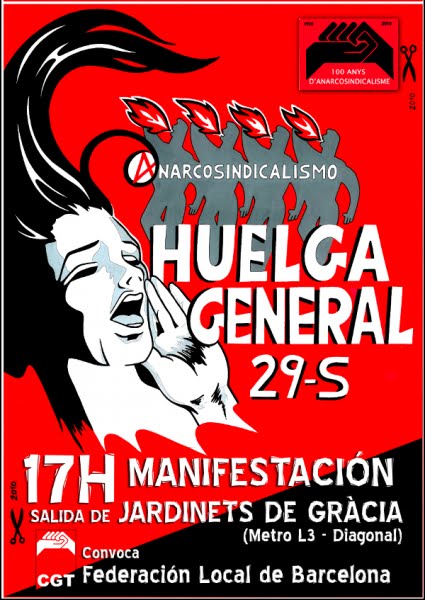
CALLS FROM THE CGT IN BARCELONA FOR THE GENERAL STRIKE WEDNESDAY 29- S

CONCENTRATION AT 12 HOURS IN SQUARE CATALUNYA / PORTAL DE L' ANGEL

RALLY TO 17 HOURS IN Jardinets with Diagonal ( route: Jardinets de Gracia / Diagonal / Via Laietana / Avda . Catedral)

CGT Barcelona

Sunday, September 26, 2010


INTERNATIONAL LABOUR SPAIN:
INTERNATIONAL SUPPORT FOR SPANISH GENERAL STRIKE:


On Thursday, September 29, there will be a general strike in Spain protesting the Spanish government's austerity measures, mislabelled "reforms". All of Spain's labour federations are supporting this action, some more than others. As Molly has mentioned before on this blog there is some suspicion that the major union groups (CCOO- controlled by more or less "ex" communists and the Socialist Party UGT) deliberately set the date far enough into the future to allow for backroom political maneuvers after a less than stellar turnout for the previous public sector general strike earlier in the year.


The months have come and gone, and the government seems even less willing to compromise than it did earlier in the year. While the CCOO and the UGT have been rather tepid in their promotion of this strike Spain's third largest union federation the anarchosyndicalist CGT has thrown a tremendous amount of work into promoting the general strike. The smaller anarchosyndicalist unions such as Solidaridad Obrera, the CNT Joaquin Costa (aka the CNT-Catalunya) and the CNT-AIT have also been prominent in their support. The first two unions have entered into an informal alliance with the CGT so as to present an unified libertarian front. The CNT-AIT has decided to go it on their own.


Whether it is politically wise to put such emphasis on what, given the still solid control of the CCOO and UGT over the majority of Spains unionists, may be a potentially embarrassing show of weakness rather than strength is an open question. The anarchosyndicalist unions have all emphasized that this one day general strike can be only a beginning. The ability to go forward, however, depends upon just how popular or unpopular the work stoppage turns out to be, and just how much the ordinary workers feel that the policies of the CCOO and UGT, limited and cowardly as they are, are the only realistic course. in my mind the prospects aren't bright. In a preliminary libertarian demonstration in Barcelona on September 18 held by the alliance of the CGT, Solidaridad Obrera and the CNT Catalunya the turnout was only about 1,000 people. The CNT-AIT which didn't participate would probably have been only able to add another 100 or so people to the crowd.


Put this in context of the Barcelona demonstration for increased Catalan autonomy last July where the turnout was about 1.1 million. What is probably happening is that many average Spaniards have adopted an attitude of resigned fatalism to the severe economic crisis that Spain faces. The libertarian unions have a hard row to hoe if they hope to push this general strike beyond a token gesture of (weak) opposition.


The Spanish general strike is supposed to be part of an Europe wide 'Day of Action' on the 29th. This event has been called by the European Trade Union Confederation, and its main event will be a demonstration in Brussels, the seat of most of the activities of the European Parliament. Despite some rather cocky chest thumping at the Facebook site of the event (ahem- "towards the 1st European General Strike or even the World General Strike") the "action" proposed by the ETUC consists of little more than a series of demonstrations which national unions may or may not support with whatever attention they may or may not think it deserves. The only country in which there may have been another general strike ie Greece will be a no show this time around. One doesn't have to invoke treachery to explain this. After 6 (or is it 7 ?) one day general strikes this year with no results in terms of modifying government plans the main union federations in Greece are pretty well down to the last dime of their political capital.


Outside of the mainstream unions, however, there is a growing libertarian labour movement. While Spain may be most prominent in this regard this movement is not restricted to the land of Don Quixote. In response to the CGT's efforts towards the Spanish strike numerous groups have sent messages of solidarity with the Spanish workers. The following statement with signatories attached was recently published in an English translation at the Anarkismo site. Since then many others have added their names to the statement. You can see an updated list of the signatories (now over 80) here at the Huelga General event site by the Spanish CGT. This Spanish language site also has a wealth of information and will allow you to follow the strike as it happens.
@L@L@L@L@L
International support for the General Strike in Spain on 29 September

Of all the European Union countries, the Spanish State is facing one of the most difficult economic situations of all, with 20% of the potential workforce unemployed. The measures proposed by the government to fill the State's coffers and stimulate the economy place all the burden on the popular classes in the form of lower wages, consumer taxes, pensions cuts, cuts in unemployment benefits, more privatization and the introduction of more obstacles to workers organizing (such as making it easier for employers to lay off workers and more restrictions on collective agreements).


Ever since the crisis broke, the more militant sectors of the trade union movement [including the CGT, CNT, SO, etc.] have been demanding that a general strike be called to oppose these unpopular measures, but because they were confined only to certain sectors and geographic areas, they were unable to achieve it alone, until a general strike for 29th September was eventually - and reluctantly - called by the big unions, the Comisiones Obreras (CCOO) and the Unión General de Trabajadores (UGT).

It is very important for the General Strike to be a success and for the 29th September to see as many people as possible opposing the policies of the Zapatero government, outside the workplace and on the streets. If the strike should fail, it be not only a failure on the part of those that most of the public considers to be the unions that called the strike - the CCOO and UGT. It will be a failure on the part of the entire working class. On the other hand, the more successful the strike, the greater the success of the workers, as it will provide a clear demonstration of the strength that lies in our unity and will therefore be a step forward in our consciousness and in our levels of organization.

There follows the text of an international statement produced by the CGT and signed by various organizations of a libertarian nature.

----------------------
International statement of support

We, the signatories to this statement, wish to demonstrate our support for the general strike called by the CGT on 29th September 2010 in the Spanish State.
The widespread crisis is affecting the working class badly, in particular the most precarious sectors of the class. And though the Spanish State is particularly badly affected, this situation is shared by many different countries.

We agree with the reasons why our comrades in the CGT have called this strike, that is to say in order to defend the labour, social, economic and environmental freedoms and rights of all workers and all sectors of the working class in the face of the attacks from the multinationals and financial institutions.

We believe that Zapatero's attempt to force this new labour reform package on the workers, together with his plans for reducing the deficit and reforming the pension system, are completely unacceptable. These measures are extremely unjust, since they shift the burden of the crisis onto the backs of the masses and not the real culprits of the crisis. It is unacceptable that the very institutions that generated the crisis are those who are forcing their proposals to get out of it on everyone else, as it involves a reduction in the rights of the working class and an increase in profits for the capitalist system in general.

We also support the theme chosen by the CGT for this General Strike: "For the distribution of work and wealth". Distributing work means that everyone works less so that everyone can work, by reducing the working day (without a loss of wages) and the retirement age, preventing massive unfair layoffs, as well as overtime, piecework, etc. We understand the distribution of wealth not as a dividend or as shares amongst the population, but using that money on welfare and wage benefits for all the unemployed and a redistribution of resources on the basis of solidarity.

The crisis is affecting everyone, so our militant organizations will continue to work so that the mobilizations will continue everywhere.


Signatories to date:
1.USI - Unione Sindacale Italiana (Italy)
2.IP - Inicjatywa Pracownicza (Poland)
3.CNT-f - Confédération nationale du travail (France)
4.IWW - Industrial Workers of the World (UK)
5.ESE - Sindicato Libertario Griego (Greece)
6.SAC - Sveriges Arbetares Centralorganisation (Sweden)
7."La Voz de los Zapotecos Xiches en Prisión", part of the Otra Campaña (Mexico)
8.Colectivo 20 de Junio (Zaachila Oaxaca) (Mexico)
9.María Antonieta Robles Barja, Trabajadora Social, Baja California (Mexico)
10.Julio Cesar Rincón, (Mexico)
11.Coordinadora Valle de Chalco (Mexico)
12.LA KARAKOLA, Espacio social y kultural (Mexico)
13.La Otra ciudad de Chihuahua, (Mexico)
14.Nicte- Dzib Soto, Niñas y Niños en La Otra Campaña-DF (Mexico)
15.Edilberto Bautista Dìaz, Gen. Sec. of the Sindicato Democrático de Trabajadores de la Procuraduría Social del Distrito Federal (Mexico)
16.La Red vs la Represión en Chiapas (Mexico)
17.Frente Popular Darío Santillán (Argentina)
18.SNAPAP Sindicato Nacional Autónomo del Personal de la Administración Pública (Algeria)
19.Asel Luzarraga (Chile)
20.Frente Popular Francisco Villa Independiente-UNOPII (Mexico)
21.Colectivo Radio Zapatista (Mexico)
22.Federazione dei Comunisti Anarchici (Italy)
23.Hombre y Sociedad (Chile)
24.Colectivo Socialista Libertario (Uruguay)
25.Periódico Rojo y Negro (Uruguay)
26.Organisation Socialiste Libertaire (Switzerland)
27.Federación Anarquista Uruguaya (Uruguay)
28.Unión Socialista Libertaria (Peru)
29.Grupo Antorcha Libertaria (Colombia)
30.Union Communiste Libertaire (Canada)
31.Red Libertaria de Buenos Aires (Argentina)
32.Organización Revolucionaria Anarquista - Voz Negra (Chile)
33.Estrategia Libertaria (Chile)
34.Melbourne Anarchist Communist Group (Australia)
35.Alternative Libertaire (France)
36.Federação Anarquista do Rio de Janeiro (Brazil)
37.Federação Anarquista de São Paulo (Brazil)
38.Miami Solidarity & Autonomy (USA)
39.Organización Anarquista por la Revolución Social (Bolivia)
40.Frente Autentico del Trabajo (Mexico)
41.Moez Jemai, journalist-syndicalist (Tunisia)
42.Fédération SUD service public, Vaud canton (Switzerland)
43.CUB, Confederazione Unitaria di Base (Italy)
44.Votán Zapata (Mexico)
45.UNICOBAS (Italy)
46.Instituto Nacional Sindical (Colombia)
47.Columna Libertaria Joaquin Penina (Argentina)
48.Libertære Socialister (Denmark)
49.Centro Internacional de Estudios Sociales (Uruguay)
50.Red Libertaria Popular Mateo Kramer (Colombia)
51.Centro de Estudios Sociales Manuel González Prada, Huancayo (Perú)
52.Tendencia Estudiantil Libertaria (Perú)
53.Movimiento Manuel González Prada (Perú)
54.Sociedad de Resistencia - Santiago (Chile)
55.Workers Solidarity Movement (Ireland)

For more information on the strike, see:

Related Link: http://huelgageneral.info/