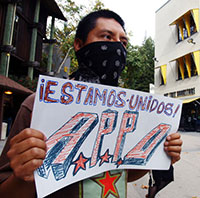
Showing posts with label Oaxaca. Show all posts

Saturday, November 29, 2008


INTERNATIONAL ANARCHIST MOVEMENT-OAXACA MEXICO:
HUNGER STRIKE IN OAXACA PRISON:
The popular struggle in the Mexican state of Oaxaca has entered a quiescent period. Several political prisoners, however, remain in detention from previous rounds of state repression. Here, from the Libcom site, is the story of how one of these prisoners has started a hunger strike to demand the release of him and his fellow detainees.
............................
APPO prisoner on hunger strike:

Following harassment and abuse of political prisoners in Oaxaca, a hunger strike has commenced for their liberation.

Oaxaca, 28th November 2008
Compañeras and compañeros of all the organisations, collectives and individuals of Oaxaca and the World, of the Other Campaign, of National and International Human Rights Organisations, to the communication media, to the members and sympathisers of the APPO in Mexico and the World.

Following the removal operation and the beatings received, PEDRO CASTILLO ARAGÓN and VÍCTOR HUGO MARTINEZ TOLEDO have since (at different times) been returned to the Central Penitentiary of Santa Maria Ixcotel, Oax. AS OF THURSDAY 27TH NOVEMBER, AT 21:00 PEDRO CASTILLO HAS BEGUN A HUNGER STRIKE TO DEMAND FREEDOM FOR HIMSELF AND THE OTHER POLITICAL PRISONERS OF OAXACA.

In response to the facts of yesterday in the Central Penitentiary of Santa Maria Ixcotel, where without explanation, PEDRO CASTILLO ARAGÓN and VÍCTOR HUGO MARTINEZ TOLEDO were removed from the location, we wish to update information and and make some clarifications:

The two compañeros were removed from the penitentiary yesterday, in the morning of Thursday 27th November 2008 during an operation beginning at 07:30 and ending at approximately 13:00. Víctor Hugo Martínez Toledo was beaten and then returned to the Penitentiary a few hours later. Pedro Castillo Aragón was disappeared for several hours and was beaten worse, before being presented at the prison of Miahuatlan,Oaxcaca. Today, Friday 28th November at approximately 15:00, compañero Pedro Castillo Aragón was returned to the Central Penitentiary of Santa Maria Ixcotel. Currently, both compañeros remain in Ixcotel.

Since yesterday there have been mobilisations taking place to demand guarantees for our compañeros. Following the uncertainty generated by the operation and its affects on the families of political prisoners and other prisoners, and after an assembly of family members, friends and participants in the APPO movement, two actions were agreed. The first, yesterday night was a march that left the building of Section 22 (of the Teachers’ Union) for the Federal Courts as well as the blockade of avenida Juárez in order to hold a press conference and meeting for the appearance and liberation of our compañeros. Today, at 09:00 a second blockade took place in front of the Federal Courts. In this action, there was harassment on the part of elements of the Federal Preventive Police, all armed, who attempted to cross the blockade with their vehicle; nevertheless, they were forced to respect the demonstration. These actions have merely provoked the mobilisation of those of us who demand justice and freedom for the peoples of Oaxaca and an end to the criminalisation of social protest.

It is important to show that as a result of these actions, compañero Pedro Castillo Aragón yesterday, Thursday 27 November at 21:00 began a hunger strike to demand his freedom, that of Víctor Martínez Toledo and of Miguel Ángel García, political prisoners of the APPO since the 3rd of November 2006. Also for the liberation of the political prisoners of San Agustín Loxicha, Santiago Xanica and San Pedro Yosotatu.

Nevertheless, we know that these repressive actions on the part of the State are politically motivated and in line with the interests of the despotic government of Ulises Ruiz and with the obvious complicity of the Federal Government. These people hope to demoralise our imprisoned compañeros and put them under a repression even greater than that to which they have been subjected for the two years in the case of Víctor Hugo and nearly six in that of Pedro Castillo Aragón in which they have been unjustly imprisoned. In this way, the authorities hope to make current their message of repression against the people of Oaxaca and their political prisoners and prisoners of conscience.

Owing to the size of the operation, the details and the current situation of repression both inside and outside of the Penitentiary,we fear for the the physical and emotional wellbeing of our political prisoner compañeros.

We hereby express our indignation at this operation that violates fundamental rights to put in danger the integrity and security of our imprisoned compañeros and take them from one place to another as if they were criminals.

We demand:
***Guarantees from the Interior of the Penitentiary, to care for the physical and moral integrity of our imprisoned compañeros!
***Freedom for PEDRO CASTILLO ARAGÓN, VÍCTOR HUGO MARTÍNEZ TOLEDO and MIGUEL ÁNGEL GARCÍA!
***The immediate and unconditional liberation of all the political prisoners of Oaxaca!
Oaxacan Voices Contructing Autonomy and Liberty (VOCAL),
Committee of Citizen Defence (CODECI),
Committee of the Political Prisoners of Santa Maria Ixcotel
Contact: vocal@riseup.net

Sunday, September 07, 2008


OAXACA MEXICO:
THE STATE OF THE PEOPLES' MOVEMENT IN OAXACA:

The following was originally published on Scott Campbell's Angry White Kid blog on September 5, and it has been widely republished since then. Campbell is an anarchist from the San Francisco area who currently resides in Oaxaca. In the following Campbell describes the present state of the movement in the Mexican state of Oaxaca, two years after the formation of the Popular Assembly of the People of Oaxaca (APPO).

................................

Mexico, Oaxaca, The APPO two years on: Where now for Oaxaca's social movement?

By Scott Campbell

This fall in Oaxaca marks a season of commemorations. Already marches for fallen APPO members Jose Jimenez Colmenares and Lorenzo San Pablo Cervantes have woven their ways through the streets of the city, pausing at the spots they were murdered in 2006, holding ceremonies at the Cathedral. Twenty-four more such processions await Oaxaca in the coming months. That number will only grow as efforts are pursued to identify the, at minimum, eight bodies in hidden graves discovered recently in Oaxaca's main cemetery.


In what is a lifetime for social movements and a blink of an eye in history's ledger, a little more than two years have passed since the people of Oaxaca erupted in spontaneous but ingrained rebellion against the barbaric rule of Governor Ulises Ruiz Ortiz (URO) and all that he embodies.Mere days after URO's storm troopers raided the city center on June 14, 2006, in an attempt to remove the encampment of striking teachers (after regrouping, the zocalo was retaken by the teachers and their supporters), the Popular Assembly of the People of Oaxaca (APPO) was formed.


At its core, the APPO was a consensus-driven, horizontal grouping rooted in the millennia-old indigenous practice of assemblies. David Venegas, APPO participant and member of the anarchist group VOCAL, recently wrote in the Oaxacan daily Noticias that "the Popular Assembly of the People of Oaxaca is, naturally, opposed to power, since horizontalism, respect for consensus and respectful dialog are the fundamental principles of the assembly."[1] For more than five months, APPO controlled the city of Oaxaca and much of the state. Not until Vicente Fox, in one of his parting shots as president, sent in paramilitary federal police on November 25 did URO regain "control." Rather it would be more accurate to say the APPO lost physical control. Much has been written and recounted about those "days of freedom", as one friend called them, that it is unnecessary to relate them here. For a comprehensive recounting, I recommend Nancy Davies' The People Decide: Oaxaca's Popular Assembly, available from NarcoNews.com.


Two years later what is left now in Oaxaca? Has the APPO been reduced to a memorial mechanism to commemorate its fallen? Is it accurate, as URO keeps insisting with epileptic vigor, that, "nothing is happening" here? Or are we seeing a movement in chrysalis, reconsolidating only to reemerge just as vibrant, but even smarter, than before?


To be sure, there are conflicting messages and what will emerge is far from predetermined. A bleak picture can easily be painted. For starters, the APPO for all intents and purposes no longer exists, in terms of an assembly which meets, makes collective decisions, and takes action. However, many organizations that were part of the APPO still use that name when publicizing their actions and sending out communiques, which ironically - or tragically - frequently denounce other organizations that were APPO members and who also use the APPO label. Obviously this creates confusion at best and dejection and disillusionment at worst.


There are no clean divisions here, but the conflict can be uneasily broken down into two general camps. Those who have chosen to use the political and social clout of the APPO to engage with the current political system and try to get what they can from it and those who reject any relationship with the system that in 2006 was killing and disappearing their comrades. This has created, as Kiado Cruz, editor of OaxacaLibre.org, wrote, "a general paralysis"[2] within the social movement and in its current formulation there is no hope for forward progress. This loggerhead has led to diminishing displays of social mobilization under the banner of the APPO, and in further blows to the now agency-less entity, these disputes between the two camps often take place publicly.


One example of the mutual animosity occurred during a march on August 10th, marking the murder of Jose Jimenez Colmenares. While the procession paused where Jimenez fell, anarcho-punks spray painted the walls of the building Jimenez was shot from. A couple of the slogans included denunciations of Zenen Bravo. "Our fallen don't fit in ballot boxes. Understand that, Zenen!" screamed the walls. Bravo is now a state representative in Oaxaca, a former council member of the APPO, and an organizer with the Popular Revolutionary Front (FPR), a Marxist-Leninist-Stalinist group. Elected in 2007, his decision to run on the joint ticket of the PRD-PT-Convergencia ("center-left" political parties) was a major blow to the integrity of the APPO which as a general rule rejected involvement with political parties and electoral politics. Later on in the march, German Mendoza Nube, another leader of the FPR, was heckled with calls of "traitor" when he gave a speech. FPR members rushed the hecklers - who were the anarcho-punks, members of the anarchist group VOCAL, and other - and an intra-APPO street fight nearly broke out.


The next day, along with the dispute being mentioned in the media, the "official" APPO website, run by an FPR member, exaggerated the incident and denounced VOCAL. The following week a march occurred for Lorenzo San Pablo, another murdered APPO member, organized by VOCAL, and the "official" APPO website did not see fit to mention it.


While this dispute plays out in the streets and the internet, the power-hungry members of APPO continue their dance with their former oppressors, now colleagues, while those seeking to stay true to the original premise of the APPO propose to construct something new. It is this phase of consolidation, deliberation, and reconstruction that many believe hold the promise for a successful social movement.


Many initiatives have taken place in recent weeks which display this new trajectory.


* A five day citizens' forum was held in the upper-class neighborhood of Reforma in early August. It was inspired by the community's successful effort to block the construction of a Chedraui (a Wal-Mart-type business) store after the company cut down 200 trees in a park there at 4am where they hoped to build their store. The forum focused not just on what to do with the denuded site but also on "participative democracy, what kind of city we want,"[3] and the problems facing each neighborhood in the city and what actions, independent of political parties and the government, can be collectively taken to deal with those problems.


* Going on right now is a "barefoot researchers" seminar organized by VOCAL and alternative education project Universidad de la Tierra (Unitierra). This free and open project meets every two weeks for five hours over the course of several months to undertake, among other things, "a systemic reflection of the economic, social and political situation in Oaxaca, with a national and international perspective, with an emphasis on autonomous social movements; that is to say, those that struggle from the grassroots to transform society without taking power."[4]


* Most recently, the First Assembly of Community and Free/Pirate Radio Stations was held in Zaachila, Oaxaca, at the end of August. There participants created a permanent assembly for the promotion and defense of community and indigenous radio stations, one of the most important tools of the social movement and which is under constant attack by the state.[5]


In a recent interview with Noticias, Gustavo Esteva, president of the board of Unitierra and long-time academic specializing in social movements, was described as noting, "Without a doubt"...in his 50 years of observing the social situation in Oaxaca, "I've never seen such movement and effervescence from below", which should worry the government...He explained this social effervescence is "invisible to the media because there is nothing spectacular; it is not defined by marches, but the solidifying of initiatives for the generation of a new social fabric".[6]


Reflecting on this new movement, Kiado Cruz labels it "communalocracy". "It is important to reflect on our actions if our movement is really to be beyond ideologies or if we are really to be movement that has a face and a heart that we intuitively know is based in the depths of our way of thinking, feeling and acting that we inherited from our ancestors...With this intuition we can be sure that amongst ourselves we can define the constructive means of action."[7]


What results from these forums, seminars and assemblies remains to be seen. However, it is clear that though the APPO may be broken - just as much by internal splits as government repression - the will of the people to continue the struggle has not waned. The focus on face-to-face, direct, horizontal community organizing, and the rejection of interacting with or relying on political parties, government and hierarchical organizations, holds great promise. It ensures that what emerges will be a movement that is genuinely one of the people of Oaxaca. A movement whose direction, actions, and victories will belong to the people.


And as David Venegas writes, "Power, as much as it licks the superficial wounds put on its body by the insurrectionary actions of the people in 2006, and although it paints and adorns itself with words of social peace, reconciliation and development on its horrendous body, it will not be able to cure itself of the deepest wound caused by the people in 2006, the wound created at the source of its strength by the consciousness gained by our people of the unsustainable situation and of the need to fight tirelessly to obtain true justice, freedom, dignity and peace. It is this mortal wound that resides in the heart of power and from which it will never recover."[8]


Scott Campbell is an anarchist organizer from the SF Bay Area currently residing in Oaxaca. All quotations were translated from the Spanish by him. He posts observations and translations Oaxaca-related material at


1 Venegas, David. "El equilibrio del poder." Noticias - Voz e Imagen de Oaxaca. 13/8/08. http://vocal.lahaine.org/articulo.php?p=179&more=1&c=1. Noticias did not publish the Op-Ed online.

2 Cruz, Kiado. "Dar vuelta a la esquina." Oaxacalibre.org. 24/8/08. http://oaxacalibre.org/oaxlibre/index.php?option=com_content&task=view&id=2082&Itemid=29.


6 Matias, Pedro. ""Incompetentes juegan con fuego": Gustavo Esteva." Noticias - Voz e Imagen de Oaxaca. 3/8/08. http://www.noticias-oax.com.mx/index.php?option=com_content&task=view&id=6583&Itemid=31.

7 See Cruz, Kiado above.

8 See Venegas, David above.

Thursday, June 05, 2008


OAXACA MEXICO:

TRAVELS IN OAXACA:

The following is reprinted from the A-Infos website. it's the description of the situation in the Mexican state of Oaxaca by Ramor Ryan, an Irish exile presently resident in Oaxaca.

................................

Mexico, Oaxaca, A Day In the Life of a Simmering City
Midnight in Oaxaca, and walking around the historic center, it's almost as if nothing had ever happened here. The bourgeoisie sit around under the colonial arches in the long stretch of French-style outdoor cafes lining the central plaza. Aside from being beset by a small army of ambulant trinket vendors and beggars, the well-heeled citizens sipping cappuccinos seem very at ease with the world. A few late night tourists wander about the pleasant old streets under the starry sky, and the industrious hum of the sultry cosmopolitan city invokes an eternal calm.
----- It's as if there had never been a riotous peoples' insurrection in these same streets just two years ago. As if the rebel citizenry had never erected one thousand and one barricades to defend their city from the marauding police forces of the despised and despotic state government.And as if the tens of thousands of rebels and insurrectionists had not been this close to winning the great battle for Oaxaca in the heady summer days and nights at the barricades of 2006. The famous subversive graffiti that painted the whole town red and black is removed, whitewashed, as is the blood in the streets of the 26 fallen comrades shot down by the police and state paramilitaries.
“Since all of this, we will not be the same at all as before; we can’t be and we don’t want to be,” said a resident shortly after the quelled uprising.
But at this moment, to a visitor just having stepped off the bus from Chiapas, the strange normality of the place gives the appearance that everything has not changed, that everything remains the same in Oaxaca as it was before the uprising.
Sometimes hope comes from the most unexpected quarters. Walking away from the sanitized Zocalo, we chance upon a moribund vista. Shuffling around in the half shadows of a street corner, about a hundred tooled-up riot cops loiter with menace -- as if itching for something to happen.
The phalanx of troops, an ominous dark mass of helmets, riot shields and shiny black boots, clank their long metal sticks on the somewhat medieval flagstones. It is an incongruous sight at this time of night,amidst this placid ambiance, without the slightest disturbance to be ascertained of any kind anywhere.
Paradoxically, their presence signifies a welcome sign -- where there are riot police there is generally trouble, and trouble in the Oaxaca context, means ... resistance.
I have followed the movements of police riot squads with close interest for many years. So I approach the last cop in the line -- a young indigenous man clad in state-of-the-art modern armor -- and with all the sweet innocence of a visiting tourist ask him as to why they are here.
"Is there a problem, officer?" I ask.
He tenses up, grips his metal baton and stares at the distant wall, not at me.
“We are here for your protection” he says sternly -- and somewhat comically.
We have heard that one before. Back in the day, during the war in Ireland, this is how the occupying British troops behaved -- nervous,uncertain and trigger-happy. So this is it -- as people had forewarned-- this tremulous peace in the city is one overseen by riot cops lingering in the shadows. Oaxaca is a city under stealthy occupation.
The March of the Umbrellas
Around midday, under the glare of the blazing tropical sun, some 50,000 protesting teachers start flooding into downtown Oaxaca. Today, May 15 is Teachers Day, and the states educators have downed chalk on-mass, and declared a strike as they have done religiously every year for the last 25 years.
It's a remarkable sight, the arrival of the teacher hordes. Teachers anywhere in the world are a most innocuous bunch of people, and the members of this particular branch of the national teachers union, known as Section 22, are the most unlikely street revolutionaries imaginable.Yet these same humble unionists were the solid backbone of the 2006 insurrection. Here they come, this sea of teachers under the midday sun,these revolutionary hordes and ... they are not masked up, nor linking arms, nor pumping fists. No, they are strolling along gaily under a roof of colorful bobbing umbrellas, singing songs and being generally full of revelry and joy. Having marched for 3 hours one would expect a certain fatigue, but no, the teachers are boisterous and upbeat and the enticing chaos is more mad hatters tea party than militant discipline.
"The teachers struggling," they sing, "celebrating their day of the teachers!
"But it would be a mistake to underestimate their militant resolve.Maria, an indigenous Zapotec teacher from the isthmus is carrying her one-year-old child Victoria in her arms as she marches.
"Victoria?," I ask.
Hasta la victoria siempre!” she laughs, towards victory always, quoting Che.
Maria had been part of the uprising in 2006.
“Wow, lots of tear gas and running,” she says, looking back, “but ... we almost made it, we almost won.”
"Do you have fear," I ask, "returning here two years later, to Oaxaca city center, after the brutal repression?"
“Not unless I don't have a stone or a stick in my hand to protect myself, no, then I am not afraid,” she says with a laugh, this 20-something-year-old mother who defines herself as "a Christian teacher".
From the central platform on the kiosk in the Zocalo, the teacher's leaders spell out their demands for higher salaries, increased funding for rural schools and the resignation of the state governor Ulises Ruiz Ortiz.
“We won't negotiate with the government of Ulises,” says Domingo Cabera,secretary general of the Section 22 of the Teachers Union, “because we don't recognize the legitimacy of his government, we will only negotiate with the federal government.”
“Here today with this massive turnout,” says the speaker, “we demonstrate that the movement is more consolidated than ever.”
Sort of. It's common knowledge that Section 22 of the Teacher Union is in a state of disarray. Maria, the rural teacher, doesn't trust the words or intentions of her union leadership.
“While striking teachers were selling their cars and their houses in 2006 to support the strike, the corrupt leaders were accepting bribes and selling out the grassroots,” she tells me.“It is a tragedy, but now we are re-organizing.”
Flavio Sosa takes the microphone and it is a significant moment.Recently released from jail, he is one of the most recognized figures of the Oaxaca Peoples Popular Assembly (APPO). As the organizing body of the uprising, APPO brought together a myriad of social and political groupings and could mobilize hundreds of thousands at the height of the rebellion. Flavio is of the faction of the APPO state council who favors negotiation with the authorities and political participation in state and municipal elections -- a very contentious issue within the rebel movement.
“We demand the release the remaining political prisoners,” says Flavio over the microphone, outlining the political demands of the movement,“[and] the cancellation of the outstanding arrest warrants (several hundred), punishment for those responsible for the deadly repression committed during 2006 and the resignation of state governor Ulises Ruiz Ortiz. Fuera Ulises -- Ulises out!”
Ulises, Ulysses, is a most aptly named tyrant -- whom Virgil refers to famously in the Aeneid, as “a cruel and deceitful man”. The much hated latter-day Ulises minor continues to be the focus of the protesters ire.Representing the PRI party who ruled Mexico for 70 years, he was elected in 2004 under very dubious circumstances, and marked the beginning of his tenure with a campaign of brutal repression against his opponents.While previous Governors had negotiated or tolerated the widespread and deeply ingrained opposition movement in Oaxaca, Ulises oversaw the criminalization of protest. But he underestimated the strength and determination of the opposition, who responded with the total takeover of Oaxaca. Exiled for most of 2006, his administration was only able to return after a bloody offensive by some 6,500 militarized cops against APPO on October 29 of that same year -- leading to 200 arrests, hundreds hospitalized and the city center resembling a battlefield.
A Cantina Full of Anarchists
We -- two Irish visitors -- have come to Oaxaca to talk with the comrades from Oaxacan Voices Constructing Autonomy and Freedom (VOCAL) (switched placement), a sizable anti-authoritarian grouping that forms part of APPO. Anarchists and libertarians had played a prominent role in the defense of the city in 2006, and remain an important voice in the movement. In a traditional cantina, a group of grassroots teachers and Vocal-istas engage in a the post-march analysis.
A big march somewhat empty of content, appears to be the general agreement.
We meet with David Venegas Reyes, a 25-year-old local resident who emerged as one of the more charismatic and articulate young voices on the street in 2006. For his trouble, the state issued an arrest warrant and in April 2007 he was abducted from a city park, and thrown in jail. After a campaign for his release, in which even Amnesty International voiced concern for the manner of his detention, he walked in February2007, all charges dropped.
“On the one hand here in the city,” explains David, “the government has been able to partially dismantle the Section 22 which was the largest of the unions and the center of the movement in 2006. But at the same time there is a lot of discontent in the ranks, and the leadership has been totally discredited by the base. So while the government has managed to corrupt the union leadership by buying them off, the base has become more conscientious and is therefore more difficult to cheat or hoodwink.”
First off, David is not a leader, nor a spokesperson for VOCAL. But it seems by general consensus of the various Vocal-istas here, that he will be the one to talk to us visitors -- maybe because he is the affable and chatty one of the group.
The owner of the cantina overhears the table talk, and voicing support for the teachers and APPO, sends over a round of beers. I am impressed by how open and conspicuous are the activists despite the general atmosphere of repression in the city. Several of the people here have outstanding arrest warrants from 2006 still hanging over their heads,yet this does not stop them going out and joining the protests, or simply going about their lives unbowed.
"What about APO?," I ask. "Is it affected by the same kind of disarray as the Section 22?"
David responds carefully and comprehensively; I think its worth quoting him at length:“APPO has basically being the unity of the different organizations of the peoples of Oaxaca. The interesting thing, the transcendental thing about APPO is that it has managed to bring together a broad representation of the various peoples of the state with a wide convergence of different ideologies and visions of the world -- all under the one assembly. Then came the great wave of actions that took place in 2006, the great advance towards realizing our collective aspirations -- first demanding the exit of Ulises, and much more than that, also demanding a radical and profound change in the society in which we live in .”
“So in 2006 our APPO assemblies reflected the assemblies of the indigenous communities in so much as that there were no leaders and it is the assembly which decides things. We tried to act like this but sadly there was a gap between how we acted in assembly and the verticalism practiced by some of the social organizations. So there was this tension within APPO as how people wanted to organize and how to practice.”
“The spontaneous combative spirit that arose in the streets was not the result of some bureaucratic orders from some leaders up on top; no, they came from the people in the streets themselves, and the spirit remains there.”
“When the brutal repression against us began, the mobilizations weakened, firstly because of fear at the ferocity of the repression. But alongside this, people felt dispirited and demoralized by the opportunistic actions at this critical moment of some of the considered leaders of a few social movements. The important point of this story is that in February 2007, some social movements decided that the movement couldn't achieve the demand of removing Ulises from government and so proposed that APPO make an alliance with the supposed left-wing political parties in Oaxaca and to compete for power in the local municipal and congressional elections. During this discussion, an important group of companeros defined themselves by opposing this proposal and we managed to stop this attempt to institutionalize our movement. And so emerged strong divisions within the movement, provoked mainly by those whose aspirations for taking power were frustrated.”
“So a group of us libertarian companeros and those who didn't believe in political parties and various ideologies, agreed that for the movement to enter into the electoral route was to merely play the states game in this context in Oaxaca and so we opposed it. VOCAL doesn't aspire to become the leadership of APPO. VOCAL is a space of unity for those who think the autonomy of our diverse and multicultural peoples is a political proposal for our reality. We stayed with the APPO because the unity of the people is important. And its important to remain true to the words that were said in 2006 that the APPO is a movement of bases and not of leaders. Although it was said, many did not act like this and began to invest their confidence in false leaders.”
Other voices around the table are more forthright in their criticism of the PRD (opposition political party) and Marxist-type elements which took control of the APPO, but David remains staunchly non-sectarian.
“So there are many of us, not just VOCAL, the Magonistas and some Marxists, but many of the base who believe that we have to re-organize the movement from below, not from the top down. Because the truth is that APPO is in the communities and in the union bases -- not just in the leadership. In Mexico there is a long history of leaders becoming compromised -- anybody who knows a little of the union history knows how often this has happened -- the leadership always becomes compromised, recuperated by power. And the leadership in APPO has similar tendencies.”
"So what are the lessons," I ask, "that have been taken away from 2006?"
"As in, you almost had it, APPO was in control of the city like a modern day Paris Commune and Ulises was on his way out the door; victory was so close. And then after holding the city for eight long, glorious months,came the huge wave of repression and the movement was beaten off the streets. What went wrong," I added.
“There are some who say we made tactical errors in 2006, but I don't think it was an error or mistake to defend our territory in a physical form against the assassins of Ulises and the militarized Federal police of (Presidents) Vincente Fox and Felipe Calderon. For me that was not the error -- to defend ourselves, no, the error that was made was when people started to believe in false leaders," said David.
Another comrade chimes into the discussion. “And there are those who say that the movement brought repression upon themselves by upping the ante of resistance, that they got what they deserved! Nonsense!”
“The prisoners and the dead aren't guilty!” says David. “The guilty are those who imprisoned and murdered them."
It's now late afternoon and everyone disperses for various meetings. The political energy is perceivable and the days' march has got people upbeat. The spirit of resistance is simmering once more in the streets of Oaxaca.
Of Police and Streets
Sometime after dusk, we reunite with David under the portal of the great old central Cathedral in the Zocalo. Despite the days events, the police presence in the center is negligible -- mostly undercover agents discreetly monitoring the proceedings. The authorities have decided upon a non-aggressive strategy and the city is teeming with teachers in repose. It must be surreal for them to be confronted with this veil of normality in the city they once occupied. One noticeable difference from even the night before is the clandestine presence of graffiti all over the place. The ubiquitous APPO slogans and Fuera Ulises! are back on the walls of the city again.
Walking the darkening city thoroughfare, a police car slowly passes by,and David involuntarily glances over his shoulder. I imagine he has his fears -- after all, it was in these very streets that he was suddenly lifted by an undercover snatch squad in broad daylight, and abruptly removed to the nightmare of indefinite incarceration.
“Fear? Yeah,” he says, “of course we have fear. But fear should not impede us from moving forward. People continue to struggle just as they did in 2006 without stepping back, or wobbling. People are coming together again, to make sure that Ulises's assassins or the abductions don't continue."
"I was a prisoner held for 11 months, just a caprice for the authorities. And then I was released for lack of evidence.” he added.
It wasn't that justice was done, more that the pressure from outside meant it was politically untenable for the state to hold him hostage any longer. David recognizes the role national and international solidarity played in his release, and in the struggle in general.
“A really important part in detaining the repression was the level of national and international observation that took place from outside. If this hadn't happened, I think that the repression would have been even much worse.”
“But it shouldn't be thought that suddenly we live in a just state now,”emphasizes David. “We still live under a state of daily repression and harassment. It's unbearable, and we can't have some government telling us that we must accept living under this state of oppression, as if it was some kind of normalcy. We don't accept it, because we are a free people, free we are born and free we were brought up. And since the resistance hasn't stopped, so the repression continues. I think that whatever happens in Oaxaca in the next while it's really important that people from outside don't stop the vigilance, and continue pressurizing the government to limit their use of reactionary violence.”
A new Amnesty International report echoes his concerns, denouncing the repression on the social movement and the general impunity that exists for security forces in the country in general, and the abuse of citizen's rights in Oaxaca in particular.
But this climate of fear engendered by the authorities doesn't stop David traversing these streets which he has known all his life. Indeed,the going is slow as he meets and greets all and sundry along the way --like this middle-aged indigenous man who stops him randomly and wishes him well, knowing of his unjust imprisonment. It's like the movement,even if it doesn't hold the center, still has the street.
We are going to a social center where a bunch of musicians and activists are gathered for a night of Son Jarocho, a traditional popular song anddance. It's an autonomous space, familiar to other cultural and political spaces in different parts of the globe -- self-managed, a shebeing of sorts, where people come and go, and the mood is friendly. Between ardent musical performances, people give brief presentations,like this from a representative of the Universidad de la Tierra (UniTierra), a peoples' university based here in the city. Another is a report back from the caravan of the isthmus region undertaken by a group of VOCAL activists, including David, who returned early this morning.The Trail of the Jaguar political tour of the rural isthmus consolidated links with indigenous communities of the region under the theme “for the regeneration of our collective memory”.
In a quiet moment we drag David away for the gathering and continue with our interrogation. On the flat roof of the social center, the city stretches out far and wide, the lights shimmering across the vast valley. Oaxaca is a much bigger place than it seems when wandering around the historic center.
"What's going on with the movement in the city, and in the countryside,"I ask, "Where do we stand now?"
“Here in the city, there has been a strong militarization and a heavy police presence to repress the movement. Meanwhile the government hassomewhat ignored the indigenous communities and it is there, in the rural community that some very important organizing is happening. I'mnot saying that the movement in the city has finished and now the movement is only in the countryside, no. It is more that the government,while focusing all their attention on defeating the movement in the city, has allowed discontent to flourish in the countryside,” says David.
While of course simultaneously letting the paramilitaries have a free hand to do their dirty work in the communities -- including the April ambush murder of two women journalists working for La Voz que Rompe el Silencio (“The Voice that Breaks the Silence”), a community radio station serving the Trique indigenous community. But the kind of police and military saturation within the City has not occurred in the communities.
“And so today in Oaxaca City there is a tense calm. The councilors and officials of the APPO and Section 22 leadership are being conciliatoryand opportunistic. Groups of Stalinists and PRD-istas of the electoral persuasion are making a pact with the business leaders to get permission to mobilize. But the others, like us in VOCAL and other groups, the majority of the movement, are in constant confrontation with the authorities because our mobilizations are not seen gladly by the state-- and the line between repression and tolerance is barely visible,”says David.
An Oaxaca Commune
The Son Jarocho session is wrapping up and people are homeward bound. Wepile into a van going out to the outskirts of town where a bunch of people are staying. There's about a dozen of us in this beat up van,rattling along the highway out of town. There's a certain spirit of abandonment about these people and it's contagious. I'm thinking if the cops stop this thing, they will net a good dirty dozen desperadoes of veteran anarchists.
The van arrives at a feral warehouse on a sprawling lot, cluttered with machines, tools and a big old bus just back from the Trail of the Jaguar tour. The collective living space is populated by a group of weary and sonambulant activists. A tattered, faded image of the Virgin of the Barricades adorns a wall, the ironic patron saint who presided overthose at the barricades in 2006. Her image, with her iconic gas mask and cloak of burning tires reminds me of Calamidad's words, the last gringa on the last barricade on the last night of the Oaxaca commune.
"A lot of people have been fucked in the head ever since November 25,2006," she lamented, "when it was all lost in a flurry of bullets -- but damn was it a close fight for awhile. In a sense people are just as traumatized by the tragic implications of what victory might have been-- and how close people were to it, so close they could taste it for the first time in their lives -- as they were by the violence. When I returned to Oaxaca, I would walk into a party, and comrades would come up to me and say -- 'she remembers! We almost did it, we had the city! All the barricades! The city was ours!' So its not only the repression that people remember, but also the memory of holding the streets for so long is a bitter one ... because they lost them.
"Here in this chaotic, creative space, among the barricadistas who have not given up, there is a palpable feeling that, despite the loss in 2006, there is still hope and people are now organizing harder than ever.
“And,” David Venegas reminds us, “as the Mexican saying goes -- 'There is no evil that can last a hundred years, and there's no body that can't resist it', meaning that everything has its own time, and this straight-jacket of a state has come to its end. That the time has come.”
Up and down the country people are invoking the centennial memory of the first Mexican revolution -- 1910 -- to herald a new revolution in 2010."What's the feeling here," I ask David, "about this quasi-mystical belief in revolutionary change on a sanctified date?"
“Well many Mexicans are resigned to the fatality of the idea of 2010,”he says with a smile, “and as you know, Mexico is profound and millenarian. But for me, its not important that the deed happens on this very date, but more importantly that it occurs! And I can feel it in the air in Mexico -- a longing for revolution. But revolutions don't just occur on a certain date -- they are prepared. And what I'm seeing is a growing insurgent spirit, alongside an increase in the brutality of the government. There is a great indignation felt by the communities and movements against whom the bad government has declared war.”
“I hope a revolutionary change occurs in this country because there can be no half solutions, reforms are not going to end the injustice and exploitation. A change from the bottom is necessary, a profound and truthful change. This is what millions are demanding, and this is what the government are trying to deny us. The government has failed to reform the state constitutionally, to comply to our aspirations. That is why it is we, the people who must make those changes -- because the government has lost its opportunity. So now its our responsibility to make those changes.”
It's midnight once more in Oaxaca, and this long plenteous day, May 15,2008, is over. We bed down in the loft cosy with about 20 other companeras and companeros and dreams come easily. History is a nightmare from which Oaxaca, like Mexico, is trying to wake up from and maybe 2006 was just a primer.
Ramor Ryan is the author of Clandestines -- The Pirate Journals of an Irish Exile (AK Press 2006). He lives in Chiapas, Mexico.

Sunday, June 01, 2008


MEXICO/OAXACA:
OAXACA TEACHERS' STRIKE SPREADS:
The following news item is from the Lib Com board. There is some dispute about the meaning of this strike, and the reader is advised to consult the article at Lib Com for more details.
.....................................
Mexico: teachers' strike spreads up the Pacific coast while Oaxaca cautiously holds firm
The annual teachers' strike in Oaxaca has been bolstered by solidarity strikes of other sections of the Sindicato Nacional de los Trabajadores en la Educación (SNTE) stretching up and down the Mexican Pacific coastline, while in Oaxaca itself, occupations and blockades continue apace in support. Most analysts however have already doomed the strike to failure.

On Friday 30th, the strike by the Oaxacan SNTE local (Sección 22, around whose strike coalesced the 2006 revolt) entered its 12th day, with more motorways blocked, more tollbooths closed down and more education buildings occupied throughout the state. Teachers have also managed to close down various shopping malls throughout Ciudad de Oaxaca itself, while the occupation of the Zócalo (central square) is maintained.

Encouragingly, the strike, supported since day one by SNTE members in the state of Michoacán, has also seen solidarity by other SNTE members in the states of Guerrero (directly to the north of Oaxaca) and Chiapas (directly to the south), although workers have now returned to classrooms in both states.

In Oaxaca, the SNTE strike is now an annual event, yet some of the teachers' demands (such as the democratization of the SNTE) are now being picked up by teachers in other parts of the country. In Tabasco, a caravan convoy of SNTE members has now departed for Mexico City, some 1500 km away.

In Oaxaca and Michoacán, responding to criticisms from some quarters which claim that the schoolchildren will lose out on their education, teachers have found various ways to avoid that scenario while maintaining industrial action. In Oaxaca, teachers have held 3 day long strikes each in rotation, depending on their region, with each region marching on the plantón (encampment) in the Zócalo of Cuidad de Oaxaca in order to relieve the last.

Meanwhile, the local government awaits the response of Sección 22 to their latest offer. The strike is still scheduled to run nine more days, but most seem to be relatively confident an agreement will be made before its official end. Indeed, the mood in Oaxaca seems to be relatively negative, with street vendors around the Zócalo and the proprietors of the plaza's various cafes and restaurants joining with the local government to condemn the strike and occupation. For most Oaxacans, the memories of 2006 are still too fresh to even consider this movement going any further.

An informative article about Oaxaca two years on from the revolt: http://www.narconews.com/Issue53/article3113.html

Monday, February 25, 2008


SOLIDARITY:

NEW ANARCHIST INITIATIVE: INTRODUCING THE SOLIDARITY WITHOUT BORDERS CAMPAIGN:

Issues regarding immigrants and their rights have become an increasing focus of public debate in the last few years, both here in Canada and in the USA. In the latter country the debate is more more acrimonious, and the right in that country plays heavily on people's fears of immigration. At the same time insurgent movements in the south of Mexico, both in Chiapas and Oaxaca, have increasingly adopted libertarian forms of organization and libertarian goals as well. This has led some anarchists to propose a regrouping of the solidarity movement---the 'Solidarity Without Borders Campaign--- for better coordination and more effectiveness. Here is their introduction...
Introducing the Solidarity Without Borders Campaign


Dear comrades,
We are writing to introduce the Solidarity Without Borders Campaign, a coordinated, sustained, three-pronged campaign in solidarity with immigrant and indigenous struggles across North and Latin America. Anti-authoritarian groups from across the Northeast and Midwest USA have come together to form the Solidarity Without Borders Group. ---- This working group came out of the recent Consulta of the Northeast Anarchist Network (NEAN) and Midwest Action Network (MAN). The proposal was initiated by the Boston Anti-Authoritarian Movement (BAAM) and NYC Local Union of the North East Federation of Anarchist Communists (NEFAC), and has been joined by anarchists from over a dozen other towns and cities.
The campaign emerges in light of the escalating war on indigenous communities in Mexico and immigrant communities in the United States: In light of military and paramilitary aggression against the peoples of Oaxaca and Chiapas, in light of Plan Mexico and the Security & Prosperity Partnership, in light of recent attacks on immigrants here in the USA, and in light of the corporate invasion and displacement of their communities.
The campaign arose in response to calls to action from the Zapatista Army of National Liberation (EZLN), from the Council of the Indigenous Peoples of Oaxaca-Ricardo Flores Magon (CIPO-RFM), and from New York City's Movement for Justice in El Barrio (MJB).
Please join us in Solidarity Without Borders, endorse this campaign, and begin to organize within your communities and alongside us.
For Solidarity Without Borders!
Our Call To Action:
We are calling for a coordinated, sustained, three pronged campaign by the anarchist movement in the United States to:
1. confront repression of our comrades, shut down Plan Mexico and SPP, and stop the invasion of rebel territory in Mexico
2. confront repression of immigrant communities in our own cities and regions
3. confront the corporations invading communities both here in the northeast and south of the border
* We recognize, with the Zapatistas, that these struggles are intertwined and none of these things can be won without the others *
Our Goals:
1. To take action at US government offices, Mexican consulates, and offices of related corporations across the region.
2. To support local and national actions in defense of immigrants, with the ultimate goal of shutting down all ICE detention centers and offices.
3. To support the International Campaign in Defense of El Barrio being launched by Movement for Justice in El Barrio.
4. To raise resources and supplies, if and when needed, for our comrades in Chiapas, Oaxaca, and El Barrio.
5. To send a delegation to Southern Mexico, in the event of invasion or escalating repression, to stand alongside our brothers and sisters.
Our Next Steps:
1. Local groups send delegates to the new Solidarity Without Borders Group.
2. Local groups make contact with local organizations in their area, join local coalitions and support their struggles
.3. Local groups support other organizations and actions with common goals in their communities.
4. Local groups visit government and corporate offices, delivering letters and ultimatums to those responsible.
5. Local groups plan and implement creative direct actions, beginning no later than May Day, sooner in the event of invasion or escalating repression.
For more information:
On the situation in Chiapas: http://chiapas.indymedia.org (Spanish)
On the situation in Oaxaca: http://www.elenemigocomun.net
On Movement for Justice in El Barrio:http://www.narconews.com/issue42/article2037.html
On the border & the war on immigrants: http://deletetheborder.org
On immigrant solidarity groups in your area:http://www.immigrantsolidarity.org

Saturday, October 13, 2007


MEXICO:
STATE TERROR AND DIRTY WAR: A YEAR OF STATE RECUPERATION IN MEXICO:
Over at the LibCom.Org site there's a great new article on recent state repression in Mexico. this article is a good backgrounder on the efforts of the Mexican state to suppress peoples' movements in Oaxaca, Chiapas and the lesser known San Salvador Atenco, just outside of Mexico City. There is information on the recent stepping up of repressive efforts in Chiapas, the cancellation of part of the Zapatista national tour and its connection to the EPR, a Maoist armed struggle group that disappeared for over 10 years and has recently been resurrected as what may be a state sponsored "black-ops" action of provocation to justify further action against truly popular groups. There is also a lot on the Mexican state's actions against the popular movement in the state of Oaxaca and a realistic estimate of the present state of the APPO, the main opposition group in Oaxaca. But then there are the events is San Salvador Atenco in the Estado de Mexico, just outside of Mexico City. This relatively unknown struggle erupted in May of 2006 over a police attempt to evict market stallholders. The resistance was relatively unorganized, and hundreds of people were arrested , many of whom are still being detained. Since then the people in this town have organized themselves in the Frente del Pueblos en Defenso de la Tierra (FPDT), have made contact with other opposition groups in Mexico and are struggling to secure the release of those still held by the Mexican state.
All told a very good article that helps to understand what is happening in Mexico today. To read the full article go to the link HERE.

Saturday, October 06, 2007


OAXACA/CHIAPAS

BACKGROUNDER ON THE STRUGGLES IN MEXICO:

There's a great new article over at the Autonomy and Solidarity site on the struggles in the Mexican states of Oaxaca and Chiapas. The article begins with a general overview of the new Mexican government of Filipe Calderon, its continuation of the repressive policies of previous governments and its refusal to address Mexico's pressing social and economic problems. As the article says,

"Almost a year after President Filipe Calderon took office, "democracy" in Mexico continues its study of the theater of the absurd. As Calderon gives speeches on the rule of law, police and soldiers attack social movements, drug-trafficking gangsters murder with impunity killing 1,951 people since January, and femicides continue in Cuidad Juarez and spread to other states. Roughly 50 million people are dropping deeper into the wreckage of hunger and exhaustion. "

The article then goes on to tell about the recent attacks on the people's movement in the state of Oaxaca and the disagreements within the Oaxaca People's Popular Assembly (APPO) about how to respond to the August 6 state elections, in which 77% of the electorate abstained from the corrupt process and the municipal elections on October 7th. The organizations comprising the APPO basically "agreed to disagree", allowing some of them to run candidates, but not in the name of the APPO. The article then goes into the cases of 26 state sponsored murders in Oaxaca and numerous cases of arbitrary arrests and torture. It also describes the resistance to same.

The author then turns his attention to the state of Chiapas where the Mexican government is moving elite troops and planning a strategy to dispossess peasants who have occupied lands under the Zapatista leadership. The history of betrayal of accords on the part of the Mexican government is detailed as is the construction of a "super-highway through rebel territory to both connect military bases and also to aid in the dispossession of peasant communities.

All told a good backgrounder to events in Oaxaca and Chiapas. To read the full article see http://auto_sol.tao.ca/node/view/2789

Friday, June 15, 2007


OAXACA JOURNALIST SHOT AND WOUNDED:
The Committee to protect Journalists has issued a press release condemning the recent attack on Miseal Sanchez Sarmiento, a reporter working for the Oaxaca dail Tiempo. Sarmiento had covered political news for the paper and had reported in Nov. 2006 on the killing of US Indymedia journalist Bradley Will. despite the fact that Tiempo is a pro-government paper Sarmiento's reporting earned him the animosity of many political figures in the Oaxaca government. Since 2000 six journalists in Mexico have been killed in direct reprisal for their political reporting, and there are 12 other killings that the CPJ is investigating. There are also 5 cases of "disappearance" of journalists in which the fate of the person is unknown. To read more about this case go to http://www.cpj.org/news/2007/americas/mexico13jun07na.html

Saturday, May 05, 2007


APPEAL FROM OAXACA
COMMUNICATIONS SERVICES:
Molly has recently received a communication via George Salzman, an anarchist physicist presently resident in Oaxaca. She reprints the full text of the communique below:
Mis amigos,
Mid afternoon on May 1, Labor Day, students took over the radio station at the Autonomous University Benito Juarez of Oaxaca. They explained that they intended to give ample coverage to the labor day events, which included a march by the Popular Assembly Movement.
By seven o'clock that night government supporters were already hard at work jamming the university signal. By 10:00 the students were no longer audible. The fear of the government is that the public may hear honest news, news of real events that affect the lives of people without money and power, in towns lacking any access to newspapers. Their only source of news is government controlled corporate television.
The only available remedy is community radio. Right now young Oaxaquenos are working to put on the air as many community radio facilities as the community can afford. The technical support project for them is completely Oaxaqueno in staff and muscle. It's controlled and managed at the base, in a system of democratic participation. But the funding comes in part from people like you.
This is the moment to show Oaxaca communities that they are not alone in wanting access to the truth as it relates to them in their towns and villages. Your donation, of any amount, will help to maintain the vital training and technical support provided by Servicios de Communicacion de Oaxaca secomo@riseup.net .
The best way to send money is to send a check made out to "Jean Rodriguez" for Servicios de Communicacion de Oaxaca and mail it to:
Jean Rodriguez
917 N. Van Ness
Fresno, CA 93728, USA
Her telephone number is 559-445-0425
Her email address is wabob@earthlink.net
Jean can refer you to contacts in Oaxaca

Saturday, February 24, 2007


WINNIPEG INDYMEDIA RE-OPENS:
As of Feb 22, two days ago, Winnipeg Indymedia ( http://winnipeg.indymedia.org ) is up and running again. The new incarnation is considerably improved over the old one. There is an events section that actually lists upcoming events and a considerable devotion to local news. One waits to see if the lessons learned from what happened to the old Windymedia have been learned ie if the usual anti-Semitic posts will be automatically deleted and if the Middle East and its arguments will once more overwhelm everything else. But for now things look good. Go on over to the site to have a look.
One particular item in the events section catches my eye. On the upcoming Wednesday (Feb 28th) Raul Gatica will be speaking at the Mondragon Bookstore and Coffee House (91 Albert St.) on the struggle of the people of Oaxaca against neo-liberalism in Mexico. Gatica was born in Mexico and participated in many of the human rights, indigenous rights, ecology and union struggles in that country. He is presently living in exile in Vancouver, and he comes to Winnipeg to speak about the struggle in his homeland. Molly will try to attend if work lets her, and she urges you to do likewise. The meeting begins at 7:00 pm.
Molly